The savings bank on the green road
20.12.2019 - With 640 employees and total assets of 3.7 billion euros per year, Sparkasse Westholstein is one of the most important public savings banks in Schleswig-Holstein. Its sustainability officer Michael Nicolas now wants to put the company on the road to success in ecological terms too. "Even though red will remain the defining colour of the savings bank, more and more green colour clusters are being added," he says. In the following interview, Michael Nicolas and Hennecke Büro-Organisation's order clerk Angela Kreminski explain the important role played by the switch to recycled paper.

How did you go about promoting sustainability at Sparkasse Westholstein?
Michael Nicolas I asked myself where we could achieve a noticeable sustainable effect in the Sparkasse as quickly as possible. With an annual consumption of 45 tonnes of office paper, environmentally friendly savings are particularly significant here. When refilling our printer paper, I noticed that we were previously using virgin fibre paper from Portugal. The transport route of around 2,500 kilometres across Europe alone gave me pause for thought. So I started looking for alternatives. With Steinbeis as a regional paper mill with an excellent reputation right on our doorstep, it made sense to find out about alternative paper products from our paper supplier Hennecke Büro-Organisation in Itzehoe.

Mrs Kreminski, how were you able to help the Sparkasse with its request?
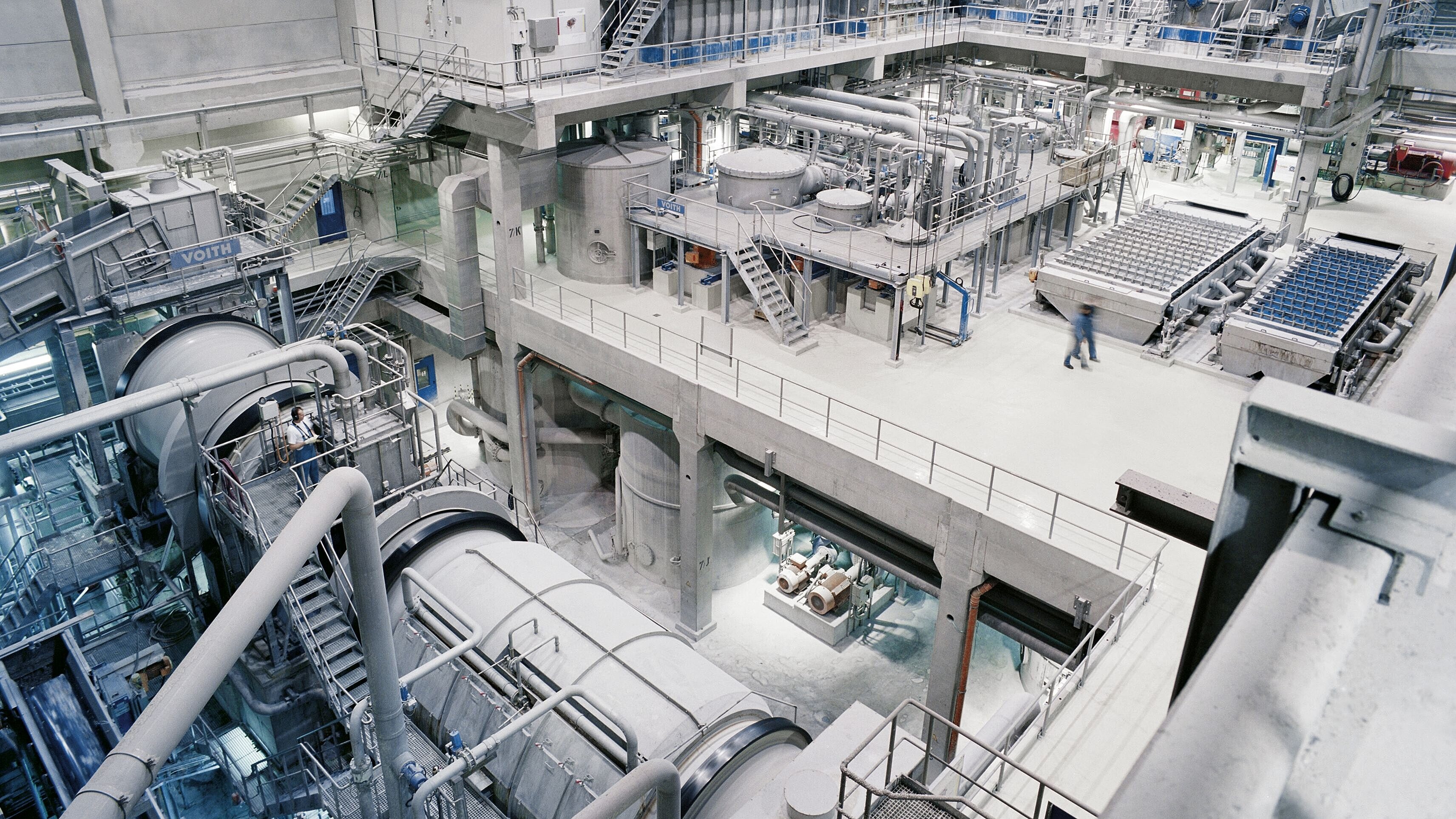
Angela Kreminski I have been working at Hennecke Büro-Organisation for 24 years. We have had a close business relationship with Sparkasse Westholstein for many years. I was therefore delighted to support the Sparkasse in its endeavours. I organised a factory tour for us at Steinbeis, the market leader and local manufacturer of recycled paper, in nearby Glückstadt. I was also able to gain new and interesting insights into the production of different types of paper made from 100 per cent recycled paper. Since then, I have also used these intensive insights in discussions with other customers.
Do you notice a growing awareness of sustainability in these discussions?
Angela Kreminski We have been working with recycled products for a long time and also have our own eco-catalogue through our purchasing cooperative, which we are always happy to present to our customers. We also offer our private customers a wide range of recycled paper and products in our store.
Mr Nicolas, what did you take away from the factory tour?
Michael Nicolas It was great that we were able to see the production conditions for ourselves. An employee gave us a vivid demonstration of the closed production cycles. I immediately felt how convinced the employees were of the processes and paper products. The savings, the sustainable production cycle, the regionality - all of this convinced me.
What was your experience of switching to Steinbeis paper?
Angela Kreminski Printer and copier technology has developed rapidly in terms of energy efficiency and printability. Nowadays, all commercially available devices are also suitable for recycled paper.
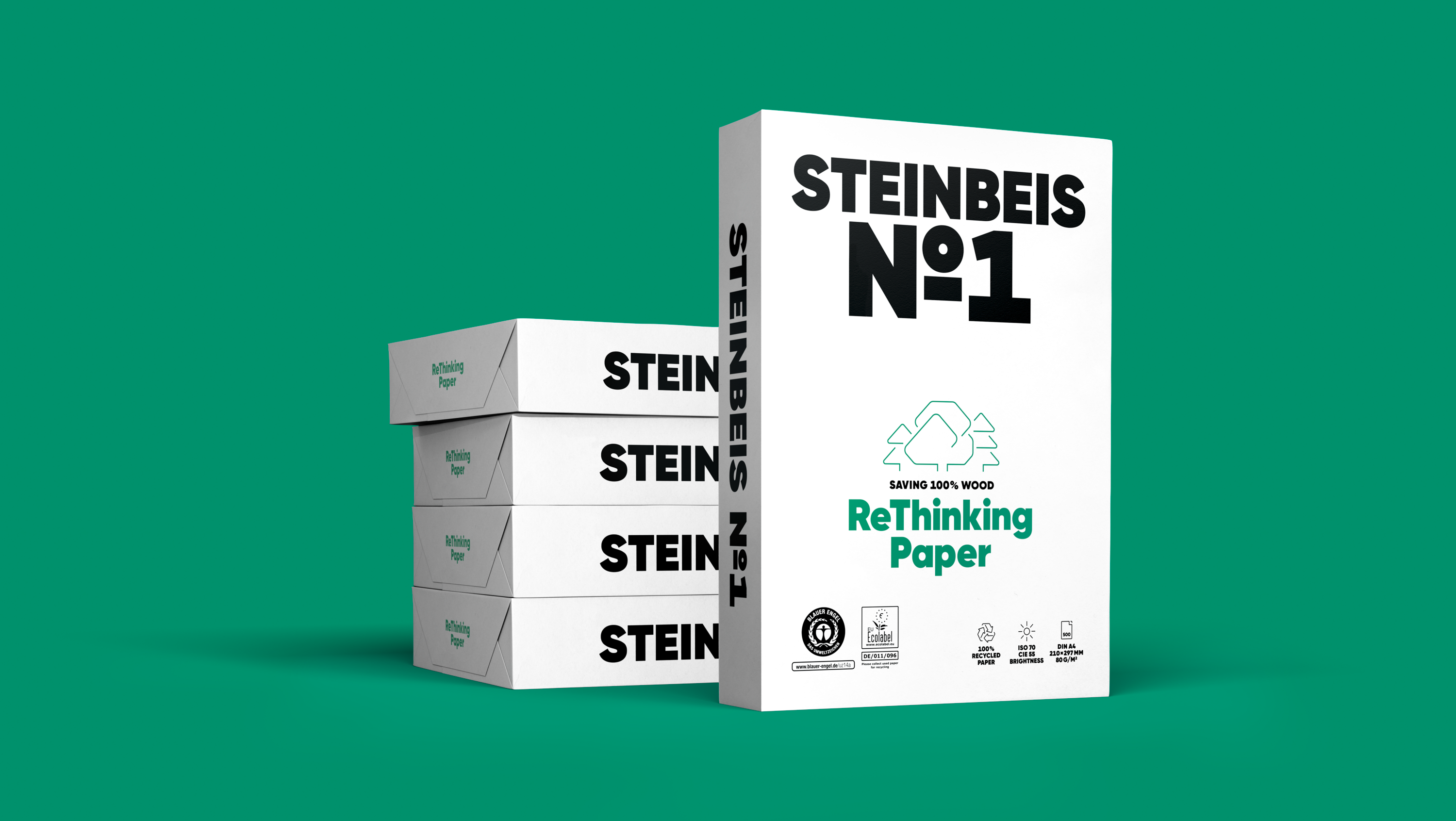
Michael Nicolas During the six-week test phase of the "Steinbeis PureWhite" recycled paper, we realised that it is very important how the paper is stored before use and how the pages are inserted when refilling the paper tray. After a short familiarisation phase, however, everything went smoothly.
How has the switch from virgin fibre to recycled paper been received by your customers?
Michael Nicolas "Steinbeis PureWhite" is not quite as white and as thick as our old paper in direct comparison. But we have not received any negative feedback from our customers. On the contrary: the savings bank received explicit praise. We also like the idea that, as a regional savings bank, we can also buy a regional product when it comes to printer paper.
What topics are next on your agenda?
Michael Nicolas We have already made good progress with the topic of electricity. In the Steinburg district, we already cover 100 per cent of our electricity consumption with green electricity. In Dithmarschen, this rate is currently 50 per cent, and next year it will be 100 per cent. In addition, we have converted most of our lighting to LED and observe the "Green IT" guidelines for all IT components, which also includes the economical energy consumption of devices. We are also looking at where we can give greater consideration to sustainability in our promotional gifts and our vehicle fleet. We simply feel that the topic of sustainability is gaining more and more momentum and it goes without saying that we're getting involved.
How do your colleagues react to your commitment?
Michael NicolasIn principle,they think it makes sense and is necessary for the Sparkasse to pay more attention to the issue of sustainability. But of course, as sustainability officers, we often put our finger in the wound and scrutinise previous procedures. Of course, this is a little stressful for everyone at first. Even though we have always paid attention to sustainability in the past, there is of course also room for optimisation at the Sparkasse. The most important thing is to address the issue and consciously look for suitable alternatives.
What is your motivation?
Michael Nicolas Even a long journey always begins with the first step. We - like certainly many other companies in our region - can still improve in terms of climate and environmental protection. We are facing up to this challenge and are happy to be measured against it. After all, we are not starting from scratch. The more we deal with this topic, the more we enjoy developing bit by bit and celebrating our first successes. This rethink, this change in awareness, does not stop at the Sparkasse's front door, but extends to the private lives of our more than 600 employees. And this is the particular success factor for a sustainable change in our way of life in society. We would like to be a driver of this change process and reach as many people in our region as possible - even if it is uncomfortable at first and may cost a little more money. We take responsibility.
How do you personally deal with the issue of sustainability?
Michael Nicolas Climate protection and biodiversity are very important to me. That's why I make sure, for example, that insects find a suitable habitat in my garden. I also drive a small car and prefer to get on my bike for shorter journeys.
Angela Kreminski I feel very similar. As a mother of three children, I see it as a special responsibility to do something for climate protection and nature conservation. My garden is not an "English ornamental garden", so that insects can find a protected home here. I travel short distances on foot or by bike at home and I use our company bike at work.
Cover picture: MicroStockHub / istock
Author
Responsible for marketing, social media and e-business at Steinbeis Papier. Circular economy, recycling and biodiversity are the topics close to the heart of the graduate business economist. Enthusiastic blogger for the Steinbeis editorial team.