Sustainability under the Christmas tree: wrapping paper made from recycled paper

05.12.2023 - The festive season is upon us, and with it comes the tradition of gift-giving. But amidst the glamour and joy, we shouldn't forget to take a look at the environmental impact of our celebrations. One simple way to make a sustainable contribution is to use wrapping paper made from recycled paper. In this context, Steinbeis is proving to be a pioneer, supplying the high-quality raw material for wrapping paper made from 100 per cent recycled paper.
The use of wrapping paper is celebrated in many cultures around the world. But how can we maintain this tradition without having too much of an impact on the environment? The answer lies in choosing wrapping paper made from recycled paper. The Federal Environment Agency's life cycle assessment study impressively confirms the advantages of this environmentally friendly alternative: recycled paper offers savings of 78 percent water, 68 percent energy and 15 percent CO₂ equ. emissions compared to virgin fibre paper. One particularly important aspect of using recycled paper for gift packaging is the avoidance of logging. The production of recycled paper does not require any new wood resources and therefore contributes to the protection of forests.
A common prejudice against recycled paper is that it is less visually appealing. But this is long outdated. Recycled papers have a high degree of whiteness and manufacturers of sustainable wrapping papers print them with a variety of motifs and designs that fulfil the aesthetic requirements of gift packaging. Ergo: The variety of choices makes it possible to be environmentally friendly without sacrificing visual appeal.

Keep an eye out when buying wrapping paper
When buying wrapping paper today, the focus is not only on aesthetic aspects, but also on the environmental compatibility and sustainability of the materials. Please note the following:
Blue Angel
It is advisable to choose wrapping paper that has been labelled with the Blue Angel. This eco-label identifies products that have been manufactured in a particularly environmentally friendly way. Strict award criteria apply to recycled graphic paper, which stipulate the use of waste paper as a fibre raw material. The certification also includes strict requirements regarding the use of chlorine, halogenated bleaching agents and other chemicals, making the Blue Angel one of the most valuable and strictest environmental labels.
Innovation: film-free packaging
A decisive advance in sustainable wrapping paper production is the avoidance of conventional film packaging. An innovative method is increasingly being used instead of shrink-wrap. Some rolls of wrapping paper are already available without additional film packaging. An integrated tear strip effectively protects the wrapping paper without the need for additional plastic packaging. This progressive solution not only reduces plastic consumption, but also makes handling easier for consumers.

Even the packaging counts
The careful selection of environmentally friendly materials shows appreciation for nature and emphasises the thought behind the gift, while at the same time creating a warm and personal atmosphere. Conscious packaging also emphasises the joy of giving and enhances the festive mood in an environmentally friendly way. For example, gifts can be presented in style without the use of adhesive tape. The video tutorial shows that the trick lies in skilful handling of the wrapping paper. In this way, the gift stays together without the use of adhesive tape and presents itself charmingly wrapped at the same time.
But the paper is not enough. It's the decoration that makes the gift an eye-catcher under the Christmas tree. Natural materials such as raffia or hemp are environmentally friendly alternatives to conventional plastic gift ribbon. They also give gifts a unique, rustic touch. Using these materials is both an environmentally conscious decision and a way to personalise gifts. The rough elegance of raffia in particular harmonises perfectly with a festive interior and brings a certain warmth and authenticity to the celebrations.
Natural materials are ideal for decorating gifts with a special touch. On your next walk through the wintry countryside, you can collect small coniferous branches or pine cones. The use of natural materials as gift decorations makes it possible to convey a touch of elegance combined with naturalness. The skilful arrangement of the coniferous branches or pine cones on the gifts creates a unique look that is pleasing to the eye and at the same time emphasises the festive character. There are no limits to creativity - the materials can either be artfully wrapped around gifts or used as pretty accents on gift boxes.
After the gift-giving is before the disposal
After the presents have been given, the focus should not only be on the festive meal, but also on how to dispose of the leftover wrapping paper in an environmentally friendly way. It is important to know this: Basically, wrapping paper that consists only of paper and is printed normally in offset or with dry toner can be recycled well and reused materially for graphic applications. Wrapping paper that has been printed using other printing processes and/or has surface finishes is generally more difficult or even impossible to recycle. Surface finishes include, for example, coatings such as film lamination and metallic prints.
During the production of recycled graphic paper, impurities and printing inks are separated from the waste paper and removed in the recycling process. Foil-laminated wrapping paper does not belong in waste paper, as these papers do not dissolve sufficiently in the process. Although some coatings and metallic prints can be shredded very well, they are not removed sufficiently in the deinking process and remain as residual ink particles in the finished paper. If this content is too high, it affects printability. Therefore, as far as possible, there should be no non-paper substances on or in the paper. It can then be disposed of as normal in the blue bin and used as a raw material for new wrapping paper.
Packaged in Steinbeis paper
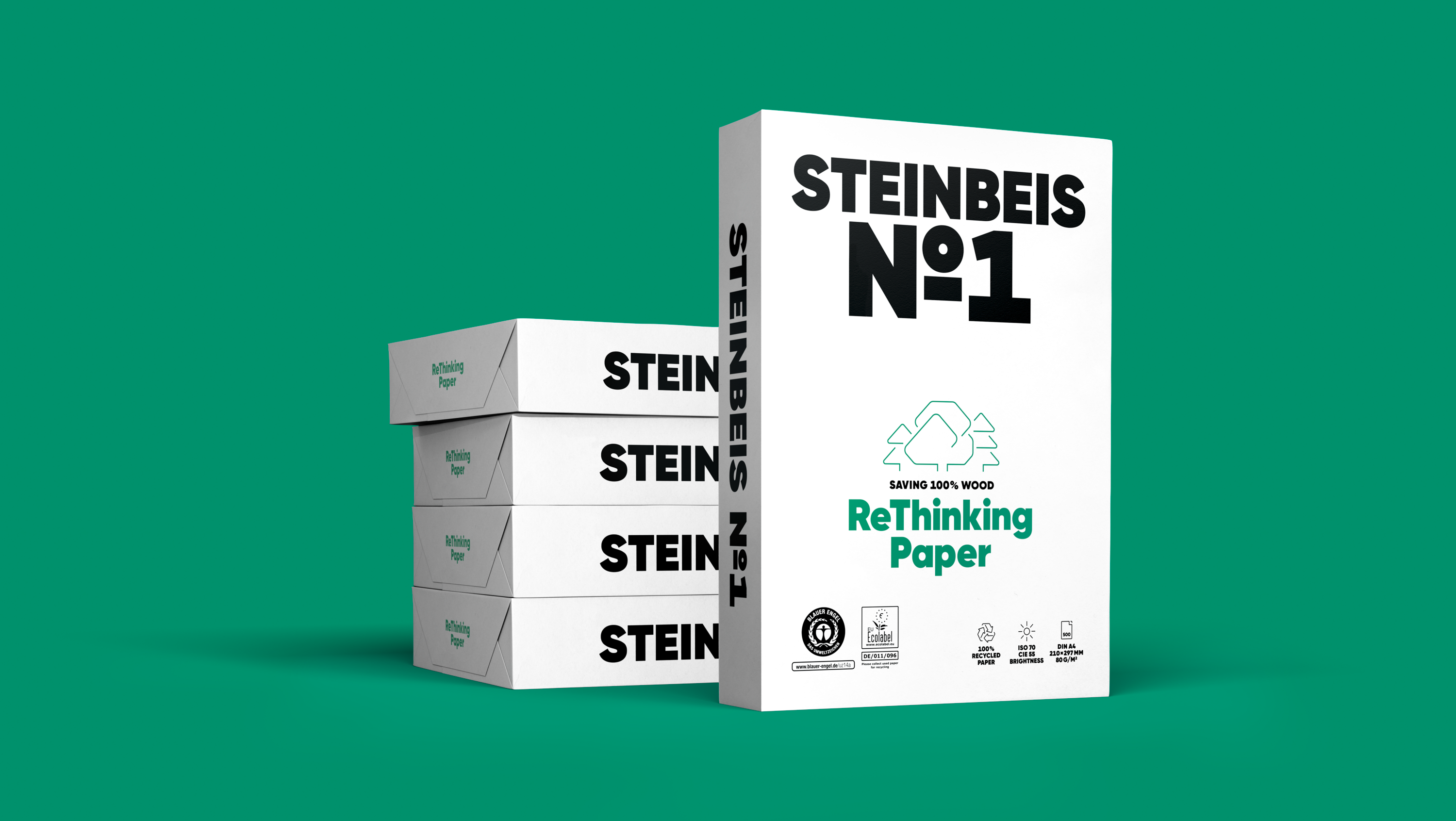
Steinbeis Papier not only produces graphic papers from 100 per cent recycled paper at its Glückstadt site, but also equally sustainable offset papers for finishing into wrapping paper. Various gift-wrapping paper manufacturers rely on recycled paper from Steinbeis Papier for their range - from Christmassy to colourful and playful. The focus in production is on a multi-layered circular economy. Starting with procurement and production through to utilisation and recycling. The switch to Steinbeis paper leads to savings that exceed the life cycle assessment values of the Federal Environment Agency: 100 per cent wood, 73 per cent energy, 79 per cent water and 42 per cent CO₂ equ. emissions.
The conscious choice of wrapping paper made from recycled materials, especially those bearing the prestigious Blue Angel eco-label, adds a sustainable dimension to the design of Christmas traditions. This conscious step emphasises that the festivities are not only characterised by material gifts, but also by the responsible use of resources and natural resources.
Cover picture: Karolina Grabowska/Pexels
Author

As a senior editor, Benjamin Seibring specialises in developing content on sustainability, mobility, technology and lifestyle. An editorial traineeship at a German media group and his many years of experience in corporate publishing form the basis. With a high affinity for trend topics and innovative AI tools, he implements cross-media storytelling.