You don't always have to reinvent the wheel. How Steinbeis PolyVert strengthens the materials cycle and creates the future.

Annika Krause is Operations Manager at the Steinbeis PolyVert site in Großenlüder and is responsible for 36 employees. Her journey there is a story of passion for technology and the courage to embrace change. A conversation about daily challenges, sustainability in practice and the power of togetherness.
Mrs Krause, at just 29 years old, you have been with the Steinbeis-Group for 10 years - and are now responsible for the operations of Steinbeis PolyVert Fulda GmbH in Großenlüder: an exciting decade behind you.
Yes, you could say that. It all started in 2016 with a dual study programme in industrial engineering at Steinbeis Papier in Glückstadt. I quickly realised that my heart beats for the technical side of things and I focused on technology and production early on. After graduating, I started as a technical assistant in project management and later moved to the holding company to expand project management centrally for all sites.
Your passion for technology is no coincidence, is it?
It started early on. My grandad was an enthusiastic car mechanic and my father is also very talented with his hands. That moulded me. At school, maths was my hobbyhorse. However, as my parents have more of a commercial background, industrial engineering was the perfect combination of both worlds and that ultimately led me to Steinbeis.

And yet the move from Glückstadt to Großenlüder is not only a big one in terms of expertise, but also in terms of space. How did it come about?
One of my projects initially took me here to Großenlüder to Steinbeis PolyVert Fulda GmbH. When the plant manager at the time left the company, I was offered the chance to stay here permanently and take on this role. I have now been Operations Manager here at the site for almost two years - a development that I would never have dreamed of at the beginning of my time at Steinbeis.
What is your role like, what does your everyday life look like?
The exciting but also challenging thing is that I don't have a traditional day-to-day routine. My work is a constant balance between day-to-day operations and strategic plant development. I spend part of my working time in work clothes at the machines. It's all about process optimisation and ensuring constant and stable production. My tasks also include disciplinary personnel management and the long-term development of the plant.

To get a feeling: What makes everyday life so varied?
As Operations Manager, the interests of the company and its employees are my main focus. This means that I am confronted with new situations and challenges almost every day, which require me to be able to react and ultimately make decisions.
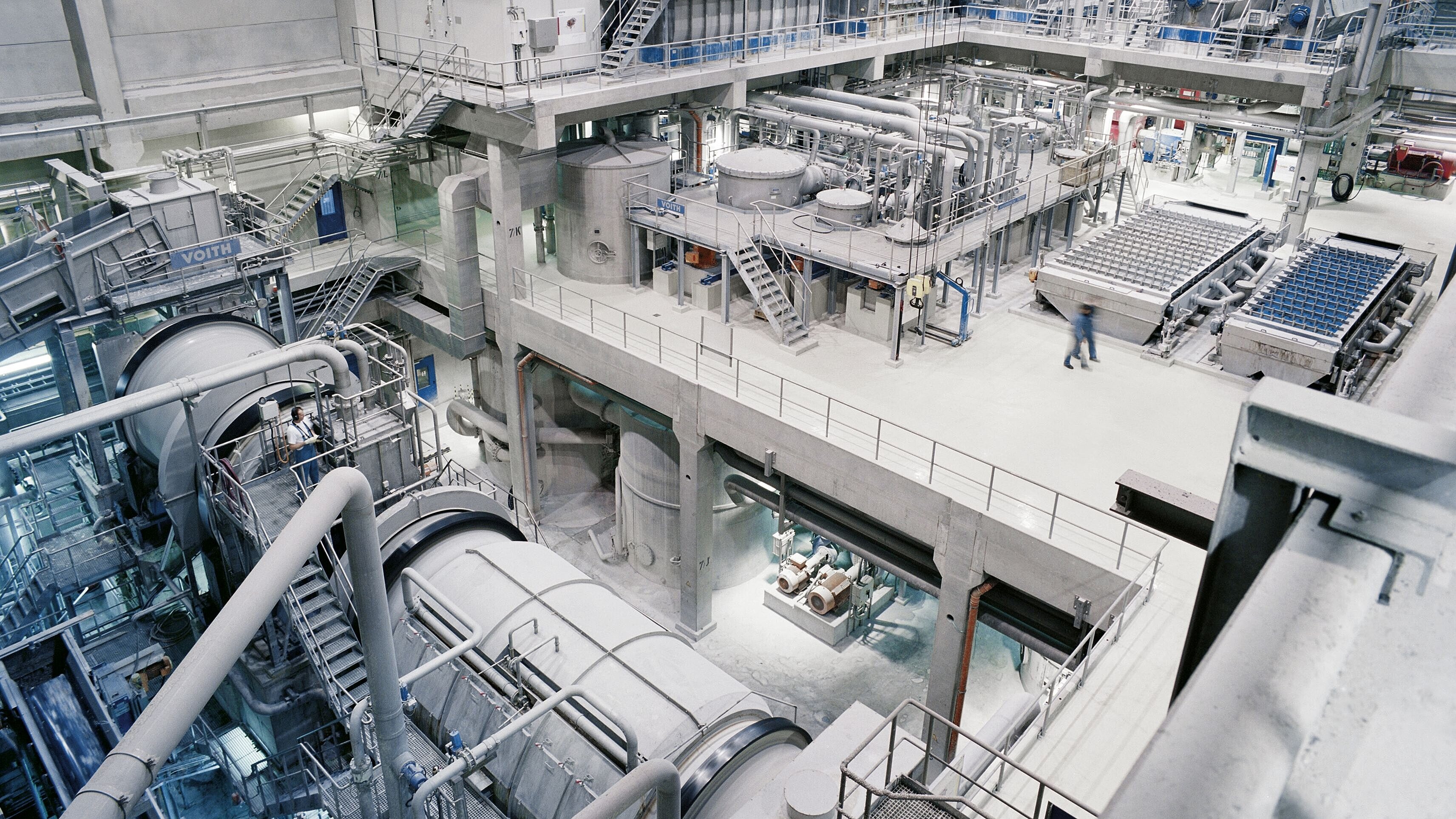
I am also fascinated by the value creation process from waste (PET drinks bottles) to a product (PET flakes). When PET bottles are recycled, they are shredded, washed and separated from foreign matter in a multi-stage process. The result is high-quality PET flakes - a valuable raw material that can be used to make new drinks bottles, packaging or other products.
That sounds energy-intensive - both in terms of personal input and in relation to the product. Sustainability is always the business model in the Steinbeis Group and is therefore of crucial importance. Where and how do you encounter this topic in your daily work?
That's right: the pursuit of efficiency and resource conservation is part of our business model and informs all our decisions. To stay on the subject of PET: For our flake quality, we wanted to replace the old washing unit, the refiner, with a hot caustic soda wash. We were faced with the choice of a gas-fuelled conventional solution or a heat pump to generate the process heat. The heat pump was the bigger investment, but in terms of sustainability and our future viability, it was the only right decision for us.
Can the reduction in energy consumption already be expressed in figures?
By eliminating an old unit, we were able to significantly reduce our energy consumption, which I find impressive. The old washing unit had an electrically powered 500 kW drive. By combining the hot wash with a new, efficient heat pump for the process heat, we are already noticing that we have been able to reduce energy consumption by around 20 per cent during test operation of the new hot wash. This shows that the investment has not only been worthwhile for the environment, but also economically.
To what extent do you benefit here at the site from the transfer of knowledge within the Group when making such decisions?
The exchange is extremely important. We are a small site and don't have a specialist on site for every area - but we do within the Group. For example, we had a problem with deposits on a screen. A call to a PolyVert colleague in Austria for an initial tip and a sample to the Steinbeis laboratory in Glückstadt were enough to find a solution. It is a great advantage to be able to access this expertise from a wide range of areas. In my case, I know many of my colleagues personally from my previous positions, which of course makes things a lot easier for me.

Is the personal aspect a stronger lever?
Absolutely, working together is also an important part of what characterises the Steinbeis Group for me. I realised that early on. I can only recommend everyone to seek and maintain personal contact as often as possible. You don't always have to reinvent the wheel; often a solution already exists in a similar form within the group. Actively promoting this exchange and building a network is priceless.
Was there a key moment that, for you, illustrates particularly well what the work in the Steinbeis Group is all about?
Yes, definitely. Directly after graduating, I was allowed to accompany a complex project in Glückstadt, the construction of a fully automated pallet warehouse, and then complete it on site with sole responsibility. I was young and inexperienced, but the team and my colleagues were incredibly supportive. This time showed me how much trust is placed in you at Steinbeis and how much you can achieve as part of a team. That shaped me and still helps me today, here in Großenlüder.
When you look to the future: What potential do you see for further advancing the sustainability agenda at Steinbeis PolyVert and in the Group?
Ultimately, it is always a question of closing the loop. The plastics industry and the use of recycled materials – and thus the conservation of natural resources – are vital to our collective future and are becoming increasingly mandatory. In this context, it will be exciting to transfer the "Towards Zero" sustainability strategy developed at Steinbeis Papier to our business in order to produce even more efficiently and sustainably. But here, too, I trust in the transfer of knowledge that will help us all move forward. After all, the avoidance and recycling of waste is an overarching issue that affects all companies within the Steinbeis Group from both an ecological and an economic perspective.
- In addition to the traditional paper business, Steinbeis PolyVert is another pillar of the Steinbeis Group and stands for its consistent focus on sustainable recycling management. The name is made up of "Poly" (for polymer, plastic) and "vert" (French for "green") and stands for the business model and the attitude behind it.
Steinbeis PolyVert produces high-quality plastic recyclates from post-consumer waste at its sites in Großenlüder and Völkermarkt, Austria. State-of-the-art plant technology, innovative processes and a deep understanding of industrial requirements result in high-performance material solutions that meet the highest quality standards. As a reliable partner to industry, Steinbeis PolyVert helps to close plastic cycles, utilise resources efficiently and enable sustainable value creation.
Cover picture: Steinbeis PolyVert
Author

Patrick Morda has gained extensive experience in senior editorial positions since 2009. He has served as editor-in-chief on several occasions and was responsible for developing new business areas in the media sector, with a particular focus on topics such as new mobility. His expertise extends to the strategic management of editorial teams and working on special interest magazines.