Safety first!

18.07.2023 - Sustainability at Steinbeis Papier not only applies to the products, but also to the working conditions at the recycled paper manufacturer. A cornerstone of this is a strong understanding of occupational safety. Luisa Egge has been in charge of this sensitive area since February of this year. In this interview, the occupational safety specialist explains how she came to take on her responsible role, why networking is essential here and what constitutes a culture of occupational safety in a company like Steinbeis Papier.
How did you come to your current position as an occupational safety specialist at Steinbeis Papier?
My roots lie in machine management. I completed my training in this area 13 years ago and developed an awareness of occupational safety over a long period of time. This experience enabled me to qualify for my new role, as they were looking for someone who knew the company and its production processes very well. As an occupational safety specialist, I now primarily take on an advisory role that operates across all hierarchies. I am the primary point of contact for more than 370 employees at Steinbeis Papier, Steinbeis Energie and AP Concept.

Why is the topic of occupational safety so important to you?
Occupational safety often falls out of focus when efficiency is required in production. However, this work philosophy must be scrutinised time and again, from the managing director to the employees and by yourself. Both physical and mental health play a role in the complexity of occupational safety. However, you first have to learn to look after your colleagues and yourself and adhere to the relevant guidelines. That's how I became interested in the whole subject.
What does your day-to-day work look like?
Like so many colleagues, I check my emails in the morning. And then I find enquiries from a wide variety of departments. Then they ask for my expertise, a risk assessment or a hazard assessment. Research activities are also part of my job profile - with the initialisation of our special variety line, questions about safety regulations naturally also arose. I then worked on these and passed them on to the relevant specialist departments.
How are you supported in your role as an occupational safety specialist?
I have a number of portals that I can use to access specialist knowledge. I also have a consultancy firm at my side that informs me about the latest amendments to the regulations on occupational safety. The DGUV (German Social Accident Insurance) is the joint umbrella organisation for the nine industrial employers' liability insurance associations and the 24 accident insurance funds. It also regularly informs me about changes to the safety guidelines that may affect Steinbeis.
What are the particular potential hazards at Steinbeis Papier?
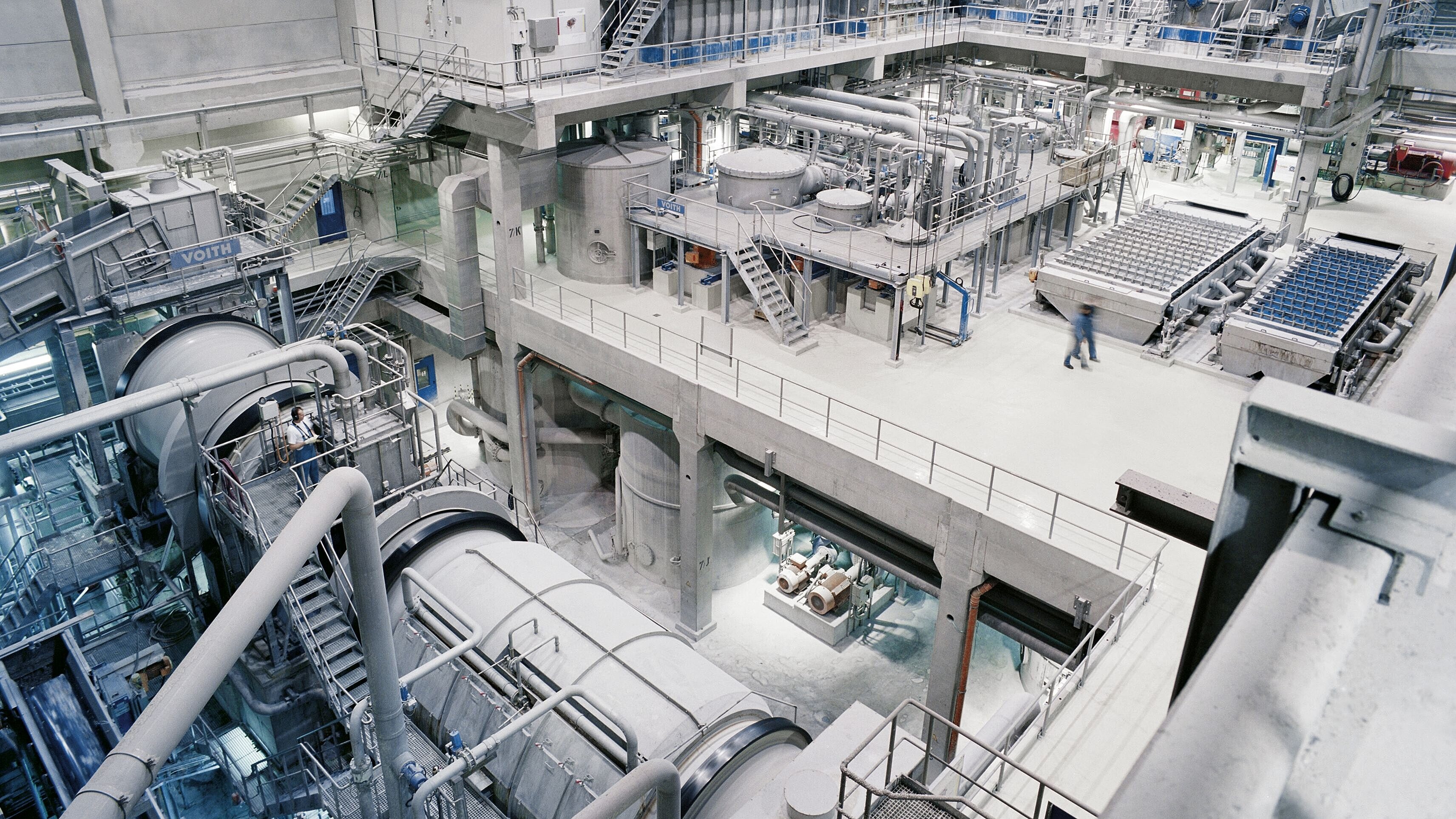
There are many potential hazards in an industrial company. In our production, for example, there is the pre-drying section where the paper is dried. High temperatures have to be handled at this workplace. The risk assessment states, among other things, that long clothing must be worn to prevent burns. Dehydration is also an issue here, as you need to drink a lot in a hot workplace. These regulations then apply to everyone who works in this environment - not just paper technologists, but also fitters or electricians who come into this danger zone. Another good example is the high frequency of forklift, wheel loader and lorry traffic on the Steinbeis site in Glückstadt. This also means a high risk potential. As a result, high-visibility waistcoats are mandatory in these areas and special driving licences are issued for the operation of these vehicles.
What safety procedures have been implemented at Steinbeis Papier to ensure occupational safety?
We follow a hierarchy of measures for risk assessment in the workplace and on machines, both in terms of physical and psychological issues. At the top is the elimination of potential hazards such as lorries on the site. If this is not possible, we consider a replacement option or another technical solution. One example is the place where the palletised goods containing our office papers are stored. This pallet warehouse is now fully automated. No forklift drivers are used here to load individual pallets. The robot-controlled high-bay warehouse does this itself without human intervention. Contrary to expectations, warehouse staff are not replaced by the machine, rather it has a supporting function and minimises the risks.

How do you help to ensure that these guidelines and procedures are adhered to?
Through my tours and constant dialogue with employees, I ensure that occupational safety is given a high priority in the corporate culture from now on. It is important to me that everyone takes responsibility for themselves and their health and is aware of this responsibility at all times. I take the time to answer every question, no matter how small, and I try to find out what is needed through brief discussions and to be inspired by my colleagues' good ideas for new solutions. Formulated as a guideline, I can discuss the innovations with department heads and line managers and implement them accordingly. The fact that employees' ideas are heard and implemented accordingly also means additional motivation and a boost in morale.
How do you identify potential risks in terms of occupational safety?
When we commission a new plant, for example, a risk assessment must also be available. To do this, I interview the managers to find out what activities are involved and which new units will be used in the machine. In this way, we combine the expertise of the manager and mine as a safety specialist to identify potential hazards in the daily work with the machine. In a triad, the aforementioned risk assessment, operating instructions and corresponding instruction are created.
What measures have you taken to reduce or avoid risks?
One example of this: We use caustic soda in waste paper processing. This runs through pumps and pipes, which can sometimes rupture or burst. If an employee were to walk underneath at this moment, he or she would involuntarily come into contact with the caustic soda. According to the hierarchy of measures described above, the next step would be to find a substitute for caustic soda. If no substitute for caustic soda can be provided, then another stage must be considered before protective clothing is prescribed. We have therefore protected the valves with Plexiglas panes so that leaking caustic soda is effectively stopped in the event of material fatigue.

How are employees trained in occupational safety?
For new employees, we have an initial general safety briefing that covers both those who work in the office and those who start in production. Annual mandatory training through our ISO certification covers areas such as the management system and fire safety. There are also instructions depending on the hazards. For office staff, this can be something as trivial as how to use the handrail in the stairwell. In the production plant, the foremen in the various areas have to instruct their employees in far more differentiated safety regulations. We also want to take the topic of occupational safety to a new level for our trainees and present it in a more modern way - for example in the form of quizzes or possibly short videos.
What co-operations are there in the company to improve occupational safety?
There are various meetings. I organise quarterly meetings with our 65 safety officers, who are represented in all areas. I provide information about overarching measures there. And my colleagues tell me about their concerns regarding safety optimisation. The most important thing, however, is that the departments also exchange information with each other. This is because it often happens that one department has already implemented improvement measures and another can adapt them for its own area. Six times a year, there is also an occupational safety committee with the managing directors, divisional managers and possibly also colleagues from the departments. The works council, the HR department and our company doctor are also involved. This is where we coordinate projects that are to be launched in the near future.
What goals do you have for the future improvement of occupational safety at Steinbeis Papier?
I want to motivate the entire workforce to take a closer look at the topic of occupational health and safety and to be enthusiastic about it. Ultimately, my goal is to minimise the number of accidents in the medium term with a wide variety of measures and to set a long-term target of zero. That's how I see sustainable occupational safety.
Cover picture: Steinbeis Papier
Author

As a senior editor, Benjamin Seibring specialises in developing content on sustainability, mobility, technology and lifestyle. An editorial traineeship at a German media group and his many years of experience in corporate publishing form the basis. With a high affinity for trend topics and innovative AI tools, he implements cross-media storytelling.