Plop with attitude: Flensburger mixes flavour and sustainability

With the Küstenlimo, Flensburger is expanding its range with a drink that offers balanced sweetness, full flavour and the unmistakable "plop" of the swing-top bottle - with labels made from recycled paper from Steinbeis Papier. Küstenlimo combines lifestyle, naturalness and sustainability to appeal specifically to younger target groups. In this interview, Product Manager Heike Zilm reveals how flavour selection, production and design were implemented step by step, and Online Marketing Manager Laura Henneke shows how the brand, lifestyle and sustainable values are brought together. It becomes clear that the Küstenlimo is not just a new drink, but a North German attitude to life that combines tradition, innovation and responsibility in one bottle.
What characterises the new Küstenlimo?
Heike Zilm: With the Küstenlimo, we want to establish a second mainstay alongside beer. The beer market has been stagnating for years, and for a long time we were able to compensate for this through growth. But we know that this won't last forever. So we took a look at the soft drinks market. The biggest segments are cola, lemonade and cola mix - and that's exactly where we started. We didn't want to be experimental, we wanted to develop products with no frills, but with a high fruit content and as little sugar as possible. Flavour always comes first. We also wanted to rejuvenate the brand, as beer is generally an "older" segment. With the Küstenlimo, we are also consciously addressing younger target groups, and you can see that in the fresh design.
You have retained the classic Flens bottle. Was that clear from the start?
Heike Zilm: Absolutely. Technically, there's no other way because our systems are designed for swing-top bottles. Conversely, other breweries wouldn't be able to fill swing-top bottles without further ado.
Laura Henneke: And it suits our brand perfectly. The swing-top is our brand essence and the "plop" is synonymous with FLENS. We naturally wanted to transfer this to the new product line. And let's be honest: plopping is simply fun, especially for younger people.
And does the production run on the same equipment as for beer?
Heike Zilm: Only partially. There are completely separate tanks for the sodas. Sugar in beer would be a disaster, it would continue to ferment uncontrollably. The bottling plants are of course the same as for beer. However, they have to be cleaned very thoroughly before other products are bottled.
Laura Henneke: A little anecdote about this: In the beginning, the idea was to fill orange first, then mix and finally cola, so that no colours would transfer to the next product. In practice, however, it turned out that orange is difficult to clean due to its high fruit content. That's why the order was reversed at the end.
Why exactly these flavours?
Heike Zilm: We analysed the market figures very soberly and looked at where the biggest segments are. You can reach most people with cola, lemonade and mix. In the meantime, we have also introduced a Coke Zero for the catering trade only, as this is the fourth largest segment. And we have tasted intensively both internally and externally, including blindly against competitors. You quickly realise how big the differences are in terms of fruit content, sugar and taste.
How has the feedback been so far?
Laura Henneke: Very positive. The cola in particular has been very well received because it is not as sweet as many others. We often hear that this is exactly the difference that people like.
Heike Zilm: And of course it's exciting for us to see how this is shared online - with pictures, videos and feedback on the website. We realise: It has potential, even if it's still in its infancy.
Will the lemonade become just as important as the beer at some point?
Heike Zilm: That's difficult to predict. At the moment, the two areas are clearly weighted differently. But we can see that the younger generation is drinking less alcohol and focussing much more on non-alcoholic drinks and innovation. In the long term, we want to position ourselves not only as a brewery, but also as a drinks manufacturer.
"Sustainability is now part of our DNA - with the Küstenlimo, it made sense to make the labels sustainable too."
Laura Henneke, Online Marketing Manager at Flensburger Brauerei
What role does sustainability play for you - in general and specifically at Küstenlimo?
Laura Henneke: Sustainability is now firmly anchored in our corporate strategy. You could say it's part of our DNA. It wasn't always like this, but we have initiated a real transformation process in recent years. Together with the non-profit organisation ORCA, we initially recorded our emissions and levers and derived specific measures from this. These are not just buzzwords; there are clear figures and priorities behind every measure. A lot of this relates to technology, but it has an impact on all areas. We are also setting an example in marketing, for example by switching to certified paper in administration. For Küstenlimo, it made sense to use sustainable labelling solutions as well.
Does that mean you already considered sustainability when developing the lemonade?
Heike Zilm: Yes, definitely. We wanted a product that suited the young target group, which is very aware of these issues. When it came to the design, it was clear that it wouldn't work on glossy paper. So we deliberately opted for a natural recycled paper with a slight grey tint. We leave the background visible and only print the colours and graphics. So you can see straight away that this is a natural, sustainable material. It complements the overall product perfectly.
What about the ingredients - was "naturalness" a criterion there too?
Heike Zilm: Yes and no. We have had non-alcoholic drinks in our range for a long time, such as malt or shandy, which are mainly made with sweeteners. We made a conscious decision not to do this with the Küstenlimo. We wanted to offer sugar-sweetened drinks, but with as little sugar and as much fruit as possible. This gives consumers a real choice: classic with sugar or deliberately without, as with Coke Zero, which we added later.
What are the biggest sustainability measures within the company itself?
Laura Henneke: A lot is happening at the moment. For example, we are massively expanding our own photovoltaic network in order to supply ourselves with electricity in the future. We also have a new dealcoholisation plant that produces ethanol of a quality that could perhaps even be used as a CO₂-neutral fuel in the future. The biggest project, however, is our new brewhouse, which is currently being built in Flensburg. Among other things, it will be around 30 per cent more energy-efficient than the old one thanks to the use of heat pumps instead of conventional steam. This puts us well ahead of the rest of the industry, even if we are not inventing any new technologies. It is important that sustainability is incorporated into our investments right from the start.
"The swing top is our brand essence, remains in circulation and is of course also used in the Küstenlimo - this saves us around 150 million crown caps every year."
Heike Zilm, Product Manager at Flensburger Brauerei

What role does your reusable system play in terms of sustainability?
Heike Zilm: A very big one. Around 90 to 95 per cent of our products are in reusable bottles. And unlike crown cork bottles, our swing top remains in the cycle. This means that we save around 150 million crown corks a year because our bottles always come back with the swing tops. That's a real difference.
Was this sustainability aspect the reason for the swing-top mechanism?
Heike Zilm: No, the origins go back much further. The swing top was invented in the 19th century and was standard at the time. Many breweries later switched to crown corks because it was cheaper and easier. But Flensburger stuck with it, mainly thanks to the foresight of our then managing director Emil Petersen. This consistency has characterised us. Today, the swing top is the core of our brand. The "Plop" is even registered as a trade mark.
How did the collaboration with Steinbeis Papier come about?
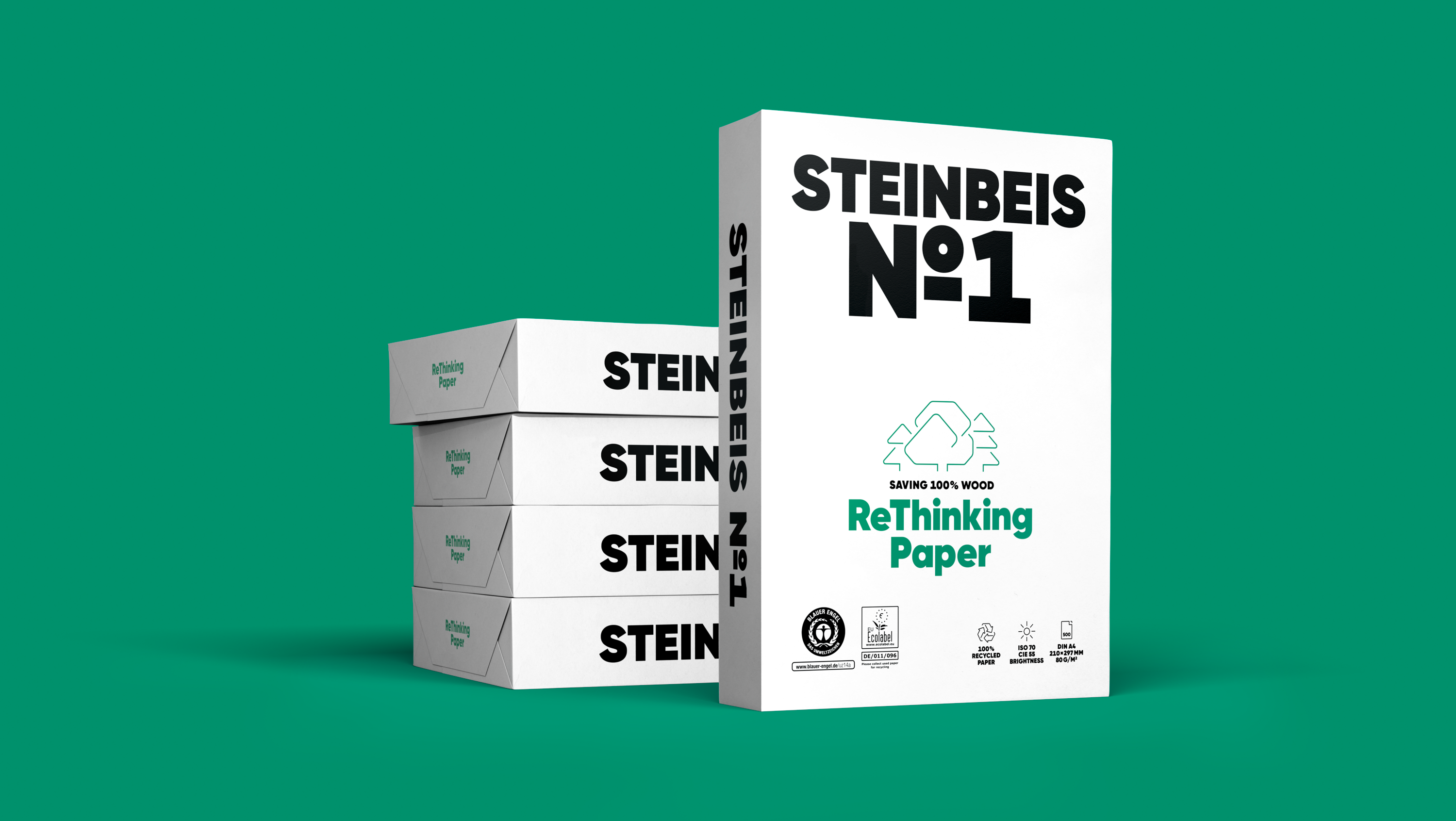
Laura Henneke: It was actually a chain of happy coincidences. We had already discussed switching our copy paper to recycled paper internally anyway. As a result, the topic of paper and sustainability was more prominent. At some point, the question arose as to whether our labels could also be made more sustainable. At that moment, our consultants at ORCA recommended that we use recycled paper. And if you look around in this area, you very quickly end up with Steinbeis Papier. Steinbeis is basically the only supplier that can deliver a label paper made from 100 per cent recycled paper at this technical level.
What did Flensburger and Steinbeis Papier have in common?
Heike Zilm: We discovered them early on in our discussions. Although we don't have a direct business relationship - we buy our labels from printers, who in turn order from Steinbeis - it was clear that the paper could only work if it was technically flawless. Labels are light, thin and must not tear or fall off. That's why we had to approach it step by step. It was a process in which it became clear: We share the same quality standards.
Laura Henneke: Exactly, such projects are always a collaboration between three partners - paper manufacturer, printer and bottler. This requires close coordination and a great deal of trust. Steinbeis considered the end customer right from the start: the label should visualise sustainability, deliberately not in pure white, but as a clear statement. Added to this is the regional proximity - short distances in Schleswig-Holstein, partners just around the corner. This creates a bond and makes the collaboration credible.
What role does regional proximity play?
Heike Zilm: A big one. We are based in Schleswig-Holstein and try to keep as much as possible in the region. We have our labels printed by Ellerhold in Wees - that's practically round the corner. Short distances are important to us, also so that the money stays in the region.
What are the prospects for the Küstenlimo range?
Heike Zilm: We are looking beyond what already exists. We believe in the range, we believe in the name - Küstenlimo simply sounds like a place of longing. Coasts are automatically associated with holidays, relaxation, nature and freedom. That is a strong foundation. Added to this is our commitment, such as the StrandGut campaign: we have been cleaning the beaches in Schleswig-Holstein together with tourism organisations since 2017. This is concrete, verifiable, accessible to everyone and not just somewhere far away. Such activities have been running for a long time and give us authenticity.
How should the attitude to life around the brand be developed?
Laura Henneke: We didn't just want to put out a new product, we wanted to understand what the reality of life is like for the younger target group. How do they spend their free time, what drives them - and how does Flens fit in authentically? Our aim is to create a world that feels natural: coastlines, water sports, travelling in a van, digital communities. We are looking for partners, sponsorship formats and influencers who embody this lifestyle. The Küstenlimos are an ideal starting point for this.
What role does sustainability play in this perspective?
Laura Henneke: Sustainability is a reality for young people - we can't ignore it. But we don't use it as a loud marketing tool. Our aim is to develop products that stand for themselves and at the same time act sustainably as a matter of course. It is not an advertising lever for us, but an added value.
Heike Zilm: Exactly. Sustainability is organically interwoven with our brand and activities without us having to constantly emphasise it. We take a North German understatement approach: The important thing is not how loudly you talk about it, but that you get going. We have concrete plans and are realising them step by step.
Cover picture: Flensburger Brauerei
Author

As a senior editor, Benjamin Seibring specialises in developing content on sustainability, mobility, technology and lifestyle. An editorial traineeship at a German media group and his many years of experience in corporate publishing form the basis. With a high affinity for trend topics and innovative AI tools, he implements cross-media storytelling.