Elections: Why we mark our ballot papers
Around 675,000 polling staff were on duty during the 2025 federal election.1 In the approximately 90,000 polling stations and postal vote constituencies, they oversaw and monitored the election. That is an incredible effort – much is clear. Is this really necessary? Wouldn’t it be more in keeping with the times if everyone voted from home on their computer? No: the fact that we mark our ballot papers by hand is more modern and more important than ever!
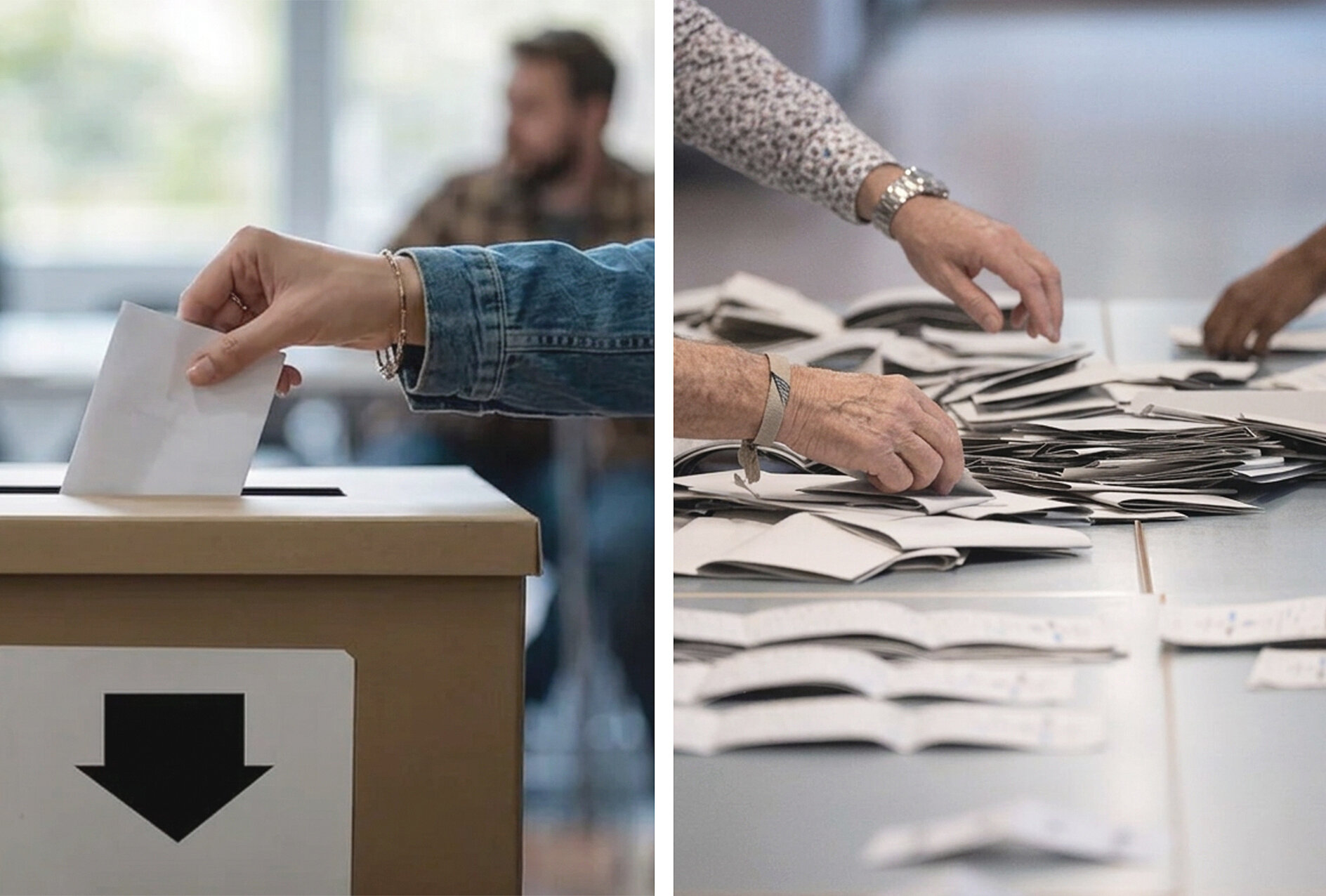
For paper plays a key role in the election: it separates those who have cast their votes from the count – and at the same time establishes a direct link between the two. Everyone marks their ballot paper in the polling booth and goes home. Later, the votes are counted. And the result is one that can be verified at any time. Just how important this is became clear after the 2025 federal election, as illustrated by the example of the Sahra Wagenknecht Alliance: the BSW fell just short of the five per cent threshold and demanded a recount of the votes. Regardless of how one assesses this dispute politically or legally, it makes one thing clear: because the votes were cast on paper, there is actually something that can be checked, sorted and counted again in case of doubt.
And that is crucial. If voting were carried out on computers, votes might be cast more conveniently and counted more quickly. But for many people, they would also feel as though they were vanishing into thin air: one click, and there is nothing left to see. Apart from a few IT specialists, who could then still understand exactly what happens during the voting process?
Even if a digital voting system were technically very secure, it could never be completely unassailable. Every technical infrastructure must be maintained, tested and understood. Any software can contain errors; any system can develop new vulnerabilities. Security and traceability are more important than ever in an age of artificial intelligence, deepfakes, fake news and targeted attacks on democratic institutions.
Electronic voting machines have also been used in Germany in the past, most recently in the 2005 federal election. Then came the ruling of the Federal Constitutional Court:2 Their use at that time was unconstitutional because citizens were unable to reliably verify either the recording of their vote or the counting of the votes themselves. Electronic voting machines would only be permissible if it were possible to carry out precisely this verification without specialist knowledge. Paper achieves this in the simplest possible way.
It is true that paper does not protect against errors. Even on a ballot paper, a cross can be marked incorrectly, a vote can be invalidated, or a stack can be counted incorrectly. But the crucial difference is this: such errors do not disappear into the system. A ballot paper is right there. You can look at it again, sort it, and count it.
Of course, there are also successful examples of digital voting. Estonia, for instance, has allowed its citizens to vote online since 2005; in the 2023 parliamentary election, more than half of voters cast their votes electronically for the first time.3 Yet Estonia remains an exception to this day. This is because whether digital voting works depends not only on technology, but also on whether the public trusts the process. The fact that this trust can be shaken is demonstrated not only by Germany but also by the Netherlands: there, electronic voting machines were withdrawn from use in 2007 following debates over security.4
What’s more, citizens are particularly well placed to exercise their rights in paper-based elections. What many people don’t realise is that, whilst the act of casting a vote itself is strictly confidential, almost everything else about elections in Germany is public.5 Anyone may observe, inside the polling station, how the electoral committee begins its work, how the empty ballot box is sealed, how ballot papers are distributed and how the votes are counted once the polling station has closed. So you can literally stand by and watch as individual crosses turn into an election result.
In a digitalised world, the cross on paper seems like an anachronism. In reality, it is a robust democratic technology: slow enough to remain verifiable – and simple enough for everyone to understand what is happening.
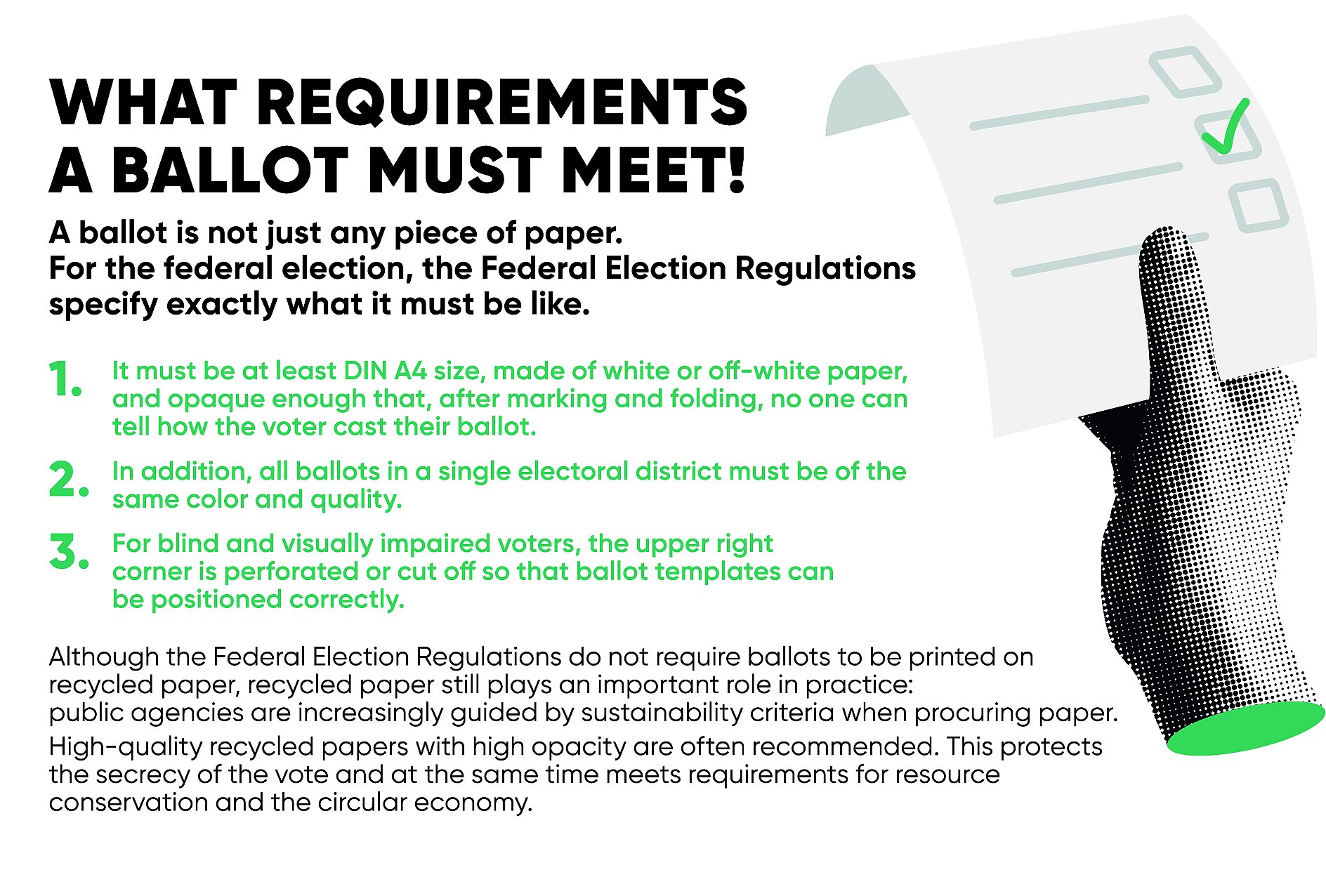
And when it comes to sustainability, too, paper is more modern than it seems at first glance. For a start, the life of the ballot papers does not end immediately with the official final result. After the count, they are sorted, bundled, packed, sealed and stored securely. Should there be any objections, recounts or investigations, they remain available. The paper therefore remains a tool for scrutiny for as long as democracy requires it.
Only when the documents are no longer required and their destruction is legally permissible are they disposed of – in the case of federal elections, this is usually no earlier than 60 days before the next election to the German Bundestag.6 The ballot papers are then returned to the paper recycling cycle as waste paper.
This creates a win-win situation for democracy and sustainability: paper enables an election that remains transparent, verifiable and comprehensible – and subsequently becomes part of a sustainable cycle. A tick turns into trust. And, in the end, many millions of ballot papers are transformed back into a raw material.
2 https://www.bundesverfassungsgericht.de/SharedDocs/Pressemitteilungen/DE/2009/bvg09-019.html
3 https://e-estonia.com/how-did-estonia-carry-out-the-worlds-first-mostly-online-national-elections/
4 https://edri.org/our-work/edrigramnumber5-20e-voting-machines-netherlands/
5 https://www.bundeswahlleiterin.de/service/glossar/w/wahlbeobachtung.html
6 https://www.buzer.de/90_BWO.htm and https://www.buzer.de/73_BWO.htm
Author

Christian Heinrich holds a PhD in medicine and trained as a journalist at the German School of Journalism in Munich. He has been working as a freelance journalist and writer since 2010. Christian Heinrich writes for DIE ZEIT, the Süddeutsche Zeitung, SPIEGEL, GEO and other publications. He is a member of the editorial office nerdpol, a collective of science journalists.