More than just reading: seven very special books
What exactly is a book? In the vast majority of cases: paper printed on both sides, with pages of equal size, bound together between two covers. Even this simple form opens up an infinite variety of possibilities. Books tell stories, explain the world, show us unfamiliar places and allow us to rediscover the familiar. What’s more, they take us into the minds of other people. ‘Reading is thinking with someone else’s brain,’ Jorge Luis Borges once said, echoing Arthur Schopenhauer. We want to take this a step further – and have sought out books for you that elevate the experience of reading to a whole new level.
After all, books can be so much more than mere vessels for text and images. They can experiment with our senses, play with them, work their magic, and unsettle us – through form and typography, and through the use of materials and mechanisms. Below, we present seven special books in which ‘reading a book’ becomes an unusual, beautiful and extraordinary experience.
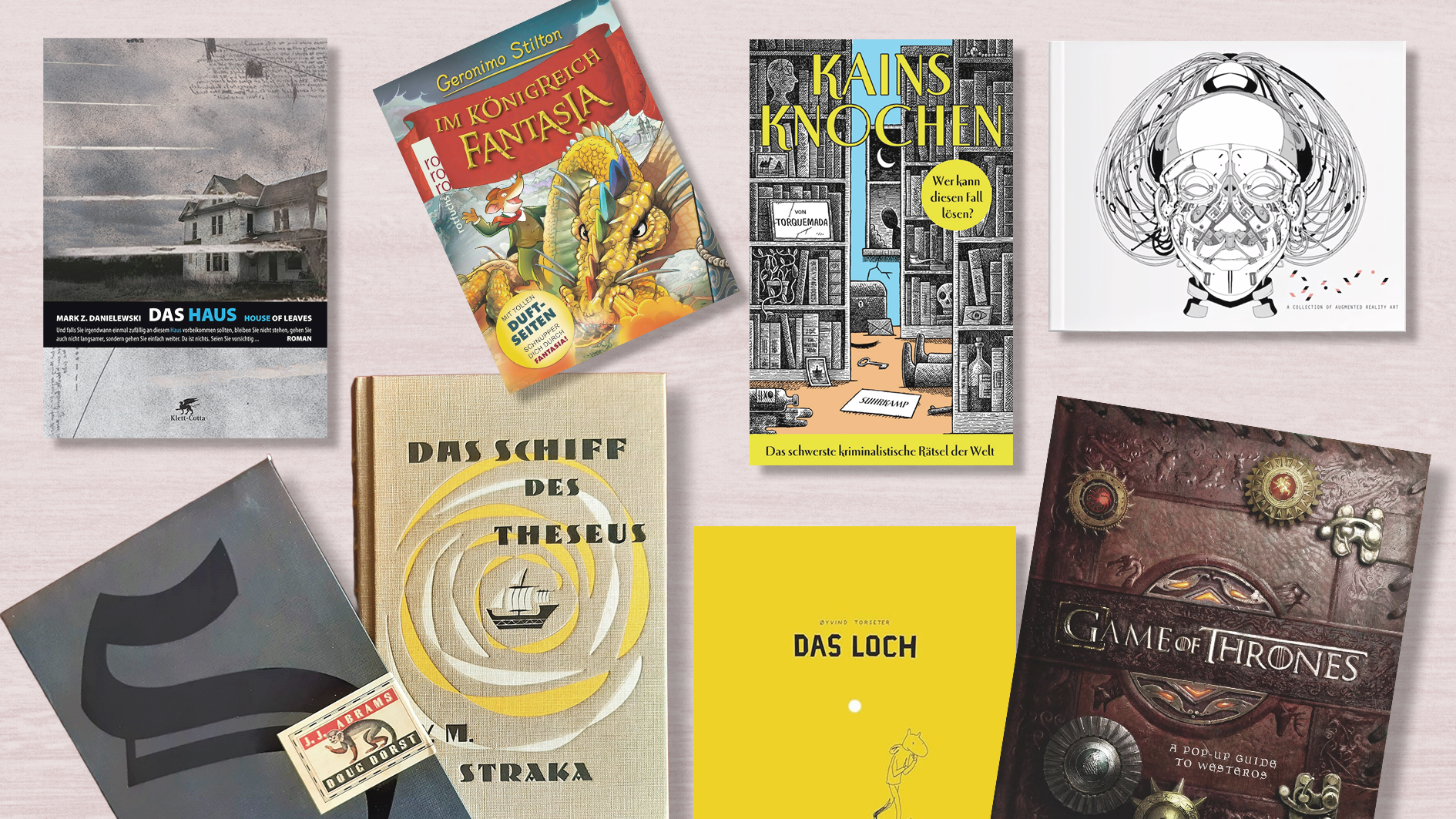
1. 'The Ship of Theseus' by J. J. Abrams and Doug Dorst
‘The Ship of Theseus’ is actually two books in one. At first, the book purports to be a novel by the fictional author V. M. Straka. On this first level, the book tells the enigmatic story of a man with no memory. And then there is the second level, which is what makes the book so special: in marginal notes, two readers exchange thoughts on the text. Jen, a student, and Eric, a former PhD student, are reading the same library copy. They take turns borrowing it and leave each other not only handwritten notes on the pages, but also letters, postcards, newspaper cuttings and other found objects, which lie loosely within the book between the relevant pages. In this way, we can follow how their joint search for clues to Straka’s secrets gradually develops into a personal connection.
2. ‘Geronimo Stilton in the Kingdom of Fantasia’
What does fiery dragon’s breath actually smell like? And what about the lovely scent of fairies? And (we might not actually want to know this, but we’re curious all the same): what do troll feet smell like? You can ‘smell’ these and many more scents in the book *Geronimo Stilton in the Kingdom of Fantasia*. That’s because there are pages you can rub – and suddenly a scent wafts up, matching the story. Actually, this book – in which even the letters are very playful – is a children’s book – but one that adults will happily stay at the table to read too. Geronimo Stilton is a timid little mouse, a newspaper editor and not really much of a hero. In his attic, he discovers a golden staircase leading to Fantasia. There, the fairy queen Floriana is in danger and Geronimo must rescue her. His journey takes him through realms full of witches, mermaids, dragons, goblins, dwarves and giants – and into the world of scents and stinks!
3. ‘Cain’s Bones’ by Torquemada
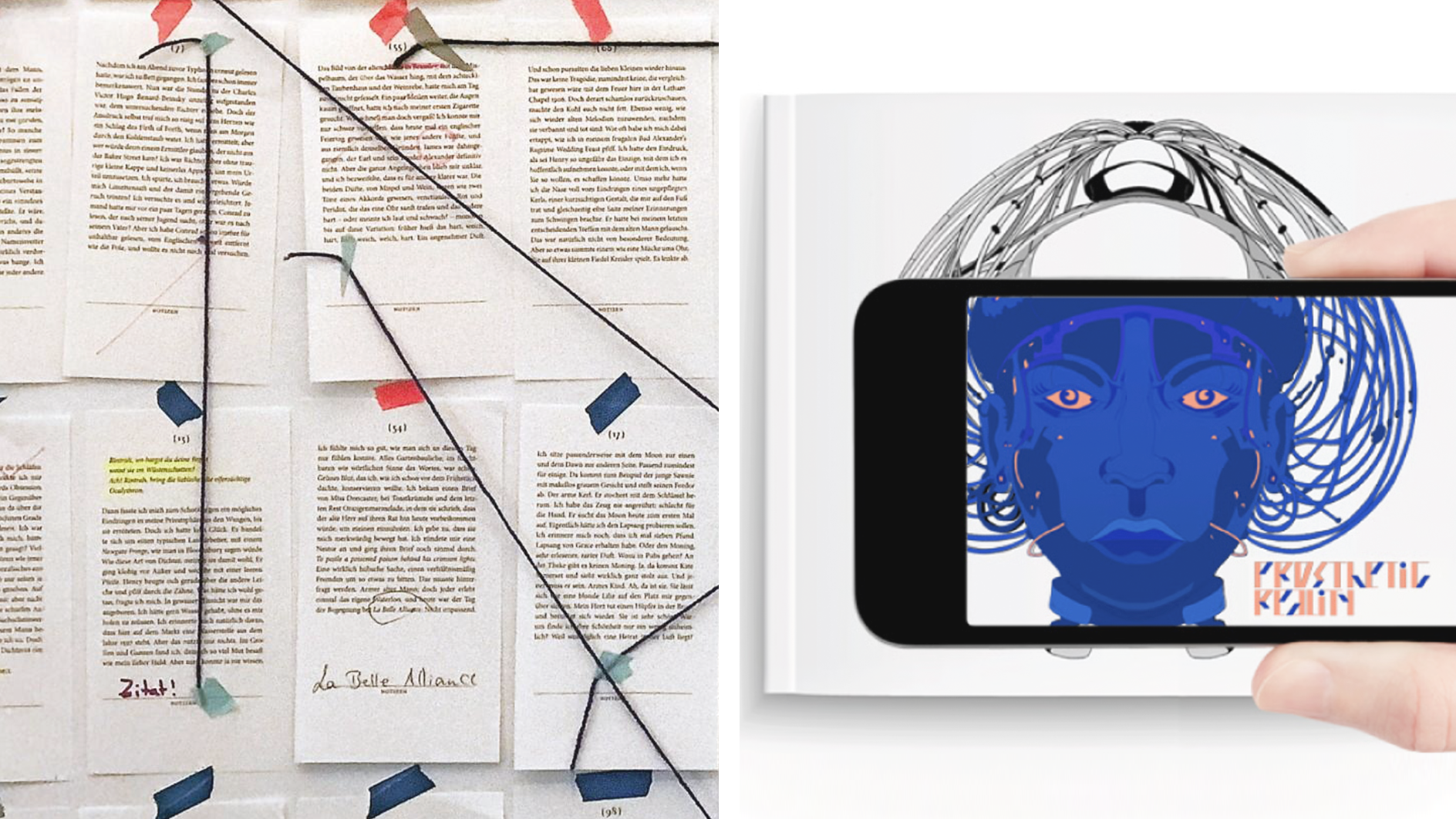
A book that essentially contains more than a million books – even though it’s only 100 pages long! But these 100 pages aren’t bound in the usual way. In *Cain’s Bones*, they appear in a deliberately incorrect order. So anyone who wants to read the book must first put it back together: page by page, clue by clue. Only when everything is in the right place does the actual plot emerge. And it’s a doozy: in this crime mystery, six people die. Readers must not only work out the correct order of the pages, but also who was murdered and by whom. The work was written in 1934 by Edward Powys Mathers under the pseudonym Torquemada. To this day, *Cain’s Bones* is regarded as one of the most challenging literary puzzles of all time.
4. 'The House – House of Leaves' by Mark Z. Danielewski
Typography refers to how letters and text are arranged on a page: which typeface is chosen, what is the line spacing, and where are the white spaces? Such decisions usually remain discreetly in the background. ‘The House – House of Leaves’, on the other hand, shows that typography is capable of much more. Mark Z. Danielewski’s cult novel is about a house that is larger on the inside than on the outside – and this impossibility is reflected in the layout. Blocks of text suddenly narrow like corridors, words get lost, standing alone on white pages, footnotes proliferate, lines tilt, run backwards or crowd together. In this way, the book builds its own labyrinth out of paper. The sense of unease arises not only from the story, but also from the act of reading itself: you leaf through the pages, turn them, search – and lose your way.
5. ‘The Hole’ by Øyvind Torseter
‘The Hole’ is a book with a small, round hole: it has been punched through every page. Around this empty space, the Norwegian illustrator and author Øyvind Torseter weaves a wonderfully quirky picture book. The main character moves into a new flat and discovers a hole there that apparently moves and defies explanation. So it is observed, packed up and taken to the laboratory. For children, this is exciting and funny. Torseter reinterprets the hole on every page: sometimes as an object, sometimes as a disruption, sometimes as a joke. For adults, there is a second, philosophical layer to it. For this hole can also be read as a disruption in the order of things: as something that is simply there, even though it doesn’t seem to belong there. Sometimes there’s just a void that you can’t fill, but have to put up with.
6. 'Game of Thrones: A Pop-Up Guide to Westeros' by Matthew Reinhart and Michael Komarck
The Great Wall in the north of Westeros protects the Seven Kingdoms from the cold – and from whatever lurks beyond it. In this book, the Wall truly soars skywards. It also features Winterfell, King’s Landing, dragons, direwolves and many other characters and motifs from *Game of Thrones*, one of the most successful series in television history. However, the ‘Pop-Up Guide to Westeros’ is no ordinary pop-up book where a tower pops out here and there. Five large scenes can be unfolded at the end to form a massive three-dimensional map: around one square metre of Westeros made of paper, full of little extra pop-ups, flaps and details. You look, unfold, discover – and marvel at the paper mechanics. The biggest challenge comes afterwards, when you have to fold everything back together correctly. It works. But you’ll need a bit of patience.
7. ‘Prosthetic Reality’
45 artists – including illustrators, painters, animation professionals and sound designers – have collaborated on ‘Prosthetic Reality’ to bring paper to life in a unique way. At first glance, it is an art book featuring modern, often surreal, comic-style or psychedelically vibrant images. But if you scan the pages using the accompanying app, you are transported to a second level: printed figures begin to move, shapes pulsate, colours flow and sounds are added. A man transforms into an elephant, a dashboard becomes a sinister scene, and superheroines step out of the page. The result is an experiment blending paper, animation, sound and digital magic.
Author

Christian Heinrich holds a PhD in medicine and trained as a journalist at the German School of Journalism in Munich. He has been working as a freelance journalist and writer since 2010. Christian Heinrich writes for DIE ZEIT, the Süddeutsche Zeitung, SPIEGEL, GEO and other publications. He is a member of the editorial office nerdpol, a collective of science journalists.