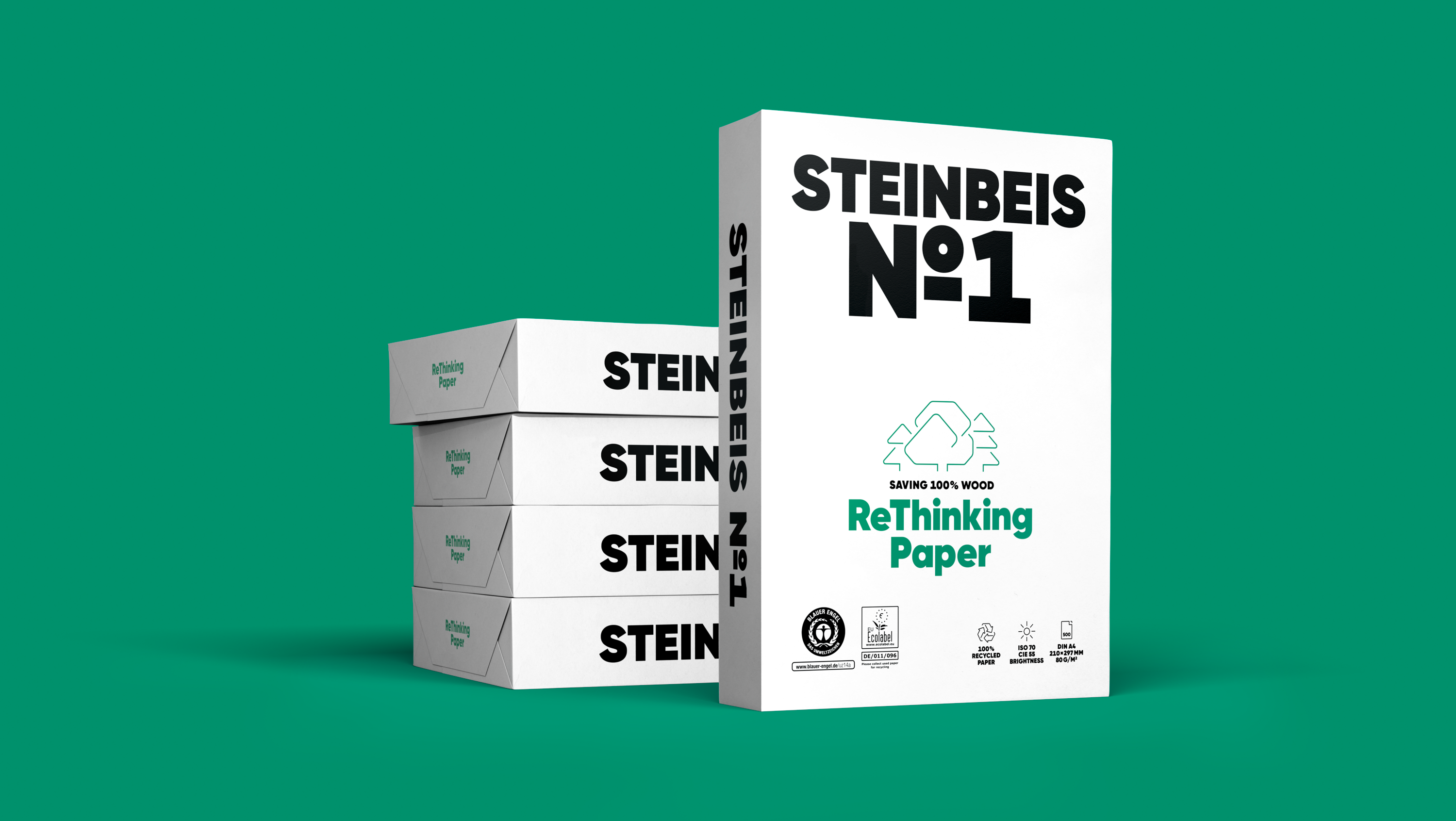
DIN A4 & Co: Why paper sizes are brilliant

DIN A4! Everyone knows straight away what that means: the paper size par excellence, found in printers, photocopiers, school exercise books, letters from government departments and everyday office life. A DIN A4 page – though not everyone realises this – is exactly 29.7 centimetres high and 21 centimetres wide. Why such an odd number? Why, on 18 August 1922, when the DIN 476 standard laid the foundations for today’s paper sizes, didn’t they simply choose 30 centimetres by 20 centimetres? The answer to this is one of the reasons why the paper sizes established back then are not merely a standard, but have, both mathematically and practically, produced a piece of everyday ingenuity.
For there is something truly magical about the principle behind it: an A-sheet can be halved – for example, by folding it – and the new size retains the same shape. A4 thus becomes A5, and A5 becomes A6. The same applies to doubling: two A5 sheets make an A4, and two A4 sheets make an A3. The A-series format is therefore a rectangle with a built-in principle of multiplication!
What’s the point of this? A great deal! Because printed paper can be transformed into new formats by folding and creasing – a kind of machine-assisted folding: a single fold turns an A4 sheet into A5, and another fold turns it into A6. This is a godsend for letters, leaflets, brochures, flyers, invitations or small booklets. A print shop, an office or a school doesn’t have to start from scratch for every product, working out which format will still fit. An A3 sheet can be folded into a four-page A4 brochure. Two A5 pages can be made from A4. Two A6 cards can be made from A5. The system takes post-press processing into account straight away.

Anyone who uses a photocopier will have experienced this: if you want to reduce an A3 page to A4, there’s no need to spend ages fiddling about. The correct setting is 71 per cent. And if you want to turn A4 back into A3, select 141 per cent. That’s why many photocopiers have dedicated buttons for precisely these scales. This way, you can reduce a single A4 sheet without suddenly ending up with wide white margins at the top or bottom, or having text cut off.
But the magic doesn’t stop at shape and area. It even extends to weight. A0 has an area of almost exactly one square metre. A1 is half a square metre, A2 a quarter, A3 an eighth and A4 a sixteenth of a square metre. And because paper is often sold by basis weight – for example, as 80-gram paper – the maths suddenly becomes clear: 80 grams per square metre divided by 16 equals 5 grams. A single sheet of A4 made from standard 80 g/m² paper therefore weighs approximately 5 grams.
This means that even the postage becomes a little DIN maths problem. In Germany, a standard letter may weigh up to 20 grams. A typical envelope weighs around 4 to 5 grams, depending on the type. That leaves around 15 grams for the contents – which is pretty much exactly three A4 pages of 80-gram paper. Three pages, three times five grams, plus the envelope: that usually comes in just under or roughly at the 20-gram limit. Of course, a letter scales is more accurate, especially with thicker envelopes, lots of printed material or heavier paper. But the principle is brilliant: you don’t need an app or a measuring device to make a surprisingly good estimate. A bit of simple maths is all it takes.

None of this would be possible if a DIN A4 page were just half a centimetre longer or shorter, wider or narrower. But this discovery had to be made first. The aim was to “find a sheet of paper on which all formats would be similar to one another”, as the German physicist Georg Christoph Lichtenberg put it in a letter to his colleague Johann Beckmann in October 1786. His solution was the ratio of 1 to the square root of 2: the short side is thus to the long side as 1 is to 1.414. Only then does halving a rectangle result in a rectangle with the same basic shape. That is why this aspect ratio is occasionally also referred to as the ‘Lichtenberg ratio’.
However, Lichtenberg’s idea did not catch on at first. It was not until some 125 years later that the mathematician, physicist and engineer Walter Porstmann revisited the principle and made it suitable for standardisation. On 18 August 1922, the DIN 476 standard ‘Paper Sizes’ was published. Initially, individual authorities such as the Wunsiedel District Office adopted the new formats; in 1923, the Deutsche Reichsbahn followed as a major user – and the breakthrough began. Later, the German standard became the international standard ISO 216; today, the A-series formats are taken for granted in almost every part of the world. A4 is perhaps one of Germany’s most successful export products – though you wouldn’t realise it, because it’s so commonplace everywhere.
And it is not just the paper itself that follows this principle. The items associated with the paper are also designed to fit it: envelopes, ring binders, filing compartments, folders, photocopiers, printers, cutters and desk drawers. An unfolded A4 sheet fits into a C4 envelope. An A4 letter folded once fits into a C5 envelope. Folded twice, it fits into a C6 envelope.
The paper standard also helps in production: when formats build logically on one another, it is easier to plan print sheets, machine widths and cutting dimensions. That does not mean, of course, that every scrap of waste automatically disappears. But it remains minimal, as everyone involved works with the same basic dimensions. The paper machine, the print shop, the office supplies department, the post office and the filing cabinet all speak the same ‘format language’, so to speak.
As mentioned above, this applies almost worldwide – but only almost: in the USA and Canada, a different standard format is still widely used today: ‘Letter’. It is slightly wider and shorter than A4. You often only realise just how big the difference is when you try to print an American PDF on a European printer: suddenly, something gets cut off at the bottom or strange white margins appear.
Of course, everyday paper use there is also geared towards this format. Yet the special magic of the A-series is missing: the ability to halve, double, reduce and enlarge the size whilst maintaining the same basic shape. Viewed from this perspective, the ideal format is, after all, DIN A4 – and its variants.
Cover image: Generated with “firefly”
Author

Christian Heinrich holds a PhD in medicine and trained as a journalist at the German School of Journalism in Munich. He has been working as a freelance journalist and writer since 2010. Christian Heinrich writes for DIE ZEIT, the Süddeutsche Zeitung, SPIEGEL, GEO and other publications. He is a member of the editorial office nerdpol, a collective of science journalists.