Between blog and notepad: How different generations use paper
Calendars, shopping lists and meeting notes are moving onto smartphones, into apps and into the cloud. Yet desks are still often littered with notebooks and Post-it notes, calendars hang on the wall and shopping lists are tucked away in trouser pockets, just as they always have been. Why is that, actually? A look at how different generations use paper in their daily lives shows that paper isn’t going away. But when and how we use it is changing.

There is a small notepad on Katrin’s bedside table. Not out of nostalgia, nor because the 60-year-old doesn’t know how to use digital devices, but because her bedroom has a fairly strict rule: digital devices are kept out.
So if something pops into her head at night, she reaches for a pen and paper and jots down her thoughts. She doesn’t keep her diary exclusively on a digital device either. One hangs on the wall – which is handy, as she can see it as she walks past. What’s more, it’s beautifully designed. And when she goes shopping? There’s a small folded piece of paper in her bag: “I don’t like walking round the shop with my mobile, and I don’t like having my mobile with me all the time, everywhere,” she says.
Someone using a piece of paper as a reminder: a few decades ago, that wouldn’t have been worth mentioning. Shopping lists, diaries and notepads were, of course, made of paper. Today, using them has often become a conscious choice – for or against the smartphone, for or against an app.
The fact that our relationship with paper has changed is particularly evident when it comes to reading. A study on the reading and media habits of Generations X, Y and Z identified clear differences as early as 2018: Whilst Generation X mainly used paper books and magazines as well as e-books, the younger Generations Y and Z preferred blogs and social media. So there really are generations between blogs and notepads – at least at first glance. Because if you look more closely, the picture is no longer quite so clear-cut.
Paper is no longer something we take for granted
Everyday life has become more digital. This is evident from the people who spoke about their use of paper for this article. Catrin, 45, now keeps her diaries and to-do lists digitally. In meetings, however, she still sometimes jots down notes on paper, and traditional shopping lists remain part of her daily routine. Overall, though, she says she “definitely uses far less paper than I used to”.
She cites practical reasons above all: digital notes aren’t so easily lost and can still be found years later. At the same time, she no longer needs to buy extra paper for many purposes.
That sounds sustainable. However, there is no one-size-fits-all answer as to whether paper or digital solutions are the more sustainable choice. Digital communication and data storage also require energy and technical infrastructure; on top of that, there are the resources needed to manufacture and dispose of the necessary devices. Paper production, in turn, consumes energy, raw materials and water. Both options therefore have environmental impacts – the key is to use the appropriate medium in a conscious manner.
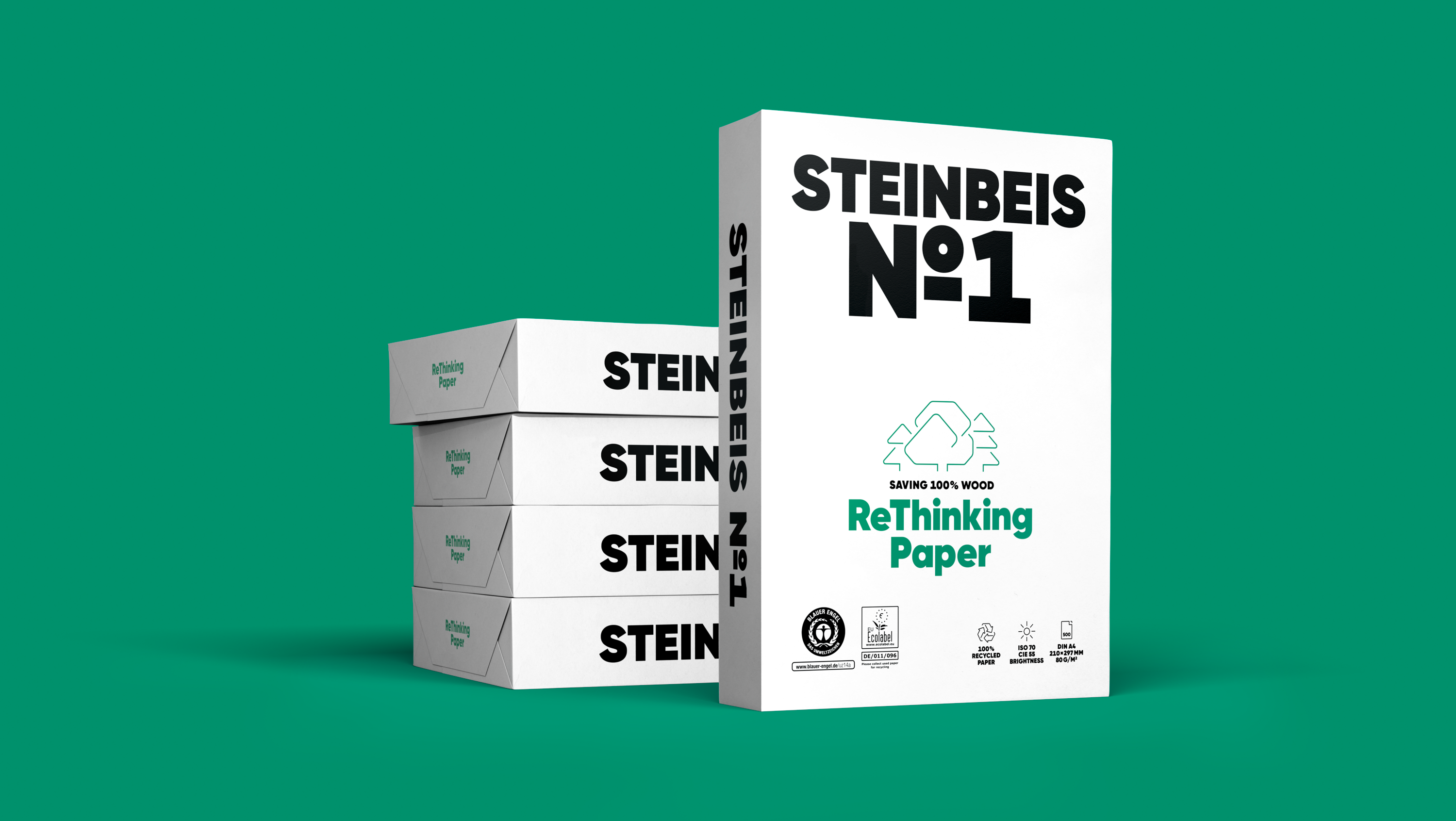
Where paper continues to be used, the choice of paper plays an important role. Recycled paper made from 100 per cent waste paper conserves resources compared to virgin fibre paper:according to the Federal Environment Agency, its production requires on average 78 per cent less water and 68 per cent less energy, and results in 15 per cent fewer CO₂ emissions. The Blue Angel label, for example, can provide guidance on the sustainable purchase of paper. Its certification criteria stipulate that certain recycled paper products must be made from 100 per cent waste paper.
For Andreas, paper tends to end up on the table particularly when it’s not yet clear what will ultimately be written on it: “I always use paper when I don’t yet know where it will take me,” says the 38-year-old. In workshops, whilst studying, or when developing ideas – whenever thoughts take the form of text, a drawing or a sketch, paper remains invaluable to him.
His digital setup is now so good that it has replaced his former analogue notebook in many areas. Voice memos, apps and digital documents open up possibilities for him that paper does not offer. And yet, for certain thought processes, he still reaches for a pen: “I think more deeply and am more creative when I’m working on paper or have a physical object in front of me.”
In saying this, Andreas describes a sensation that has also caught the attention of the scientific community. An EEG study published in 2024 by the Norwegian University of Science and Technology examined the brain activity of 36 students whilst writing by hand with a digital pen on a touchscreen and whilst typing. When writing by hand, more complex connectivity patterns were observed between different brain regions.
The medium also appears to play a role in reading. A large meta-analysis from 2018, which evaluated 54 studies involving a total of more than 170,000 participants, found a small but significant advantage in text comprehension when texts were read on paper rather than on digital devices. The advantage was particularly pronounced with informational texts and under time pressure.
Paper is therefore not inherently the ‘better’ medium. However, there are situations in which its specific characteristics make a difference. These include its independence from digital infrastructure: where electricity, networks or IT systems fail, information on paper remains accessible. This can be relevant, for example, in the event of technical faults or cyber-attacks.
Whether it’s thinking, reading or the availability of information: paper has properties that can be advantageous in certain situations. When we turn to it therefore depends less on whether it is fundamentally ‘better’ or ‘worse’ than on the specific purpose – regardless of which generation we belong to.
Paper for now, digital for later?
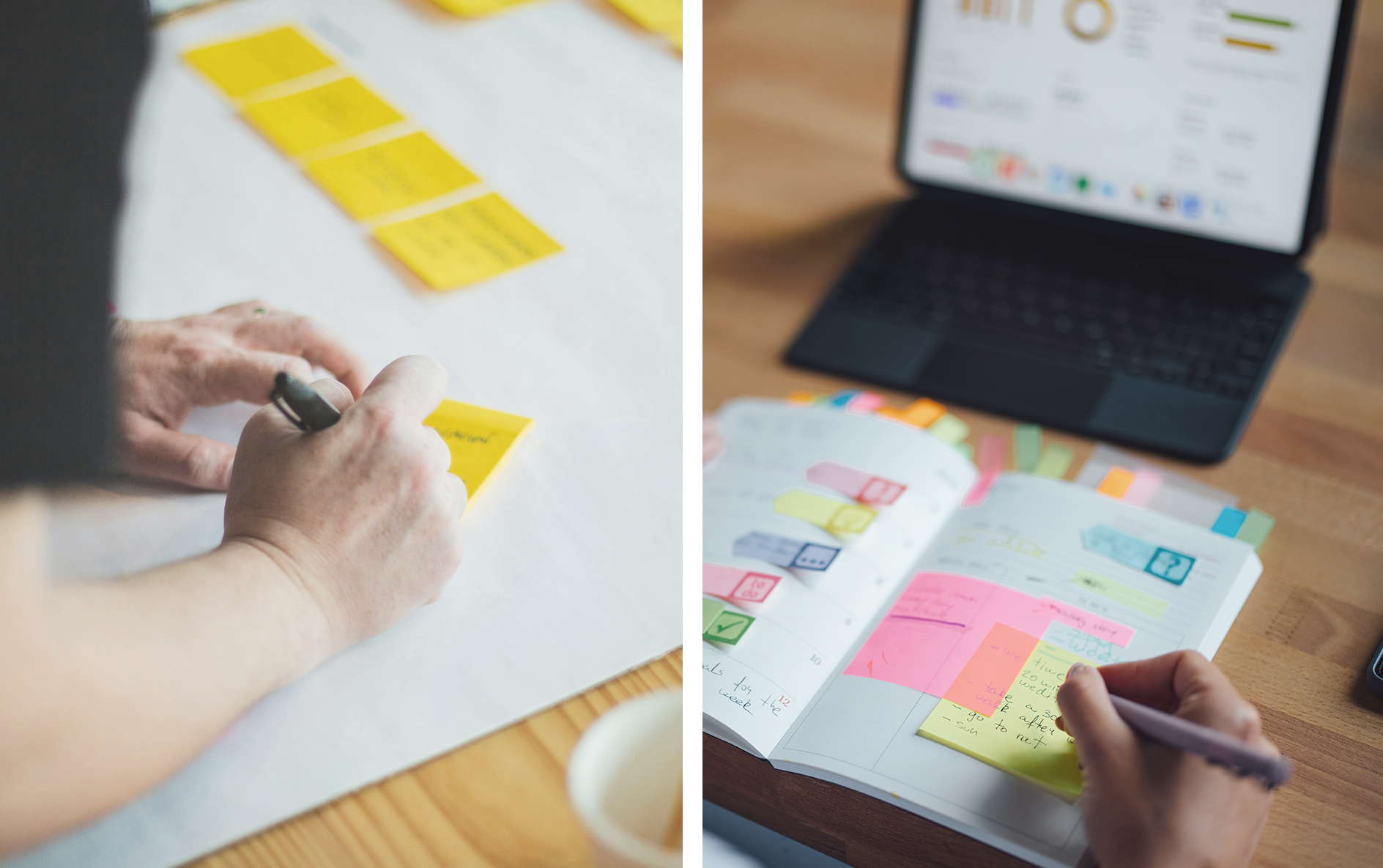
One of the potential qualities of paper is, of all things, something that initially sounds like a disadvantage: paper is allowed to be ephemeral. Andreas, for example, regularly uses Post-it notes. He can write on them, stick them up, move them around, rearrange them – and eventually throw them away. “In this case, what’s actually a downside – namely, throwing them away – is in fact an advantage.” Catrin, too, deliberately writes some meeting notes on paper because she can then dispose of them. However, anything she wants to keep permanently and be able to find again later, she prefers to record digitally.
This creates two distinct worlds of information: anything intended to be stored permanently, searched for and retrieved is best kept digitally. Paper, on the other hand, can be particularly useful precisely when something is temporary. A first thought. A quick sketch. Three items that still need to go in the shopping trolley. A Post-it note whose purpose is served the moment it is removed from the wall.
At the same time, physical durability is one of paper’s strengths, protecting what is worth keeping. A document or publication remains intact as a physical object, independent of software or digital platforms.
And even if paper is indeed intended only for the moment, its disposal does not necessarily mean the end of the material’s useful life. If paper is disposed of and recycled correctly, its fibres can serve once again as raw material for paper production. According to the Federal Environment Agency, the proportion of recycled paper in paper production in Germany stood at around 84 per cent in 2024.
Grown up in the digital age, yet still not paperless
Paper is thus evolving from a universal medium for information into a specialist one. But is its use really a generational issue – or is it not rather a question of personal preference and practicality in everyday life?
For 23-year-old Max, the trend is quite clear. The architecture student explains that whilst at school, he still worked with paper every day. Even at the start of his degree, he produced many sketches by hand; in some cases, hand-drawn sketches were even compulsory. Nowadays, he works predominantly digitally. However, he still uses paper for quick sketches; some models are made from cardboard; and for presentations, the digitally created results are printed onto large posters.
For Aenne, 20, things are different. She, too, organises a lot digitally: she keeps her calendar on her smartphone and often saves lists there as well, because she doesn’t carry a pen and paper with her when she’s out and about anyway. “It would be yet another thing to have to carry around.”
And yet she still likes to write her shopping and to-do lists on paper. She finds it clearer when she’s out shopping. Above all, however, the digital version can’t compete when it comes to one crucial detail: “Crossing tasks off the to-do list is simply a satisfying feeling. I don’t get that feeling with my mobile notes.”
Aenne is clearly not alone in this. A recent consumer survey shows that paper has by no means disappeared from the everyday lives of younger people. In a representative survey of 2,000 people in Germany commissioned in 2025 by the industry association DIE PAPIERINDUSTRIE, 79.2 per cent stated that they prefer to jot down their thoughts and notes by hand. Even amongst 18–24-year-olds, the figure was still around 70 per cent.
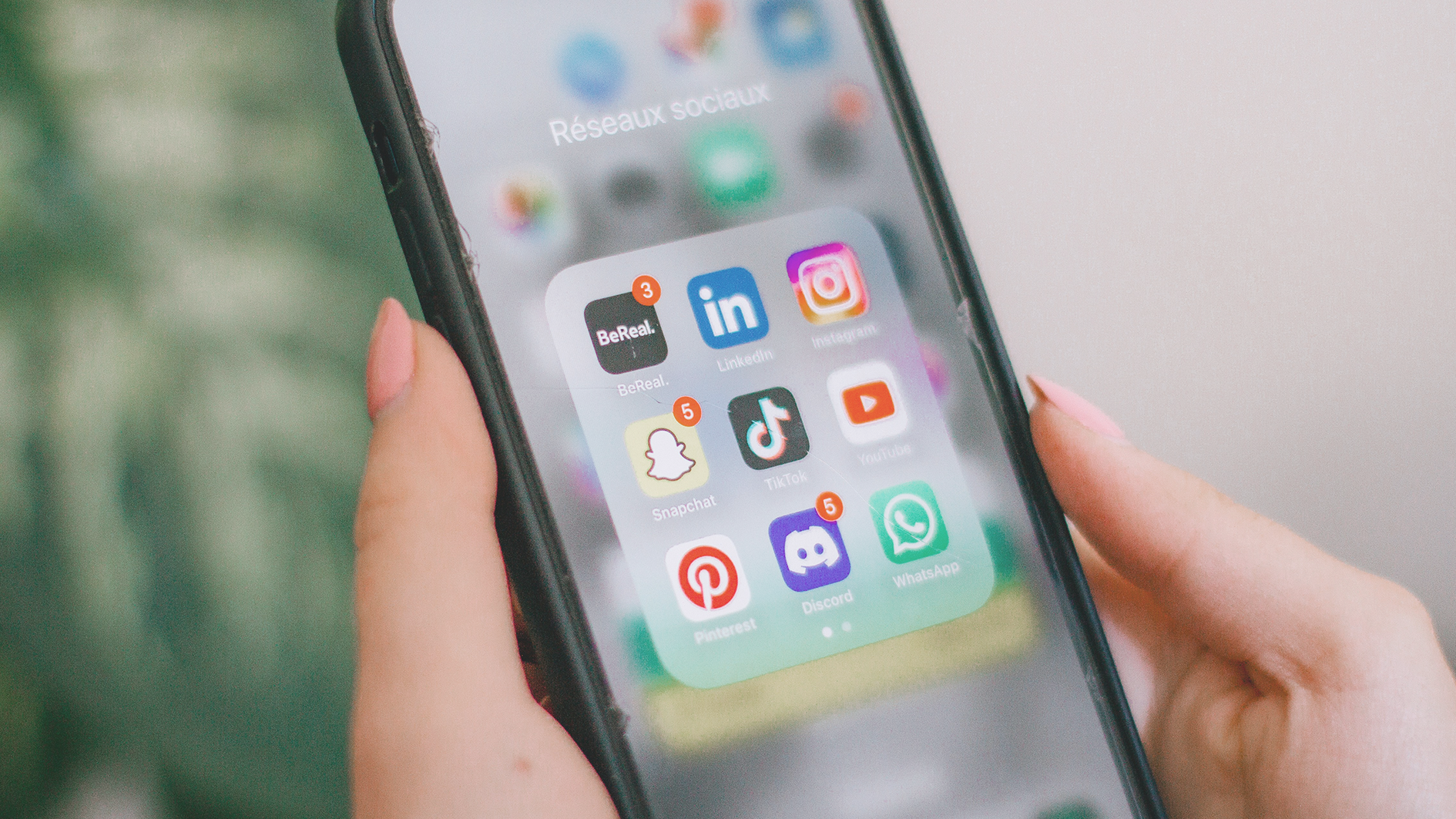
But for Aenne, it’s not always just about practicality. Even for something else that has long since gone digital, the 20-year-old deliberately reaches for paper: she writes postcards. “Even though I message people every day on WhatsApp, I still find writing postcards rather lovely.”
This is down to another quality that digital communication struggles to replace: paper is not just a medium for information, but also a physical object. Sophisticated design, high-quality paper and a pleasant feel encourage us to keep a card, a book or an elaborately produced print – even long after the actual information has been read.
20 or 60: In the end, it’s the purpose that counts
The fact that paper is still around is clearly less a question of age than of the specific occasion. Despite a 40-year age gap, Katrin and Aenne are united by the classic paper shopping list. And in other respects, too, the boundaries between the generations are less clear-cut than one might assume. On the one hand, Katrin and Andreas, both Gen Y, have digitised large parts of their organisation. Max, a Gen Z, also works in a much more digital way in his studies today than he did at school.
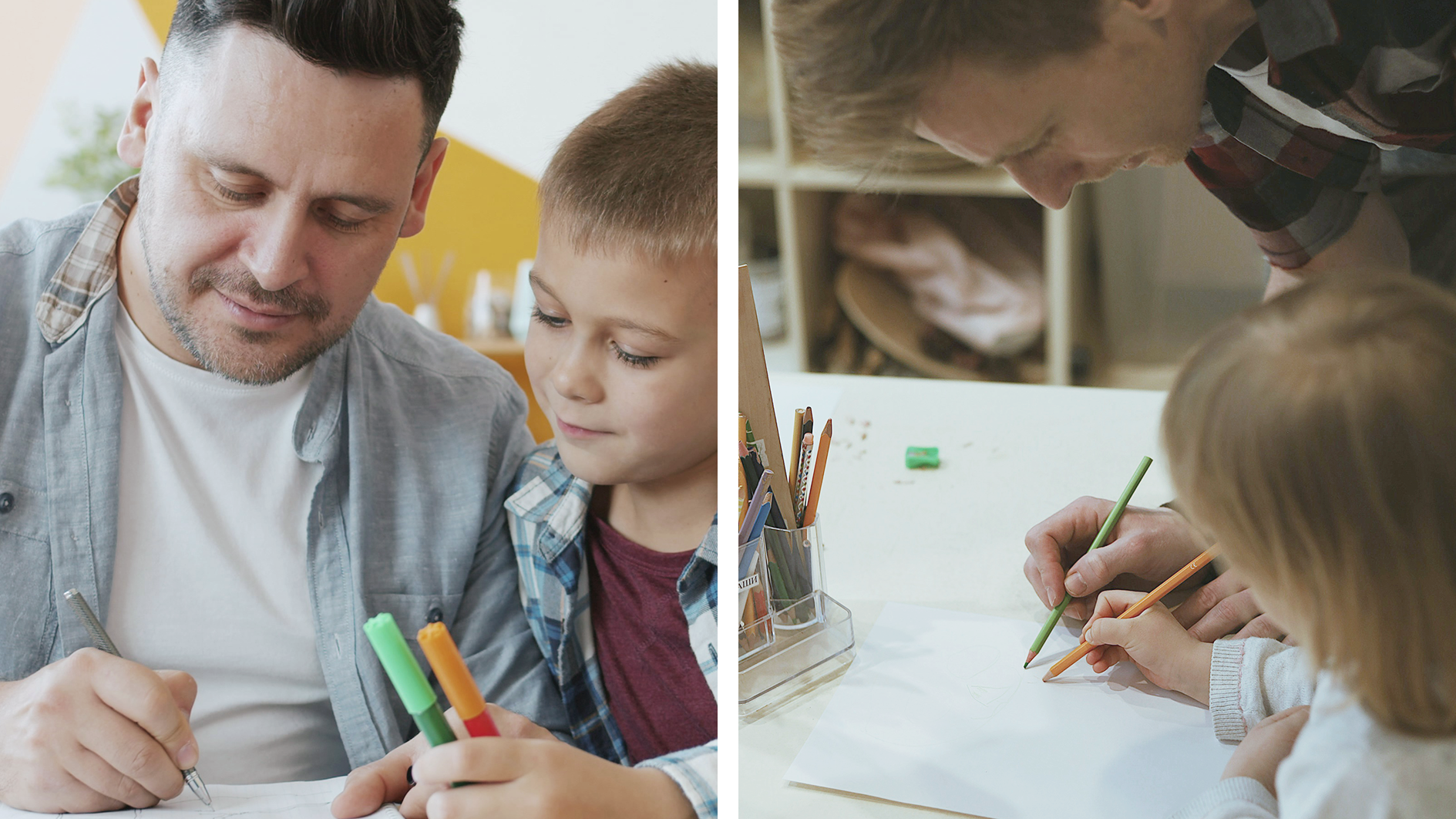
On the other hand, paper seems to play a particularly enduring role in creative activities. Sixty-year-old Katrin is actually using more of it again at the moment because she paints, does crafts and draws. Catrin, aged 45, also turns to paper when painting and drawing with her daughter. And four-year-old Kira, too, answers the question of what she likes to use paper for without a moment’s hesitation: “For painting. And for making things.”
Paper is here to stay – just in a different form
Whereas in the past a sheet of paper, form, calendar or note was needed for almost every piece of information, today we have a choice. Smartphones and laptops can handle many tasks more quickly, are easier to search through and take up less space.
This has changed the role of paper. What was, in past decades, a medium for which there was virtually no alternative, is now used as a result of a decision that is often a conscious choice. Paper is the medium of choice for a quick sketch that can be freely added to. For the ticked-off to-do list that leaves you feeling: ‘I’ve really got a lot done today.’ For the postcard that’s special precisely because it contrasts with a quick WhatsApp message. Or for the sheet of paper on which we paint, draw and do crafts.
The choice between a blog and a notebook is therefore less a question of generation and more a matter of what we’re actually planning to do at any given moment. When it comes to the relationship between paper and digital media, it’s not a case of ‘either/or’, but rather ‘both/and’ – choosing the right medium for the moment.
Cover image: istockphoto-2189540575
Author
Luisa Häußer has a degree in communication studies and has been working as a freelance copywriter and communications strategist in Hamburg since 2018. Her work focuses on projects relating to social and environmental sustainability, as well as interpersonal communication. Alongside her strategic work, she volunteers to promote equality and address future-oriented digital issues.