Home game for marine conservation
How can a top handball club like THW Kiel use its charisma to promote sustainable engagement in the region? In this interview, Stefanie Klaunig, Head of Marketing at THW Kiel, provides insights into the För de Küsteproject - an initiative for environmental education, marine conservation and social cohesion. Schools, fans and partner companies are actively involved in taking joint responsibility for the North and Baltic Seas. The focus is not only on education, but also on concrete action skills. A conversation about attitude, regional effectiveness and the power of sport.
What exactly is behind the För de Küste project?
För de Küste is our coastal and marine conservation project. In concrete terms, this means that we organise beach clean-ups, launch awareness campaigns, involve partners and use match days to raise awareness for the protection of the Baltic Sea and our coastal region. It's not about a complete sustainability strategy, but rather a focused project that emphasises our social responsibility as an association. We officially started in August 2022, but planning began a year earlier. The idea was: as a strong regional club, we don't just want to show responsibility on the pitch, but also off it, especially in the area of sustainability.
Was there a specific trigger for this?
We had already done a lot in the social sphere, and thinking in terms of economic sustainability is important as a club anyway. But the topic of ecological sustainability was still missing. So we asked ourselves: what suits us, what can we really do well? The Baltic Sea is practically on our doorstep. Our arena is less than 400 metres from the water. So it simply made sense to focus on coastal and marine conservation. Of course, strategy also plays a role. The league is now demanding more commitment to sustainability from clubs, and many sponsors are paying close attention to whether the club's values match their own. But for us, it wasn't just about a nice green label. We wanted to create something that is honest and has an impact on the ground.
To what extent did THW Kiel orientate itself on existing initiatives?
We naturally looked at what was already happening in football, for example. But there wasn't a format like this in handball yet. It was important for us to start small, without the big sustainability circus. We didn't want to spend two years writing concepts, but rather get started, try things out and develop them further. That's why we deliberately called it a project and not a strategy. We were supported by a marketing agency that we have been working with for a long time. And because we weren't the absolute experts when it came to coastal protection, we brought three strong partners on board. First of all, we held one-to-one discussions to find out whether a collaboration was conceivable and then brought them together.
Was there a key moment in the initialisation of the project?
Our managing director sat down with the press spokesperson from the State Agency for Coastal Protection (LKN.SH) and something clicked. The idea was that we had the reach and could publicise topics such as coastal protection and sustainability in a positive way. This resulted in a joint mission statement. We took a look: Which of the 17 UN Sustainable Development Goals (SDGs) fit the organisation and which fit our project? We defined these and derived specific measures from them.
With För de Küste, we want to bring together people and companies who want to protect and help shape our homeland.

What does THW Kiel want to achieve with the project in the long term?
The long-term aim is to significantly reduce the club's ecological footprint. Starting with the office, through match days to away trips. These are all areas where we can do a lot better and reduce emissions. At the same time, the project aims to raise awareness, both within the club and externally. Because it's clear that a club like THW Kiel has charisma. Fans identify with their players. When they get involved in such issues, it simply has a different effect than when someone brings it up privately with friends.
So the idea is not just to start with yourself, but also to take others with you.
The aim is to be a pioneer to some extent. Especially because many people look at THW Kiel in terms of sport, but also beyond that. Of course, other clubs are also doing a lot in this area. But with the För de Küste platform, which specifically brings together science, business and sport, we are taking a slightly different approach. We are not interested in comparison, but in taking responsibility and making the topic our own brand. In the best-case scenario, people will say at some point: Oh yes, that's THW Kiel's sustainability project, I've heard that before.
But why exactly coastal and marine protection?
Climate protection was the big issue right from the start. When it came to the question of what is really concrete and regionally relevant, it quickly became clear: sea levels are rising, storm surges are increasing, which directly affects us here on the coast. When it comes to the Baltic Sea, many people may still think: "Oh, nothing will happen here". But that's not true. The changes are tangible. And that's exactly where the project comes in. What's more, the association is firmly anchored in the region. Kiel is home, as is the Baltic Sea. So it's only logical to stand up for the things that shape our own identity. As a sports club, you not only take on responsibility on the pitch, but also socially. And if you're also able to get people excited about an issue like this, then you've already achieved a lot.

Taking a closer look at the project - what has actually happened so far at För de Küste?
A lot has really come together in the meantime. We've already done three beach clean-ups. For one of them, we even travelled with the LKN.SH to survey the steep banks. It was exciting to get a look behind the scenes and experience live how ghost nets and other rubbish are removed from the water. And then there were smaller activities, for example with school classes. Our mascot Hein Daddel, who always goes down well with the kids, was there too. We then talked about marine conservation in a playful way for a whole morning. These are great formats because they are up close and personal and you realise: it sticks.

And on the match days themselves?
We have now organised three major themed play days. We then open the doors to our partners from the network. They then set up stands and present their topics - just like a small trade fair in the arena. Sometimes there are also lectures or workshops. For example, the LKN.SH was there the second time and provided information about coastal protection in the adjoining room. This year, we have added an educational element to the experience for our run-in children. In cooperation with a non-profit organisation, a three-hour workshop on recycling was held in the arena before the match. The children were not only able to prepare for their big performance, but also take something away with them in terms of content.
How is För de Küste still visible?
The first two years we had special jerseys made. It's noticeable when THW doesn't wear white, but blue, and everyone asks: What's going on? And then we just tell them. This year there were warm-up shirts that were auctioned off afterwards. Or we organise raffles. This not only raises awareness, but also money, which we use specifically for marine conservation projects. We have already raised more than 30,000 euros in total. We usually pass this on to NGOs. We see ourselves more as a platform than a project organiser.

And how does that go down with people?
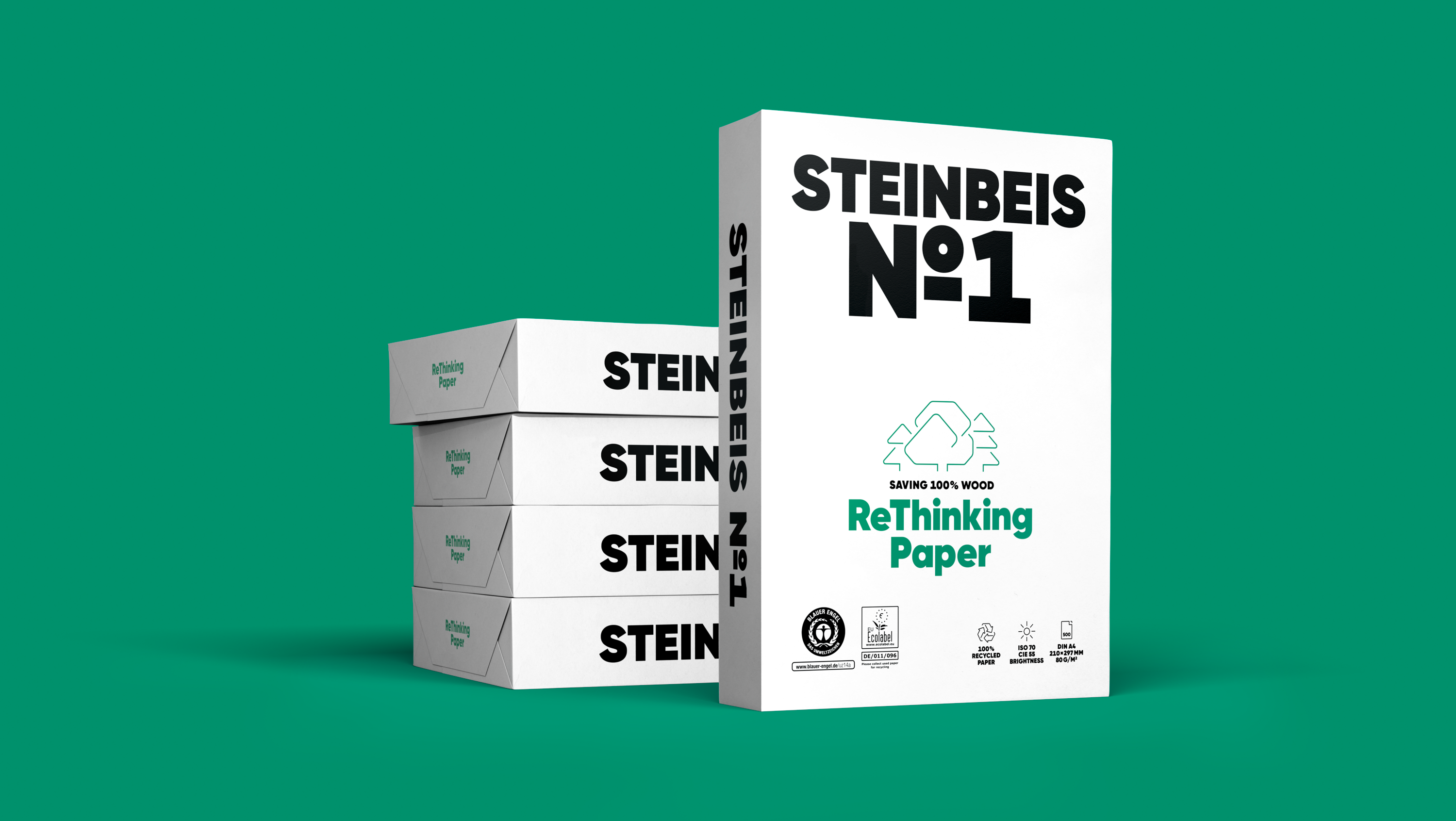
I think the match days in particular have great appeal. The campaigns attract attention and the feedback is positive. And what I particularly remember: at the first beach clean-up, we stood on the beach with 15 people in the freezing cold. I was a little disappointed at first because half of them were my own people. But the next time there were 150, and suddenly youth teams came with their coaches. And the third time, we still had 80 to 100 people there, which is a lot for a campaign like this. The fans can also get involved in a very concrete way, take part in the raffle, think about the booklet or the clapping cardboard: Do I take this with me or just throw it away? In cooperation with Steinbeis Papier, we have now set up special bins in the arena where exactly this can be collected and returned to the waste paper - for example to Steinbeis, who will use it to make new paper.
To what extent is sustainability already part of the club's DNA?
Of course, we are first and foremost a handball club. For us, it's all about the sport and match days. But the topic of sustainability has now become much more important. It's no longer a small marketing campaign, but an integral part of the overall strategy. Of course, such a process takes time. You have to keep pushing internally, keep at it and question things. Even with employees or players. But that's exactly what's happening now. There are questions, including from the team: "Does this new sponsor actually fit in with our sustainability concept?" And then you realise: Okay, there's a change in thinking.
The collaboration with Steinbeis Papier not only provides recycling expertise, but also enables concrete measures with a real impact.
How are project partners selected for För de Küste - and what makes the collaboration with Steinbeis Papier particularly valuable?
Sustainability thrives on cooperation. This is also demonstrated by the cooperation between THW Kiel and Steinbeis Papier. This specific partner not only brings recycling expertise to the table, but also facilitates very specific measures: from branded collection bins in the arena and the recycling management of the hall booklet to film projects on the video cube in the arena that sensitise fans to the added value of recycling. The selection of partners also follows a clear principle. The content and spirit must fit. It quickly becomes clear that THW Kiel and Steinbeis Papier are on the same wavelength here. Both are united by the will to take responsibility and at the same time a certain looseness in the realisation. It's not just about sponsorship, but about impact.
What's next for För de Küste?
After we were able to attract many strong partners at the beginning, the main focus now is on motivating new supporters and keeping the existing ones on board for the long term. We are also planning smaller events, such as one beach clean-up per season or themed match days in the arena. We also want to promote personal exchange, for example at partner events such as the one at Steinbeis Papier in autumn. A real highlight is coming up in August with the Ocean Race in Kiel. För de Küste will be taking part in a side event here. At the same time, we are working intensively on internal development: at the initiative of the league, we will be introducing binding sustainability reports in future. In order to implement this in a well-founded manner, we are further expanding our collaboration with external experts. In addition to long-term partnerships, we are also focussing more on targeted project collaborations, for example with Schleswiger Werkstätten or Play Handball, an initiative that combines up-and-coming handball players in Africa with environmental education.
Where could För de Küste develop in the long term despite its limited capacities?
In the long term, we hope that För de Küste will be recognised as a flagship project beyond the borders of Kiel, as an example of how sustainability can work in practice in professional sport. Ideally, this will also inspire other clubs to set up their own platforms. It is important that the project is also secured in the long term with regard to social and political developments around the topic of sustainability. Our goal remains clear: together with committed partners, we want to make THW Kiel and its environment more sustainable step by step.
Cover picture: Sascha Klahn/THW Kiel
Author

As a senior editor, Benjamin Seibring specialises in developing content on sustainability, mobility, technology and lifestyle. An editorial traineeship at a German media group and his many years of experience in corporate publishing form the basis. With a high affinity for trend topics and innovative AI tools, he implements cross-media storytelling.