A sustainable start to the school year – done properly!
To begin with, a guess: what percentage of the exercise books sold in Germany are made from recycled paper? This is a significant factor; after all, around 200 million exercise books are sold here every year.1 Recycled paper not only conserves wood as a raw material, but also saves, on average, well over half the water and energy required for production compared with virgin fibre paper.2
Unfortunately, the proportion of exercise books made from recycled paper is just: ten per cent.3 The fact that the proportion of exercise books made from recycled paper is so low is likely also due to the fact that buying sustainable paper in everyday life seems more complicated than it actually needs to be. Notebooks, notepads and photocopying paper often feature various labels and certifications: FSC, for example, stands for ‘Forest Stewardship Council’ and refers to standards in forestry management. ‘Chlorine-free bleached’ also sounds environmentally friendly. Neither of these is wrong, and both have their advantages – but they have only a limited connection to recycled paper.
Yet it’s actually very easy to find and buy recycled paper. What matters is the first of
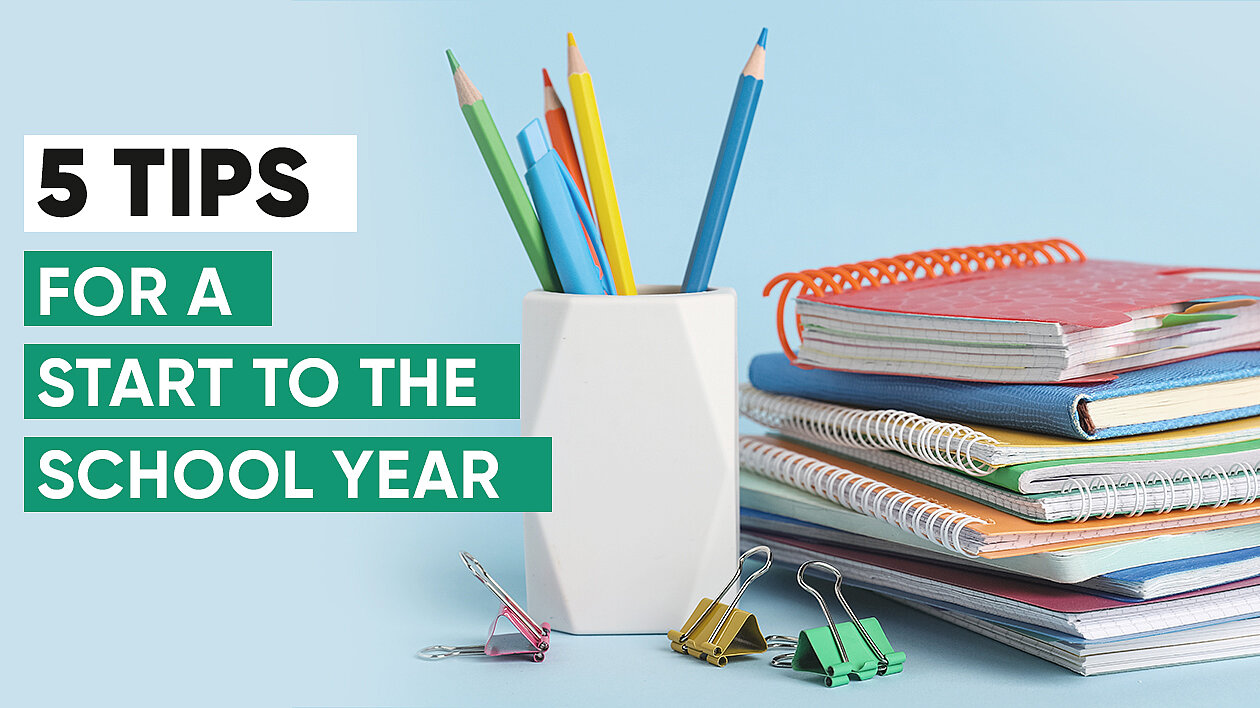
five tips we’ve put together in this blog post for all parents, children and teachers to ensure a sustainable start to the school year.
Tip 1: Look out for the Blue Angel label on all paper products
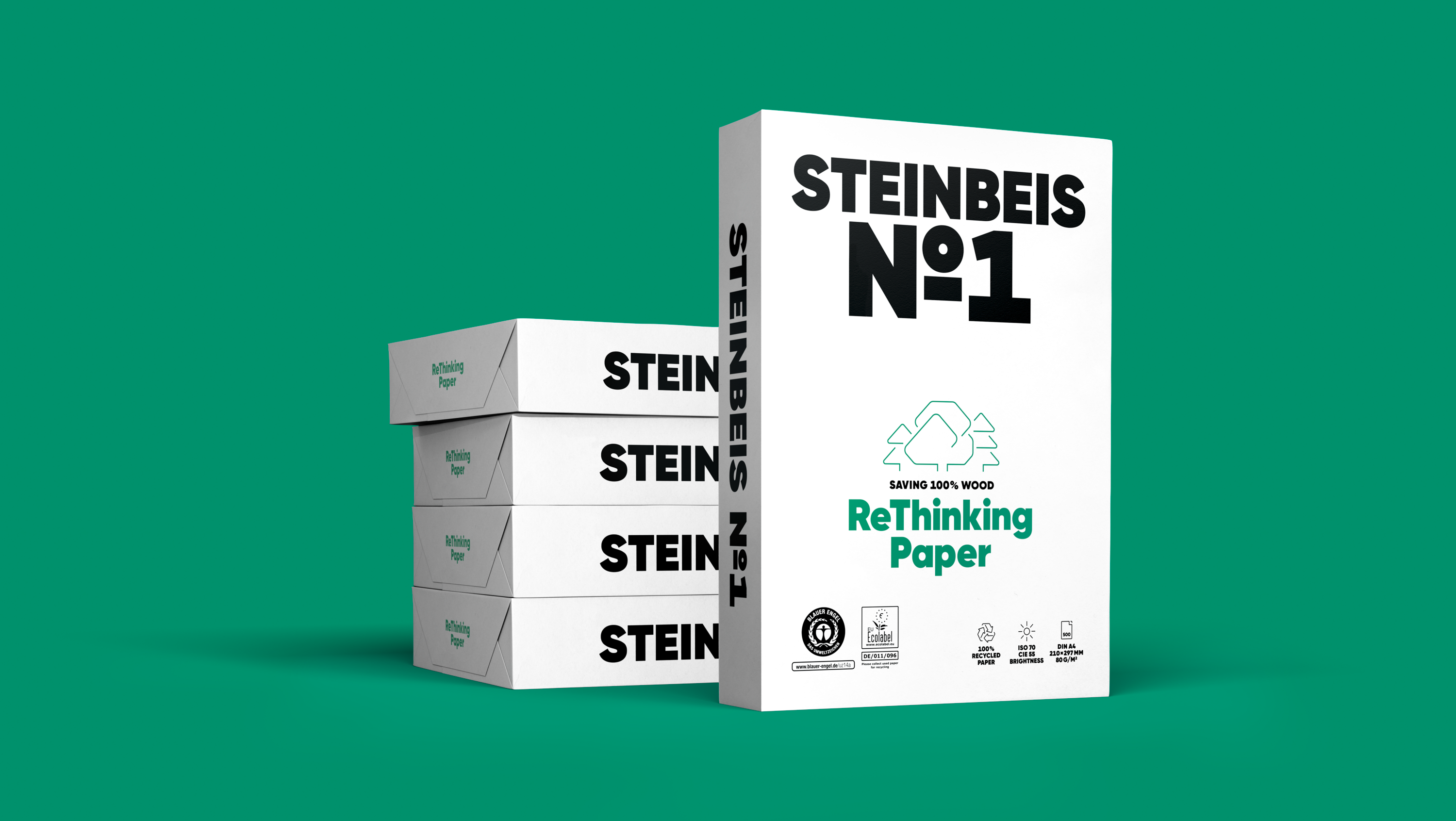
The Blue Angel is the most important guide when it comes to paper; products bearing this label are guaranteed to be made from 100 per cent recycled paper. And they are no longer grey and coarse – modern recycled papers can be light in colour, smooth and of high quality, and perform just as reliably in everyday school life as paper made from virgin fibres. Incidentally, it’s not just exercise books that offer an opportunity to switch to recycled paper. Ring binders, corner clips, collection folders, divider strips, index sheets and folders with cardboard covers can all be bought made from recycled paper instead of plastic.
Unfortunately, not all parents and children read our blog – so we’re dedicating our next tip to teachers, who can act as advocates when it comes to parents.
Tip 2: Dear teachers, please bear sustainability in mind when drawing up your resource lists
The lists of materials that you, dear teachers, send out before the start of term are
read very carefully – and are usually followed quite meticulously. Even a small addition can
make a big difference: instead of writing ‘2 DIN A4 exercise books, 25-line ruling’, it’s better to write ‘2 DIN A4 exercise books,
25-line, with the Blue Angel label”.
There’s also a lot to bear in mind when it comes to pens.
Tip 3: No ink, no disposable cartridges – what to look out for when choosing pens
Pencils and coloured pencils should be unvarnished, as varnishes may contain additional substances – and because children do, after all, sometimes put pencils in their mouths.
It’s also worth paying attention to the details when it comes to fountain pens: a sturdy fountain pen that lasts for years is more sustainable than frequently buying new ones. It’s even better for the environment if it’s filled using a converter or a tank system and ink from a glass bottle, rather than with individual disposable cartridges. The same applies to highlighters, ballpoint pens and fineliners: it’s better to choose refillable models, replacement refills or recycled options rather than single-use products that end up in the bin after a short time.
And what if you still have unused plastic ring binders left over from when you were shopping for your older child? What if relatives have given you the finest lacquered coloured pencils as a gift? And what if the godfather, at the child’s request, gives them a plastic lunchbox featuring a superhero character instead of a sustainable stainless-steel one? Please take it all and use it!
Tip 4: Don’t replace anything you already have just because there’s a more sustainable alternative
That, too, is sustainability – perhaps even the most genuine form of it: making use of things that are already there. After all, from an environmental point of view, it rarely makes sense to replace an existing product simply because a more sustainable alternative is now available. The plastic folder, the lunchbox with the superhero character or the coloured pencils have already been manufactured, bought and brought into the home. So the rule is: use them up, pass them on, repair them or use them for as long as possible – and only make a more conscious decision when the next necessary purchase comes along.
That next purchase is also the subject of the next and final tip.
Tip 5: Take stock first, then go shopping
Before you go shopping, it’s worth having a quick rummage through drawers, pencil cases, cupboards and old school bags. You’ll usually find more than you think: half-used exercise books, empty ring binders, loose sheets of paper, rulers, set squares, pencil sharpeners, pencils, coloured pencils, ink erasers, glue sticks, index cards or exercise book covers that are still perfectly usable.
Even a half-filled exercise book isn’t something to be thrown in the bin; it can still be used as a practice book, a notebook or scrap paper. The mindset should be, for example: an eraser that’s snapped in the middle isn’t broken – it’s doubled in size!
And when it’s finally time to part with school supplies – when the exercise books are full but not important enough to keep – here’s a bonus tip for the end of the value chain, which should mark a new beginning: School exercise books and paper that are no longer needed belong in the waste paper bin – only then can they be turned into new paper.
Author

Christian Heinrich holds a PhD in medicine and trained as a journalist at the German School of Journalism in Munich. He has been working as a freelance journalist and writer since 2010. Christian Heinrich writes for DIE ZEIT, the Süddeutsche Zeitung, SPIEGEL, GEO and other publications. He is a member of the editorial office nerdpol, a collective of science journalists.