Three symbols for copy paper that protects the environment, climate and resources.

04.09.2018 - Oceans full of rubbish, climate change, high resource consumption - topics that have recently caused a lot of fuss in the media. Plus a whole host of slogans about what needs to be changed and what needs to be done. The responsibility for environmental and climate protection lies not only with politics, industry and business - it lies with each individual. There are already a lot of simple, directly realisable solutions that help us to act and consume sustainably and conserve natural resources. Such as the use of printing and copying paper with the Blue Angel, EU Ecolabel and FSC environmental labels.
Continued high use of printing and copying paper
Printing and copying paper is still used in large quantities in administrations, office environments and companies. Millions of A4 and A3 copy papers run through high-tech printing systems every year. As invoices, customer letters, contracts, mailings, presentation templates, handouts and much more. Behind the paper products are two industries with completely different production and raw material concepts. One is the traditional, virgin fibre-based paper industry. The other is the recycled paper industry based on secondary raw materials. Fresh fibre products (high proportion of wood as a raw material) still account for the lion's share of the market. The market share of recycled paper made from 100% waste paper is growing steadily. For most paper users, the quality and performance characteristics of the products are the deciding factors when making a purchase. In terms of whiteness, running reliability, look and feel, recycled papers have made up for the lead of virgin fibre products. Printer papers from sustainable production are in demand, especially those with the Blue Angel.
The Blue Angel - the German government's environmental label since 1978
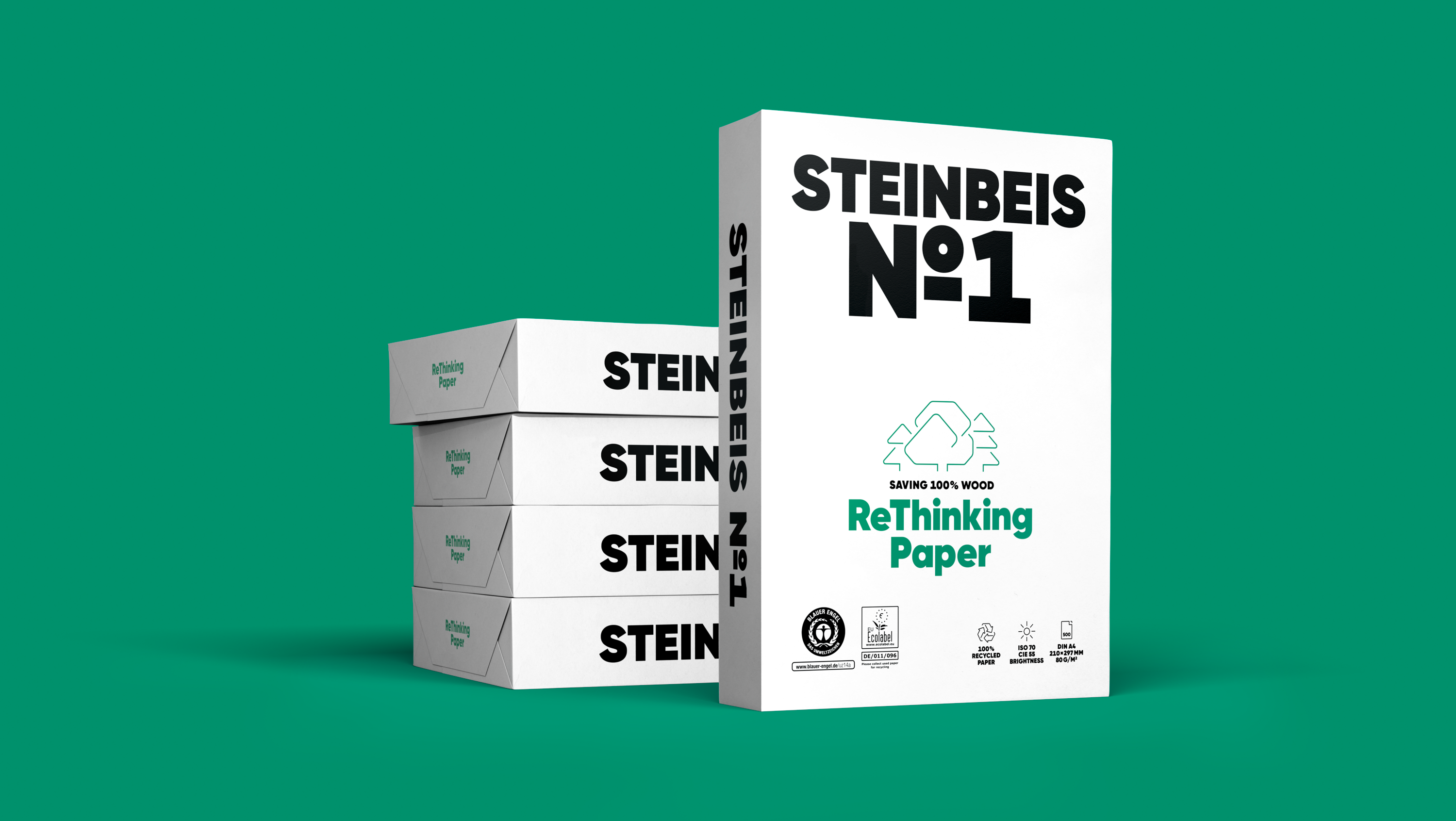
The Blue Angel is the label for consumer protection. The RAL German Institute for Quality Assurance and Labelling explains: "The Blue Angel guarantees that products and services meet highstandards in terms of environmental, health and usage properties. The entire life cycle must always be considered in the assessment." Before a printing and copying paper is awarded the Blue Angel, it must fulfil all of the strict criteria: Guaranteed production from 100% recycled paper, no use of chlorine or halogenated bleaching agents, clear limitation and exclusion of certain chemicals in paper production. All auxiliary materials must be authorised in accordance with the XXXVI Recommendation (Food and Commodities Act of the Federal Institute for Risk Assessment BfR). The use of recycled paper with the Blue Angel is a contribution to sustainability and resource conservation.
The EU Ecolabel - the environmental label of the European Union
The EU Ecolabel identifies products and services that have a lower environmental impact than comparable products. "The EU Ecolabel is intended to enable consumers to identify more environmentally friendly and healthier products and services." with regard to paper, the criteria focus on the chemicals used, energy consumption, water and air emissions and waste management. The raw material can be either virgin fibre or waste paper. The use of chlorine is also prohibited here, although the use of halogenated bleaching agents is permitted. There is a clear limitation and exclusion of certain chemicals in paper production. The criteria are largely identical to the Nordic Ecolabel and the EU Ecolabel is increasingly replacing this environmental label.
FSC (Forest Stewardship Council) - the eco-label of the forestry industry
The FSC is an organisation that has established a system for certifying responsible forest management. "The FSC was founded to promote ecologically appropriate, socially beneficial, economically viable management of the world's forests, thus ensuring that the needs of the present generation can be met without compromising the needs of future generations. " The FSC logo may only be used for products that consist of known or certified fibre raw materials and have been procured via a certified supplier - starting with the forests, through production, further processing and trade (chain of custody). This means that the FSC assumes the control function from the cultivation of the raw material to the further processing of the manufactured paper. The fibre raw material comes from 100% controlled or certified sources/forestry. In the context of paper, the fibre raw material can consist of highly pulped cellulose (hence the term wood-free), but also less highly pulped cellulose (hence the term wood-containing) or recycled fibres. The FSC provides different labels depending on the material used: FSC, FSC Mix, FSC Recycled. The FSC Guide makes no statements on the use of chlorine and halogenated bleaching agents or on the limitation and exclusion of certain chemicals in production.
Three environmental labels, three different approaches to doing something good for the environment and resources
There are different positions when it comes to the question and discussion about the "true" sustainable paper. But the common denominator is the decisive factor: Companies are fully committed to sustainable industrial and procurement practices. This enables consumers to play an important role in promoting greater sustainability, responsibility and environmental protection.
Cover picture: Corinne Kutz on Unsplash
Author
Responsible for marketing, social media and e-business at Steinbeis Papier. Circular economy, recycling and biodiversity are the topics close to the heart of the graduate business economist. Enthusiastic blogger for the Steinbeis editorial team.