The renewable office

03.09.2019 - Resources are becoming scarcer and sustainability is also playing an increasingly important role in the office. In our Green Office series, we show you how you can make your everyday office life more sustainable with just a few tricks. Small changes can have a big impact. This is not only good for the ecological balance sheet, but can even reduce your operating costs.
Sustainability on thedesk
Anyone who values sustainability when it comes to office supplies can now find numerous alternative products that conserve resources and save energy. This applies above all to the material from which they are made. Quality seals such as "FSC" or "Blue Angel" provide general guidance when shopping. But what is really sustainable when it comes to pens, paper, printer cartridges and monitors?
Office supplies in the plastic age
Since the breakthrough to mass production, plastic has become an integral part of our everyday lives - especially in the office. From monitor housings, printers and telephones to the chairs we sit on and the pens we write with. With littered beaches and plastic bags at depths of 10,000 metres, we can now see quite clearly the damage plastic waste is doing to our planet. Added to this are the enormous quantities of greenhouse gases that are released into our environment from production to disposal. In 2019 alone, this amounted to an estimated 850 million tonnes - a figure comparable to the emissions of 136 coal-fired power plants in the same period (Plastic & Climate: The Hidden Costs of a Plastic Planet).
On closer inspection, the German recycling rate also proves to be a sham: at 46 per cent, it is above the EU average, but the rate includes the proportion that is shipped abroad. We have no influence whatsoever on the environmental standards under which the waste is processed there. And: this does not solve the plastic problem at all, but only shifts it. Out of sight, out of mind.

Not all plastics are the same
Those who want to escape this cycle are looking for alternatives to conventional plastic. There is now a whole range of alternative plastics on the market that are touted as sustainable alternatives. These are made entirely or partially from biomass. Instead of fossil resources, they are made from corn or potato starch, cane and beet sugar, vegetable oils, cellulose or agricultural waste. How high the proportion of renewable raw materials must be for them to be labelled as biobased products is not regulated by law, however. Their names sound just as cryptic as those of the established plastics: polylactides (PLA), bio-based polyethylene (PET), bio-based polypropylene (BioPP) and bio-based polyethylene terephalate (BioPET). In addition to bio-based plastics, there are also biodegradable plastics. However, it is not the composition of the plastic that determines whether it is biodegradable, but its chemical structure. Just because something is biobased does not necessarily mean that it is biodegradable. And just because something is biodegradable does not necessarily mean it is biobased. Biodegradable plastics can also be made partly from fossil, and therefore unsustainable, resources.
Is bioplastics the solution?
To meet demand, around 8 per cent of global oil production is used to manufacture conventional plastic. This figure could rise to 20 per cent by 2050 (Plastic Waste Statistics 2016). Nevertheless, the new plastic alternatives are not necessarily considered a sustainable alternative by the Federal Environment Agency. A comparison of the life cycle assessment shows that the production of bio-based plastic also has a negative impact on the environment: although there are fewer CO2 emissions, there is more acidification and eutrophication potential. The conclusion is similar for biodegradable plastic: Bio-plastics, for example, are sometimes not identified as such by the machines in the waste separation plant and are therefore disposed of in the residual waste like conventional plastics. There is also concern that misinformation could lead to overly careless handling of the supposedly sustainable plastic. After all, regardless of whether it is conventional plastic, bio-based or biodegradable: reusable is always better than disposable, because the best waste is no waste.
The following therefore applies to the procurement of everything from monitors to highlighters:
Buy plastic products consciously, handle them carefully and only buy them again if there is no other, truly sustainable alternative. Depending on the area of use, switch to bio-based reusable alternatives that are also biodegradable. You should also take advantage of opportunities to reuse or buy used items.
Sustainable alternatives
While some office supplies are more difficult to replace, it is easy to find plastic-free alternatives for others: pens made of wood or bamboo, chairs covered with cotton, floor coverings made of natural rubber or cork. Environmentally friendly and durable materials that are free of harmful substances are best. This conserves limited fossil resources and reduces CO2 emissions. But here too, not all that glitters is gold. Quality seals (also known as "labels" or "logos") serve as a guide. They track the development of the product from the extraction of the raw materials, through the working conditions to the actual quality.

Waste paper as a raw material
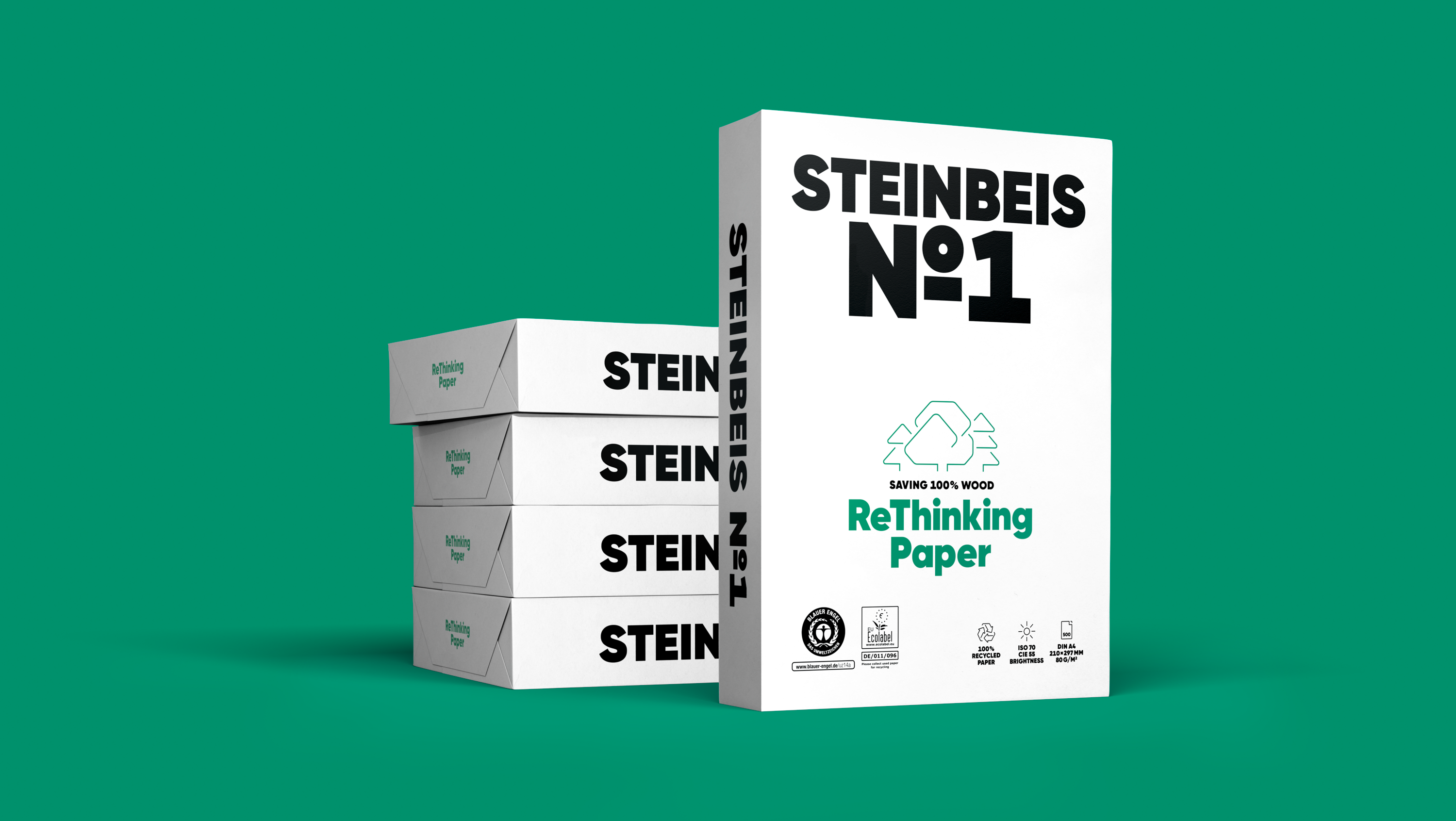
When it comes to paper, the "Blue Angel" environmental label guarantees the highest ecological standard. It guarantees that waste paper is used as a raw material instead of wood - 100 per cent.
However, the term "wood-free" is not a registered seal of quality. Although it suggests a sustainable use of resources, it does not refer to whether or not trees were felled to produce the paper, but only to the process by which paper was made from the tree. (Read more about this in our article Deceptive wood-free packaging)
Paper with the "Blue Angel" preserves natural resources and at the same time significantly reduces water and energy consumption. Here's a quick calculation: an office employee prints an average of 25 pages a day. If this employee uses recycled paper instead of paper made from virgin fibres, he or she could make around eight pots of coffee with the energy saved. That makes the staff happy! According to IPR, six sheets of recycled paper also save one litre of water. In total, around 70% water and 60% energy are saved during production compared to conventional fresh fibre paper. What's more, one tonne of recycled paper saves the amount of CO2 that an average car emits over a distance of around 1,000 km compared to virgin fibre paper made from cellulose.
Responsible consumption taken a step further
The choice of ecological materials is only one component in the procurement of sustainable office supplies. Depending on the product group, other aspects can also be taken into account:
- For a long time, conventional adhesives contained organic solvents that irritate the mucous membranes, fog the senses and can damage the internal organs. Many manufacturers have now reacted and offer solvent-free adhesives.
- Nine out of ten printer cartridges and toner cartridges end up in the bin as soon as the colour is used up. They could easily be used a second time. When refilling, you can choose colours that are certified with the "Blue Angel". There are now even soya-based alternatives.
- The choice of sustainable materials for electrical appliances is very limited. Nevertheless, it is possible to take the ecological footprint into consideration when purchasing: Pay attention to power consumption. Many appliances can also be manually switched to lower power consumption. A very simple tip: turn down the brightness of the screen a little or set it to energy-saving mode. You can find more tips on saving energy in the office here.
- Whether pencils or desks: transport logistics offer considerable potential to reduce the ecological footprint through shorter procurement routes and local sources of supply. Some companies communicate the logistics behind their products transparently. The following applies: transport by aeroplane generates the most emissions, transport by ship generates fewer, but heavy fuel oil has a high impact. Transport by lorry performs better and rail transport is the most environmentally friendly over longer distances. When buying office supplies, you can also check whether the products are made in Germany. This shortens the transport route.
Whether plastic, wood or recycled paper, whether energy-saving or locally produced - the same applies to all office supplies: only conscious purchasing and careful handling can initiate sustainable change.
Cover picture: Sebastian Kopp on Alamy Stock Photo
Author

Valerie Bachert is a journalist, chief of staff and sustainability officer. She is interested in the areas of organic farming, conscious consumption, species extinction, social injustice and sustainable nutrition.