Sustainability - the ecological imperative for the digital age

03.08.2018 - The "digital transformation", artificial intelligence and data protection (GDPR) are the dominant topics in SMEs and industry. However, "ecological change" and resource conservation should not be forgotten. Despite the high media and discussion presence and benchmarks that various industries have set, sustainability is still a long way from achieving a breakthrough. Although the Germans are at the forefront of waste separation, waste paper collection and recycling, the nation is far above average when it comes to resource consumption: "Germany is living on credit", Welt online recently headlined, referring to calculations by the research organisation Global Footprint. Germany's resources had already been used up by this point. "From then on, people in Germany were living at the expense of future generations for the rest of the year."
The ecological footprint - unfairly distributed
The decoupling of resource use and economic growth is a core requirement of sustainable programmes in politics and business. Leading companies that are committed to Corporate Social Responsibility (CSR) are focussing on solutions that follow the principles of recycling, resource efficiency and sustainability along the entire value chain. Many consumption and investment decisions are made according to CSR criteria. Nevertheless, Germans are living beyond their ecological footprint. It calculates the area andCO2 required for per capita consumption of natural resources in order to provide the corresponding energy and raw materials. In terms of a fair distribution of resources, the "fair ecological footprint" (global footprint) would be 1.9 hectares. However, the German footprint is 5.09 gha. In Bangladesh, on the other hand, it is only 0.8 gha.
Ecological stress test - nature on the brink of collapse
For a few decades now, ecosystems have been unable to keep up with the provision of biocapacity. Since the 1980s, the world's population has been consuming more resources than the earth can "replenish". The consequences of this development are climate change due to global warming and resource scarcity. We are already experiencing what this can mean in the summer of 2018: the long heatwave and water shortages are having a massive impact on agriculture, which is suffering a 50 to 70 % drop in yields. Harvests are too early and additional feed needs to be purchased because the low grass stocks are not enough for livestock. Lakes and rivers with low water levels heat up to 29 degrees - fish start to die off at 27 degrees. Scientists predict that by 2030 at the latest, there will be wars over water as a resource. If we don't suffocate in the plastic waste that accumulates in households, industry and commerce before then.

Waste disposal - a cost-intensive business that is felt by consumers
The German waste disposal system is one of the most expensive in the world. However, the disposal of plastic waste will become even more expensive in the future. Every German produces an average of 37 kg of plastic waste per year from packaging waste alone. In total, around 6 million tonnes of plastic waste need to be disposed of every year. Until now, one third of plastic waste had to be recycled, but from 2019 the recycling rate is to be increased to 63 per cent. However, the waste management industry is already struggling to cope with the mountains of plastic, some of which is incinerated, recycled and exported. This is also because China, one of the largest export markets for Germany and Europe, has closed its borders to used plastics since the beginning of 2018. This means that an important financing component for the recycling system is no longer available, according to the German Retail Association. The disposal costs for plastic packaging have already risen by 10 to 15 per cent in 2018 compared to the previous year. Costs that are passed on to product prices.
Differentiated high-tech systems for plastic recycling do not yet exist
The different plastic materials in the food industry alone need to be recycled in different ways. However, solutions for high-tech recycling do not yet exist. As a measure to reduce plastic, the EU plans to abolish single-use packaging by 2030, ban microplastic additives such as those used in shower gels or toothpaste and introduce recyclable plastic packaging onto the market.
The environment and resources concern us all
"Act only according to that maxim by which you can at the same time will it to become a universal law," wrote the German philosopher Immanuel Kant in 1785 in his Groundwork of the Metaphysics of Morals. He thus formulated one of the most influential sentences for the orientation towards the common good. Everyone is part of the environmental problem and the excessive consumption of resources. Climate change, the catastrophic state of the oceans and air quality cannot be blamed solely on political bodies and industry. Consumers are a key component in waste production and are partly responsible for overloading the waste disposal industry. Ecological change must start in the minds of consumers. Consumers who demand sustainable products will shape the supply market accordingly.
Companies want sustainability, but cannot
The consultancy firm Baker Tilly, together with the Chair of International Accounting and Auditing at TU Dortmund University, conducted a study of 229 medium-sized companies on the topic of sustainability and its importance. Martin Weinand, Partner at Baker Tilly and co-author of the study, summarises the results: "Most SMEs want to - but are unable to (...) There is a lack of binding orientation, as is the case in other areas of the company where profitability is the primary and immediate concern." However, this is secondary in view of increasingly scarce resources. Handling resources responsibly, ensuring their continued existence and utilising the potential of recycling and the circular economy ensures productivity and profitability. Even digitalisation can offer advantages here. "The digitalisation of all possible areas of industry and life is accompanied by enormous potential for increasing efficiency. On the one hand, digitalisation can increase resource and energy savings, for example when means of transport are intelligently networked or industries produce less waste," writes Tilman Santarius, sustainability researcher at the Technical University of Berlin, in his blog "Digitalisation: opportunities and risks for sustainability?"
Resource conservation starts with paper
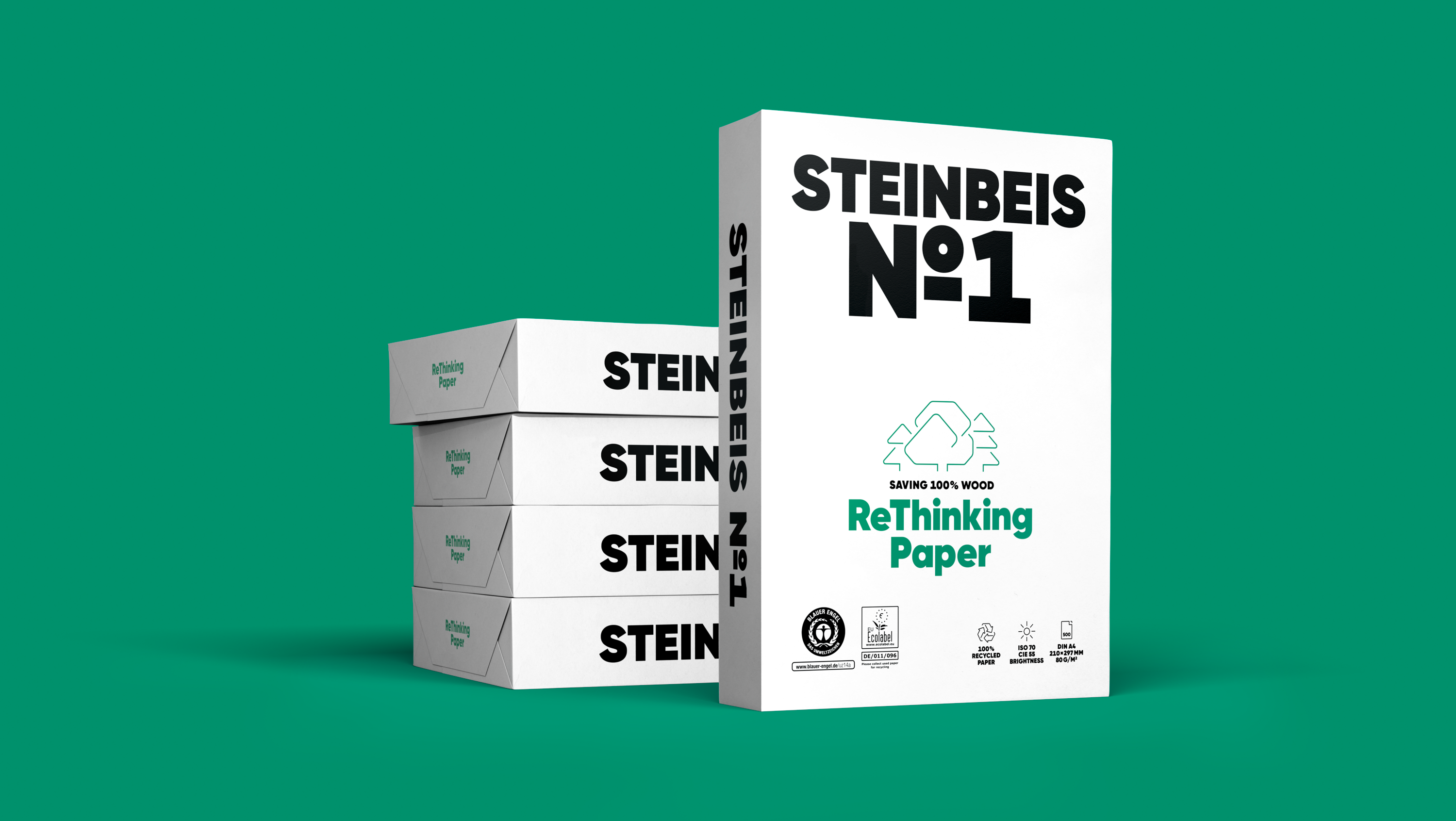
Resource conservation can also be implemented indirectly and still be listed as evidence in the CSR reporting obligation, for example by promoting the ecological added value that industries achieve with a sustainable procurement, manufacturing and supply chain. Such as the use of recycled paper for printers and copiers. The savings in wood, water and energy consumption as well asCO2 emissions are above average and contribute to maintaining the ecological balance. If 18 million office workers, who print out an average of 25 sheets of paper every day, only used recycled paper made from 100 per cent waste paper, there would be considerably less need to worry about forests. "Every hour, trees covering an area the size of around 500 football pitches are felled worldwide. Half of this is turned into paper," says the Stern online article "How Amazon is littering paper waste."
Sustainability should be the "ecological imperative" for consumers and industries that want to secure the necessary resources for future generations. It is a global issue, but Germany can also become a leader in this area.
Author: Klaus E. Jopp
https://www.jopp-communications.de/
SOURCES:
Cover picture: dan carlson via Unsplash
Helmut Bündner: The limits of recycling: Germany is drowning in plastic waste, FAZ net, 05.01.2018, http://www.faz.net/aktuell/wirtschaft/deutschland-versinkt-im-plastikmuell-15374075.html
Germany is living on credit: resources used up for 2018; Welt online, https://www.welt.de/newsticker/dpa_nt/infoline_nt/brennpunkte_nt/article175971951/Deutschland-lebt-auf-Pump-Ressourcen-fuer-2018-verbraucht.html
Resource scarcity, climate change and ecological footprint; www.going-green.info/themen/konsum/ressourcenverbrauch/
Christoph Fröhlich and Christian Krug: Waste paper: How Amazon is littering paper waste, Stern Spezial, 18 April 2018: https: //www.stern.de/wirtschaft/muell/altpapier-wie-amazon-den-papiermuell-vermuellt-7879824.html
Documentary / planet e.-Deutschland macht Müll, 28 January 2018, zdf online; www.zdf.de/dokumentation/planet-e/planet-e-deutschland-macht-muell-100.html
Plastic waste facts, figures & studies 2017/2018; https://www.careelite.de/plastik-muell-fakten/
Tilman Santarius, "Digitalisation: Opportunities and risks for sustainability? " http://n21.press/digitalisierung-chancen-und-risiken-fuer-die-nachhaltigkeit/
Sustainability: German SMEs lack orientation, Baker Tilly press release, 30/08/2017, www.bakertilly.de/aktuelles/presse/detailansicht/nachhaltigkeit-deutschem-mittelstand-fehlt-orientierung/