ReBoat: Old boats, a new future – sustainability on the water

Around 300,000 end-of-life boats are awaiting disposal in Europe alone. Most of them no longer float, but are left on trailers in backyards, left to rot in harbours or rusting away on company premises. It is a problem that hardly anyone talks about. And yet it exists. The Hamburg-based company ReBoat has decided to tackle it. Its programme does exactly what the boating industry has so far considered virtually impossible: recycling old boats and yachts in a systematic, cost-effective and environmentally sound way.
A problem nobody wants to see
When people think of the water, they think of freedom, wide open spaces and holidays. Not boat graveyards. Yet they are very real and widespread. When a boat reaches the end of its useful life, its owner is faced with a problem for which there is no easy solution. A regulated recycling infrastructure, such as has been the norm for cars for decades, is virtually non-existent for watercraft. What remains are years of inactivity, illegal disposal or simply abandonment. Abandoned boats are a burden on harbours, pollute the seabed with antifouling paint and waste oil, and tie up resources that nobody uses any more. This is not a marginal issue, but a structural problem affecting an entire industry that has long simply ignored the issue of disposal. The reason why this has been tolerated for so long has a name: GRP.

The toughest case: fibreglass
Fibreglass-reinforced plastic has been the dominant material in boatbuilding since the 1960s. It is lightweight, dimensionally stable and low-maintenance. As a waste product, however, it poses a real challenge. As a composite material in which glass fibres are firmly bonded to synthetic resin, it cannot be melted down like metal, nor does it rot like wood. For decades, it was therefore considered virtually non-recyclable, and end-of-life boats consequently ended up in landfill sites or were simply left where they had last been moored. ReBoat is working to change this fundamentally. Once shredded and processed, GRP is now used as a secondary raw material in the construction and cement industries, where it can replace conventional materials. It is not a perfect cycle, but it is a significant step away from landfill, and one that improves in quality with every advance in recycling technology.
Dismantling as a craft
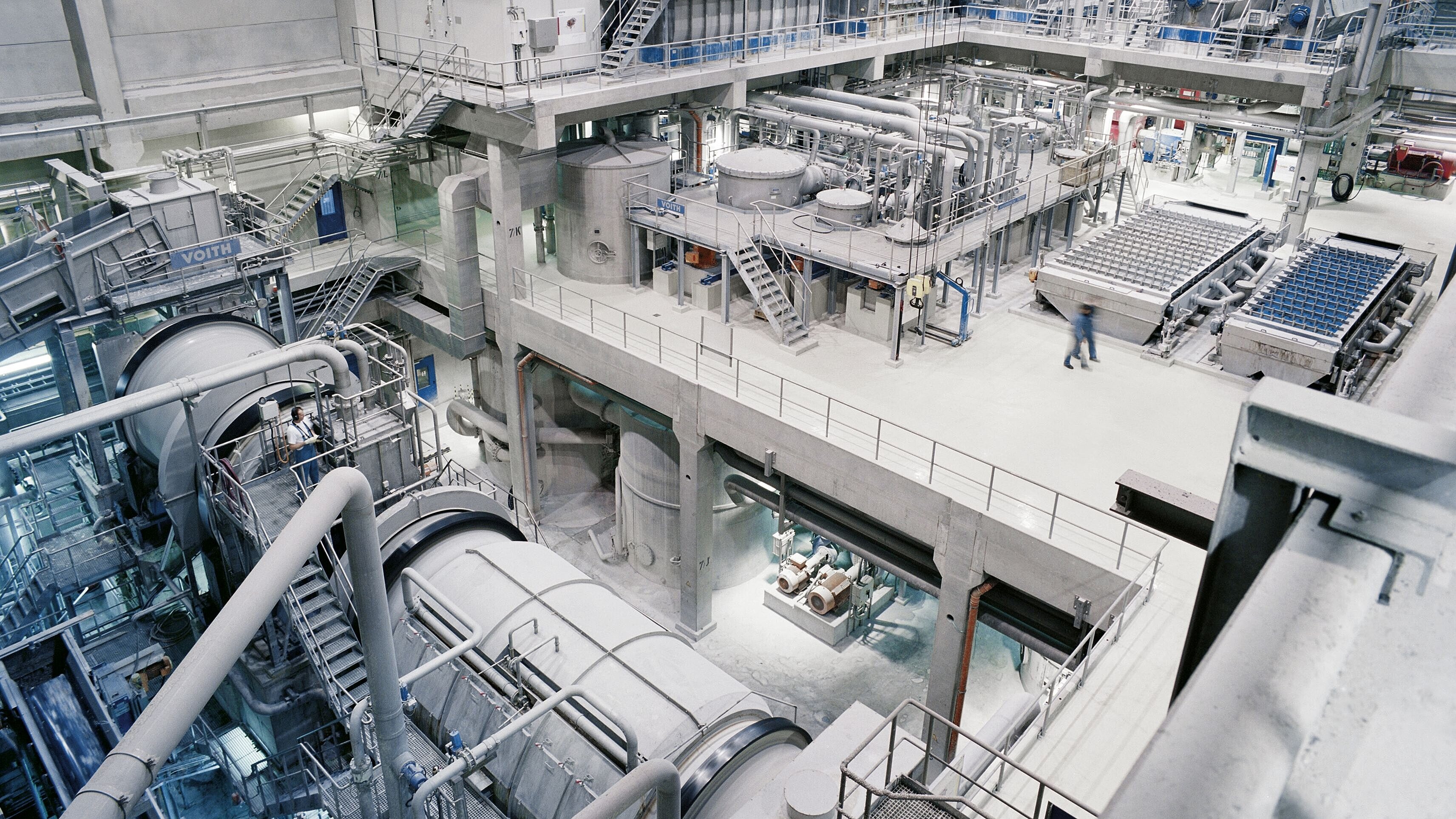
What sets ReBoat apart from a traditional waste disposal company is the thoroughness of the process. Every boat is dismantled down to the smallest component: metals, wood, sails, electronics, engines, tanks and fittings are carefully separated, inspected and channelled into the appropriate recycling streams. Lead from the keel is melted down, functional parts are returned to the market as spare parts, wood is processed, and stainless steel and aluminium are fed back into the metal cycle. Anything on board that still has value retains it. This principle of consistently separating materials, consistently recycling them and not discarding any material until everything that can be extracted from it has been recovered is not a new concept. Steinbeis Papier has been following precisely this approach since 1976: waste paper is turned into recycled paper, with every fibre kept in the cycle for as long as possible. The idea is the same; the material is different.

Recycling that pays off
What makes the ReBoat model special is the economic approach behind it. Anyone who hands over their boat for recycling receives a share of the proceeds from the recyclable materials. The more recyclable material a boat contains, the lower the disposal costs; in some cases, the owner even receives a payout. A boat that has reached the end of its useful life is therefore no longer a costly problem, but a source of raw materials with a residual value. This approach creates something that is crucial for any functioning circular economy: acceptance. As long as recycling feels like a sacrifice, hardly anyone will do it voluntarily. When it pays off, that changes fundamentally. This is precisely where ReBoat’s real innovation lies.
Hamburg as a starting point
It is no coincidence that this concept is taking shape in Hamburg. The city is not only one of Europe’s most important port cities, but also a hub of the maritime economy, where the challenges facing an entire sector are visible and tangible. Here, they are literally at anchor, and here solutions can be tested before being scaled up elsewhere. The boating industry is still lagging behind when it comes to the circular economy. Regulatory pressure, such as that which forced the automotive industry decades ago to introduce take-back and recycling obligations, is still largely absent for watercraft. But the pressure is growing, as is awareness, and pioneers such as ReBoat are showing that no legal obligation is needed. Sometimes all it takes is a good idea, a viable business model and the willingness to take a problem seriously – one that everyone can see but which, nevertheless, nobody has tackled for a long time.
Find out more about ReBoat and the recycling process: re-boat.de
Cover image: Soroush H Zargarbashi / Unsplash
Author

Responsible for marketing, social media and e-business at Steinbeis Papier. Circular economy, recycling and biodiversity are the topics close to the heart of the graduate business economist. Enthusiastic blogger for the Steinbeis editorial team.