Perfect match: recycled paper and school

04.09.2020 - "Notebooks out, classwork" - who still remembers this phrase, perhaps even a little nostalgically? One thing is clear: handwriting is used at school. Perhaps less so today than 20 years ago, as our everyday lives have become more digital and technical. But children still pick up a pencil to learn to write. This article looks at why this is a good thing and what adjustments we can still make in favour of sustainability in schools.
When was the last time you wrote more than a shopping list, a post-it note or a birthday card by hand? If - like most people - it was a long time ago, it's no big deal - it has no negative effect. The situation is different for beginners: for them, it does make a difference whether they learn to read and write using a keyboard or a pen. Writing by hand requires fine motor skills, which means that a third of the brain is active. This is why learning to write is easier. For the same reason, we can also remember things better if we have written them down by hand. Age is irrelevant here. You've probably made this observation yourself and wondered whether it's just you - it's not, it's scientifically proven! And even if we don't write by hand, words on paper have a different effect on us than words on a screen.
Printed information is better absorbed
Especially in everyday school life and learning, we should be wary of trying to replace print products with digital learning. Professor Anne Mangen, chair of the E-READ initiative and initiator of the Stavanger Declaration, explains why this is the case: she and her colleagues have proven that reading on paper is superior to reading digitally. The longer a text is that is read on a screen, the clearer this effect becomes. The fact that online texts tend to be shorter is therefore not only due to an accelerated society and our ever-shrinking attention spans - because these have not generally become shorter, but only in situations in which we are confronted with a screen. Especially with longer texts, we find it more difficult to maintain the necessary concentration and focus. This is especially true for informational texts. One could assume that we have become better at reading on screens since the 2000s. However, a large meta-analysis on this question shows the exact opposite: the gap between reading on paper and reading on a screen has widened over time and continues to grow. Why is this the case? Apparently there is a connection with the haptic component of paper, meaning that we read not only with our eyes but also with our hands. At first glance, this may seem like a pointed statement, but it is actually the case that the inclusion of the sense of touch stimulates the brain better to absorb information. So let's summarise: phones and laptops are ideal for small "snippets" of information and are of course unbeatable in terms of their topicality, but: we learn better from paper than from screens.
Is our learning behaviour harmful to the environment?
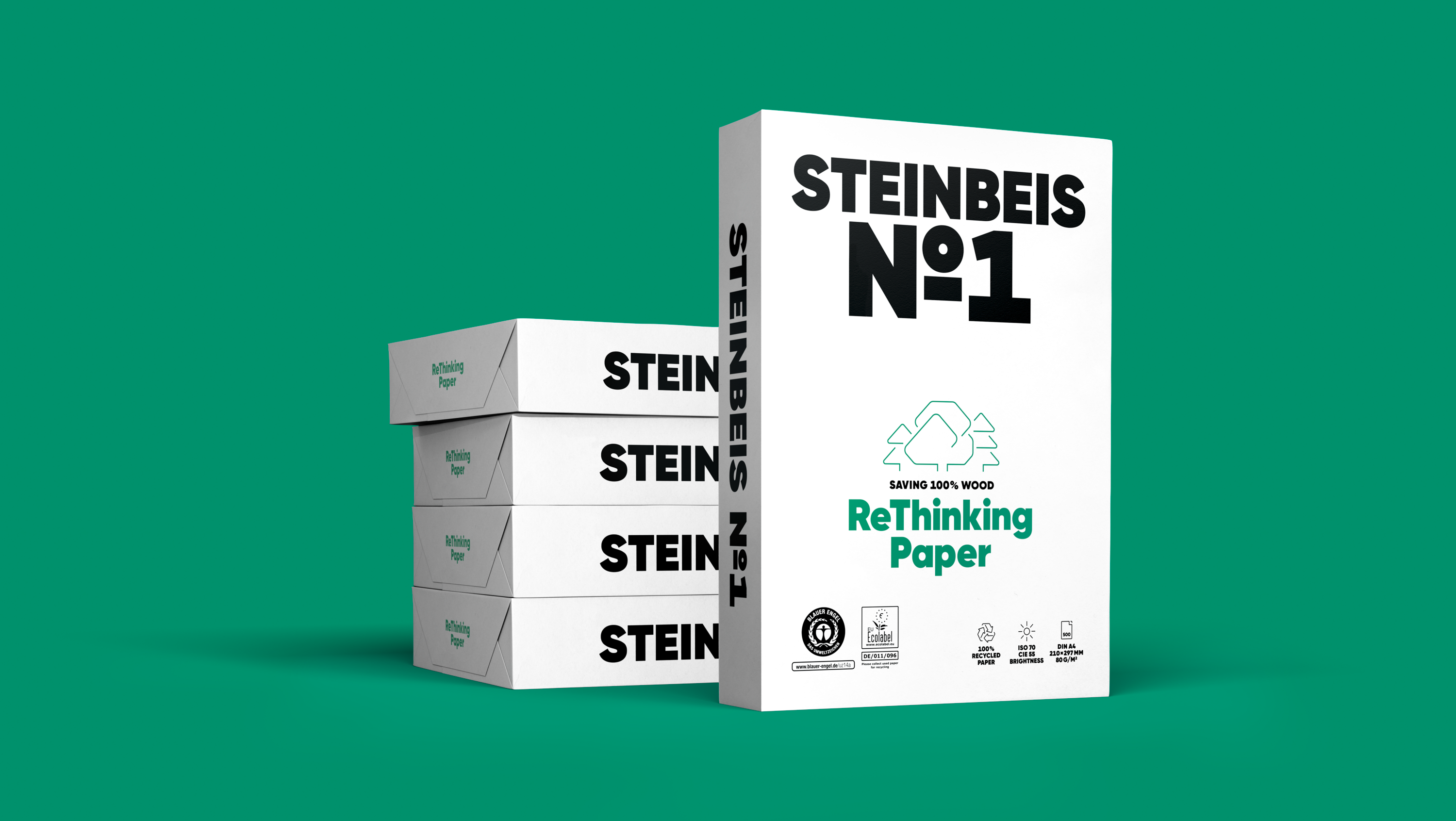
Anyone who is now worried that the environment is suffering as a result of our paper-heavy learning behaviour should be told that it is not generally better to do without paper and only provide information in digital form. After all, 4% of global greenhouse gas emissions are already attributable to digitalisation, the energy consumption of which is also growing by around 9% every year. So digital is not more sustainable per se, at least not until we have completely switched to renewable energies. Readers of this blog also know that Not all paper is the same. And not all recycled paper is the same. Like the Federal Environment Agency, we refer to the Blue Angel label because it is the most demanding label and is based on the idea of circularity, i.e. the circular economy. We should urgently turn to the latter in general if we are pursuing the goal of sustainability.

So we learn well with paper, absorb information better in printed form and have unproblematic, sustainable solutions at our fingertips. When school starts, millions of pupils need pads, exercise books and the like. However, only one in ten exercise books purchased is still made from 100% recycled paper and bears the Blue Angel. There are no valid arguments for this, because recycled paper has no disadvantages, only advantages: 60% less energy, 70% less water and 100% less wood are generally required for production than for conventional products.
Recycled paper: the right choice for pupils
So why is it that the proportion of recycled paper in schools is still relatively low? Certainly not because our young generation doesn't care about the environment. On the contrary, the representative youth study "Zukunft? Young people ask" conducted by the Institute for Ecological Economy Research (IÖW) on behalf of the Federal Ministry for the Environment and the Federal Environment Agency revealed that environmental and climate protection is a top priority for young people in Germany. The majority of our pupils are politically interested and willing to get involved. They expect more from politics than their predecessors. For example, that politicians show greater commitment to the environment and at the same time endeavour to achieve greater social justice. And: the pupils believe that each individual can do much more to protect the environment.

This seems understandable, as the younger a person is, the more they will be confronted with the consequences of climate change in the future. It is therefore all the more important for these young people to collectively take an environmentally friendly path so as not to make future generations pay for their environmentally damaging actions. The willingness of the younger members of our society to act sustainably is therefore beyond question. They are prepared to make an effort to protect the environment. We can therefore assume that one reason for the few notebooks made from recycled paper in everyday school life is a lack of education. And that is our task, that of the "big ones". Whether grandparents, parents, teachers or others: We need to set a good example to children and share our knowledge with them. We need to sensitise them to the issue and help them develop an awareness of these small areas in which they can make good choices for the climate. In this particular case, the effort is minimal, the result maximum - because our youngsters expect us to show responsibility and they gratefully accept sustainable impulses.
Our tip: "Start school with recycled paper" campaign
If you are looking for inspiration or information on this specific topic, we recommend the "Starting school with the Blue Angel" campaign organised by the Federal Ministry for the Environment, the Federal Environment Agency, the Environmental Label Jury and RAL gGmbH. More at: www.blauer-engel.de/schulstart
Cover picture: pixabay/Pexels
Author

Isabella Bigler is an editor and copywriter. Here she writes about sustainable topics, the past and the future - occasionally with the support of her dedicated interns Lumen Nguyen and Liam Jennings.