New product, new challenges

09.08.2022 - Steinbeis Papier sets another milestone with its new label paper. A great deal of effort had to be made on the way to a new product with corresponding sustainability claims. The Research and Development department and its head Dr Frank Wenig played a central role in this. The 45-year-old explains how his team's work is organised and traces the path from the idea to the finished new product.
What are the current topics in research and development?
The product development of wet-strength label paper is currently a priority. Specifically, we are in a phase in which we are transferring the product from the research area to the production process. However, new auxiliary materials and alternatives are also on the agenda, as we are currently very concerned about availability and prices. When it comes to the finished product, there are issues such as whiteness, dirt speck content and the proportion of adhesive impurities. The main aim here is to avoid rejects and become even more efficient. In the production process itself, we constantly try to identify, describe and analyse optimisation points and then ideally offer solutions.
What does your working day look like?
My day starts at six o'clock in the morning and is also quite structured. I'll see what happens later on. With a coffee in my hand, I look at the quality and production data. This is usually followed by coordination meetings, discussions on project progress and presentations. However, I also like to get personal impressions of production or waste paper processing and talk to my colleagues there in order to recognise or understand potential problems. We then work out appropriate solutions from this.
Which departments do you work with?
We actually work with every department: Production, Technology, Controlling and Purchasing. We are mainly in contact with the latter department when it comes to identifying product alternatives and supporting price and contract negotiations with our expertise.
How is your team structured?
The team comprises twelve employees: two technologists, one for the paper machines and one for stock preparation. These two are supported by other employees who work in the quality laboratory. One colleague analyses the running properties of the paper in the technical centre, among other things. Two colleagues work in technical marketing (complaints and customer service) and are supported by a colleague in data preparation.
What is it like to work in research and development?
It always depends on the area of work: There are administrative tasks such as recording working hours or occupational safety, data collection procedures in the laboratory, and travelling with colleagues from technical marketing. My tasks also include liaising with universities about possible research collaborations, attending specialist conferences or visiting suppliers who manufacture new systems for paper production, for example.
Quality management is an important part of your work. What does this look like in concrete terms?
We have a very well-equipped quality laboratory. There we examine paper samples from production with regard to optical properties such as whiteness, colour locations or opacity. We also analyse properties such as thickness, grammage and strength. In production, we have an automatic testing line. Here, sample strips are taken from the finished Steinbeis paper, measured and analysed. We transfer the measured values directly into our quality measurement system. Batches that deviate from the limit values can then be blocked. The maintenance work on the testing line is also coordinated and checked by our department. However, it is not only our finished papers that are regularly checked for quality, but also the auxiliary materials required for production.
Thanks to digitalisation, we can minimise losses and produce even more efficiently.

What role does digitalisation play?
By using appropriate programmes and algorithms, deviations from the target status can be identified fairly accurately. Countermeasures can then be initiated automatically or through user intervention. This works very well for process parameters such as flow rates or quality data. We can minimise losses and thus produce even more efficiently.
In view of an almost perfect product, to what extent is there room for improvement?
Customers determine how perfect a product is. Our job is to adapt the product to their wishes and needs. However, these change again and again over the course of time. That's why we are in a never-ending optimisation process.
What does the path from research object to finished product look like?
First of all, you need a vision, an idea, and there has to be a demand. The two are interdependent. The path to industrial production can be very different. As a rule, this is characterised by laboratory tests. We produce small quantities on the test machines in our laboratories and check whether the result corresponds to Steinbeis Papier quality. Operational trials are also carried out directly in the production process to see how the paper reacts. After successful short-term trials, daily operational trials are then started. Depending on whether and to what extent modifications to existing process parts are required, this development step can also take longer.
How did the label paper process look from idea to realisation?
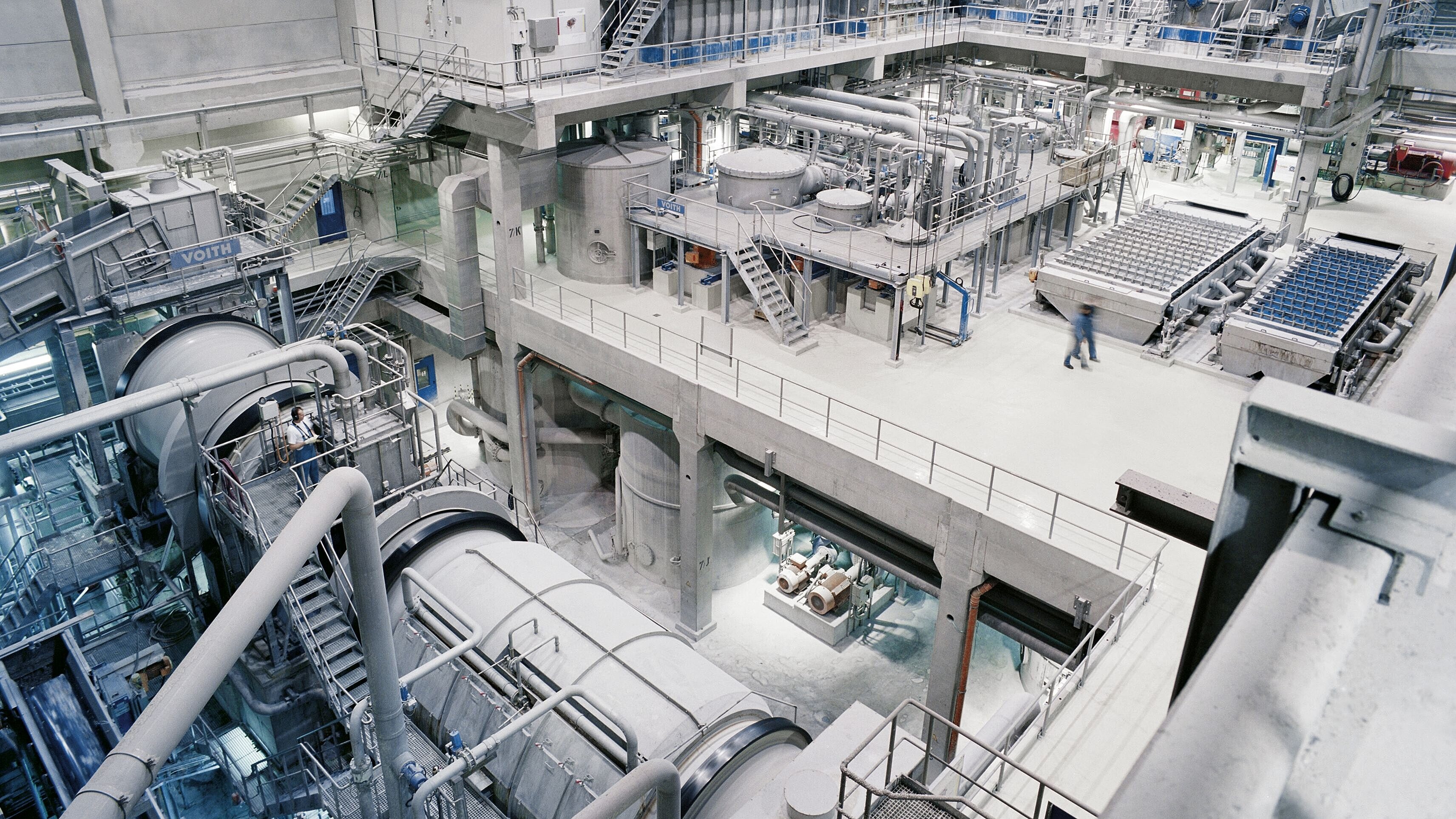
The process for wet-strength label paper was quite complex. Because - as the name suggests - this paper has to be wet-strength. Our existing recycled papers are not designed for this. When water and energy are added, it breaks down into its individual fibres. This posed particular challenges for the new label paper, especially in the production process. We first had to find out what requirements the paper would have to fulfil, what additives would be needed and how the whole thing could be implemented permanently in terms of production technology.
To what extent did the existing production infrastructure have to be adapted?
We produce the label paper on the PM6 paper machine. Our other recycled papers continue to be produced there. However, there are now temporary changes for the label papers. After working intensively on the requirements, we were able to carry out initial tests on the paper machine in August 2020. We then had to make modifications to the units, for example to be able to dissolve the wet-strength paper again. One of the tasks was that the label paper had to be different on the front and back. We therefore interconnected system components in such a way that we could produce the paper with a front side (the side of a label to be printed) and a reverse side (the adhesive surface).
If everyone joins in, a product can succeed.
How intensive was the work on the new product?
That always depended on the tasks of the respective team members. The label production in May was intensive for all colleagues. We also had to provide overnight support. I am very proud and satisfied that everyone involved showed such great commitment and also agreed to work night shifts. You could see that everyone was willing to change something, to make a difference. And if everyone pulls together, a product can succeed.
Status quo - how close is Steinbeis Papier to an optimised label paper?
There is always potential for optimisation with every product. But we are already very close to what we had in mind.
What is the status of research into alternative raw materials?
The shortage of waste paper as a raw material is of course forcing us to take action. We are working flat out on a special grade line that will go into operation as early as 2023. This will include a new stock preparation line to obtain raw materials that we cannot currently use. Papers with a high coating content or wet-strength label papers will then be able to function in the new line with appropriate adjustments to the process parameters. In this way, we are establishing a new recycling model with new raw materials and new products.
Cover picture: Florian Thoss for Steinbeis Papier
Author

As a senior editor, Benjamin Seibring specialises in developing content on sustainability, mobility, technology and lifestyle. An editorial traineeship at a German media group and his many years of experience in corporate publishing form the basis. With a high affinity for trend topics and innovative AI tools, he implements cross-media storytelling.