More than just a scrap of paper
19.11.2020 - What makes paper so endearing? It's simple: it's light, inexpensive, easy to dispose of and available as a genuine recycled product. Printer paper, notepads, envelopes, cardboard boxes, tissues, toilet paper, kitchen roll - if you pay attention to sustainability when buying, you don't have to use virgin fibres for any of these products. Paper and cardboard are also popular as plastic substitutes: be it bags, paper cups or straws. Paper and cardboard accompany us in all their diversity in everyday life, even in unexpected areas of life.
Newspapers in the wall
It serves as voluminous sound insulation, is resistant to mould and vermin, protects against heat in summer and keeps out the cold in winter: we are talking about insulation made from waste paper and therefore cellulose. So that our Sunday newspaper can go from the breakfast table to the wall, it is shredded in a fibre mill. This process changes the structure of the paper shreds: They become voluminous and can be used loose as blown-in insulation. Alternatively, cellulose insulation is available in mats. For this, the fibres have to be compressed under enormous pressure. This extra mile in production naturally leads to extra energy costs. Cellulose flakes are therefore the much more sustainable choice.
Manufacturers use additives in both types of insulation to preserve the insulating material and comply with fire protection regulations. For a long time, boric acid was used for this purpose, but this is now treated as a substance of concern by the EU Chemicals Regulation. Accordingly, cellulose insulation material that has been treated with boron cannot be recycled or composted. Some retailers have reacted. As a substitute for boron, they now use mineral additives, which are also used to coat wood shavings if they are to be used as natural insulation material. It is therefore worth taking a closer look at the composition of the insulating materials.
Tiny house meets corrugated cardboard
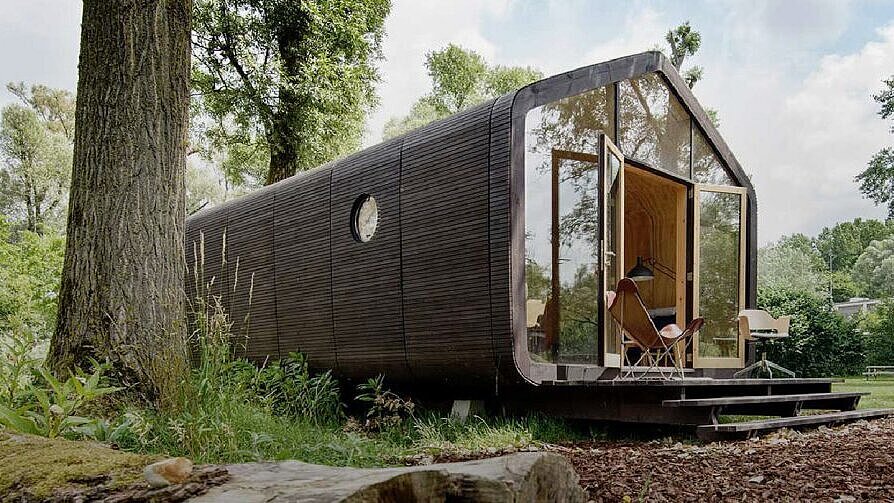
If you go one step further, you can live in a house made of cardboard. For example, the Wikkelhouse from the Dutch company Fiction Factory from Amsterdam. According to the manufacturer, it is three times more sustainable than a traditionally built house without sacrificing any amenities. Instead, each Wikkelhouse can be customised thanks to the modular system. And thanks to its comparatively low weight and self-contained construction, it does not need a foundation. For each house element, 24 layers of corrugated cardboard are wrapped around a house-shaped construction and glued together. The resulting sandwich structure is particularly stable and forms the frame of the modules, which are later assembled to form a house. To protect against wind and weather, the house is then covered with waterproof aluminium foil and clad with wood. The individual modules can be assembled and joined together in just one day and (almost) anywhere, as the Wikkelhouse is delivered to the desired location in Germany, Luxembourg, France, Great Britain, Scandinavia, Belgium or the Netherlands.
Furnishing with lightweights
Moving house, what a horror! The hassle of carrying heavy pieces of furniture, preferably from the third to the fifth floor. In an old building, of course. Cardboard furniture puts an end to this drudgery. The cardboard boxes usually only weigh a fraction of what their wooden, metal or plastic relatives weigh. Whether armchair, couch, bed or shelf - the furniture is simply folded up. And that's it. No mountains of screws that have to be carefully separated and stored. No tedious Tetris in the removal van. Transport is no longer an issue, and if you wanted to, you could even ship the furniture. Is there more space in the new flat? Or less? Cardboard furniture adapts to your needs because it can often be customised and altered. At the same time, they are extremely stable and durable thanks to intelligent plug-in constructions made of double corrugated cardboard. With a raw material weight of just one kilo, they can sometimes achieve 1000 times the load-bearing capacity. And: they are cost-effective. Sounds almost too good to be true. But only almost. Various companies have now specialised in the manufacture of stools, beds and shelves made from cardboard. The furniture is particularly sustainable if it is made from recycled materials from regional producers and is 100 per cent recyclable.
A bit of sci-fi
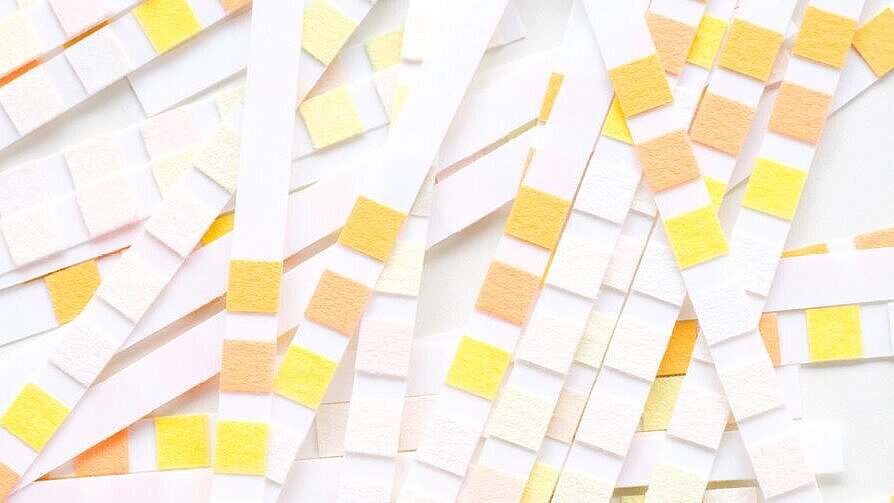
Using paper biosensors to determine glucose levels in the blood. Or the activity of enzymes. Or the content of heavy metals. There are many possible applications. And they are particularly indispensable in developing countries. It is precisely there that costly laboratory tests are not always possible. Biosensors, on the other hand, enable diagnostics close to the patient. They are inexpensive, independent of electricity and unproblematic to dispose of. The only catch is that many biosensors developed to date work with colour scales, whose measurement data is too imprecise for many areas of application. It only becomes more accurate if an external power supply is used. However, when conventional batteries come into play, the technoid elegance of the biosensors disappears. In addition, commercial batteries are expensive, must be available and are much more problematic to dispose of.
Paper under power
One solution for more precise measurement data would be a paper-based battery presented by researchers at Binghamton University in the US state of New York in 2018. Printed electrodes and bacteria generate energy on contact with liquid. So far, the maximum current of 100 microamperes and the power of 45 microwatts are low compared to conventional models. "For most practical application scenarios, the power also needs to be improved by about 1,000 times," says Dr Seokheun (Sean) Choi, who presented the battery at the 2018 National Meeting & Exposition of the American Chemical Society. According to him, the increased performance can be achieved by stacking and connecting multiple paper batteries. The service life in the freeze-dried state is also still far too short at four months. However, the results so far are promising.
Rethinking paper consumption
Paper and cardboard are omnipresent in our everyday lives. Whether as tissues, toilet paper, newspapers or even chairs, biosensors or insulating material. We need it for information, communication and hygiene and are constantly developing new innovative applications. With this paper boom, it is our responsibility to protect the planet. The best way to do this is to use recycled products that are certified with the Blue Angel. For the environment. For the forest. And ultimately for us too.
Cover picture: unsplash
Author

Valerie Bachert is a journalist, chief of staff and sustainability officer. She is interested in the areas of organic farming, conscious consumption, species extinction, social injustice and sustainable nutrition.