Game changer recycled paper

20.08.2019 - Steinbeis Papier GmbH does not use pulp in the production of its recycled paper. The secondary resource of waste paper is used as the raw fibre material - and 100 per cent of it. In an interview with producer Katja Knahn, Head of Marketing Veronika Warmers talks about the special features of the manufacturing process, trends and future prospects for the industry.
Katja Knahn: Recycled paper is becoming increasingly popular. What are the special features of the manufacturing process compared to that of virgin fibre paper?
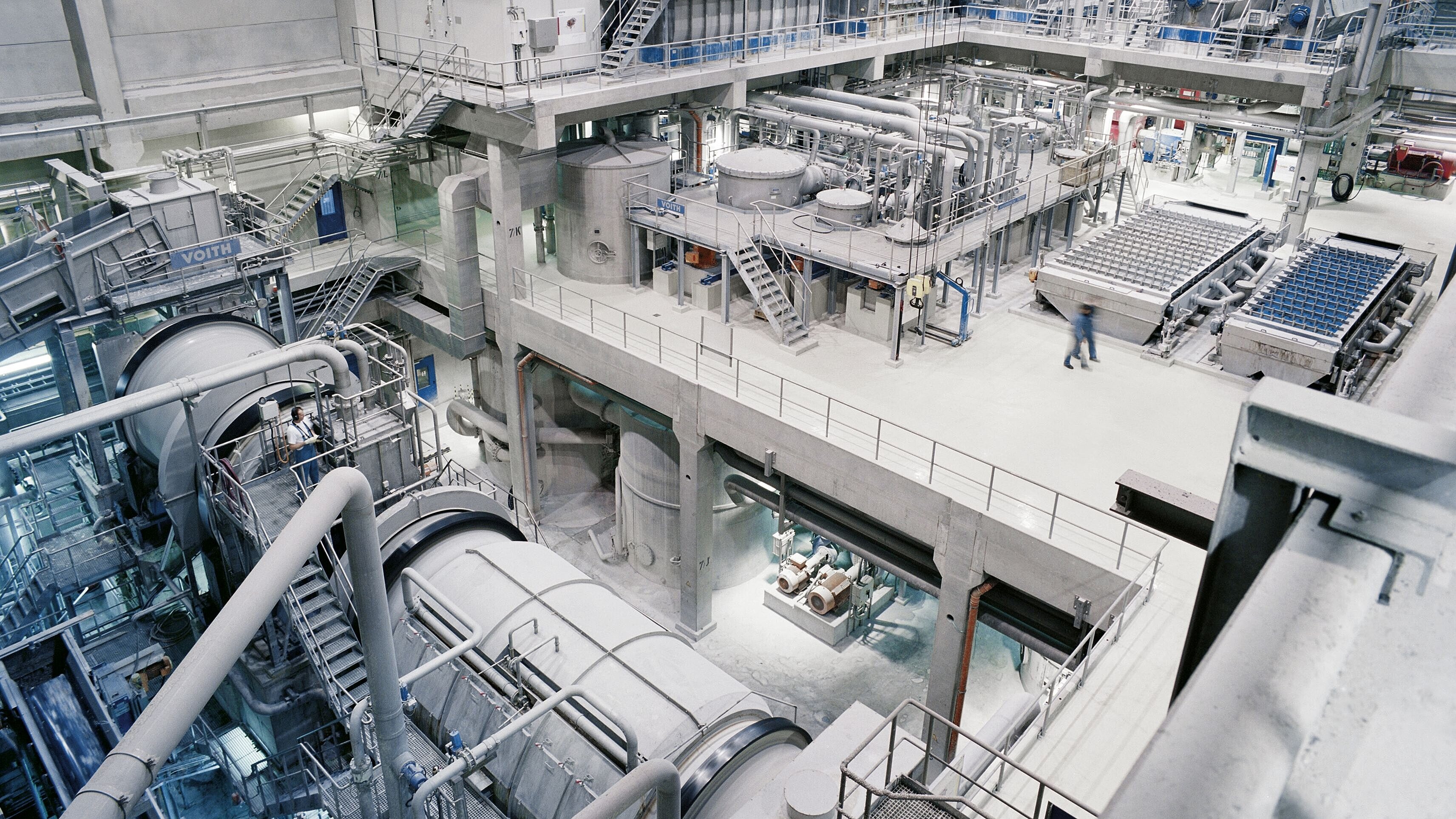
Veronika Warmers: Recycled paper is produced on a modern paper machine that does not differ significantly in technical terms from a paper machine that produces virgin fibre paper of the same quality. The biggest differences compared to virgin fibre paper production result on the one hand from the use of waste paper and its processing in a so-called waste paper processing plant - and on the other hand from the use of wood and the so-called pulp production.
What differences are there in terms of energy and water consumption in this process?
Steinbeis Papier GmbH's guiding principle is to conserve natural resources and utilise efficiency potential. At Steinbeis, the principles of sustainability and the circular economy extend across all value chains. On this basis - with the use of 100% recovered paper, the intelligent networking of material cycles in integrated fibre preparation and paper production, high raw material efficiency, environmentally friendly, low-emission energy generation and the use of state-of-the-art environmental and recycling technologies - Steinbeis makes a significant contribution to the conservation of natural resources. The Steinbeis eco-balance values compared to the production of conventional paper from virgin fibres (according to the IFEU Institute, Heidelberg, 2006/2010) prove this: Savings in water up to 83 per cent, energy up to 72 per cent,CO2 emissions up to 62 per cent, wood 100 per cent.
Let's delve a little deeper into the recycling process: deinking - i.e. removing the printing ink from printed waste paper - is an essential part of waste paper processing. What role does chemistry play in this process?
The main auxiliary materials used in the deinking process are Caustic soda, hydrogen peroxide, water glass, soap. Caustic soda can be found in almost every household cleaner. In waste paper processing, it is used to set an alkaline pH value and supports the swelling of the paper fibres and thus the detachment of the printing ink. As an environmentally friendly bleaching agent, hydrogen peroxide counteracts the yellowing of paper fibres in the alkaline pH range. After use, it decomposes into water and oxygen. The water glass serves to stabilise the hydrogen peroxide, which would otherwise quickly decompose into water and oxygen. In earlier times, water glass was used to pickle eggs, among other things. The soap, similar to common household curd soap, serves as a collector in the treatment process, binding the detached printing inks so that they can be removed from the paper fibre mixture - similar to removing dirt when washing your hands every day.
What do you think of the "cradle-to-cradle" trend with regard to recycling in the graphic arts industry? Alternative or further development?
Cradle-to-cradle follows the approach that a product is either recycled as completely as possible in a technical cycle or, alternatively, is as completely compostable as possible in a biological cycle. It is therefore not an alternative to recycling, but from Steinbeis Papier GmbH's point of view rather a further development of existing eco-labels and product designs, in which the recycling options and routes are already taken into account during product development. With the principle of "paper from the cycle for the cycle", Steinbeis papers fulfil the cradle-to-cradle principle.
What are the current problems on the market and what is your forecast for the future of recycled paper?
The digital transformation is leaving its mark on the paper industry. Demand for graphic papers is falling year on year. In the economic environment of the large paper companies that dominate the market worldwide, the medium-sized company Steinbeis Papier occupies the position of the ecological and economical alternative to conventional virgin fibre papers. The discussions about climate protection, energy transition, resource justice and reducing the carbon footprint show how important these issues are. More and more companies and consumers want to do their bit. Recycled papers with the Blue Angel, such as those produced by Steinbeis Papier GmbH, meet this consumer demand and offer corresponding growth potential.
Briefly explained: FSC Recycled versus Blue Angel
The Forest Stewardship Council (FSC) organisation awards its labels to products that promote responsible forest management. In the context of paper, the fibre raw material can consist of highly pulped cellulose (wood-free), but also less highly pulped cellulose (containing wood) or recycled fibres. The FSC provides different labels depending on the material used: FSC, FSC Mix and FSC Recycled. The FSC Recycled label stands for products that contain only recycled material.
The Blue Angel is the significantly higher quality and stricter environmental label, which places more far-reaching requirements on a paper than the FSC Recycled label. The Blue Angel guarantees that the labelled products meet high standards in terms of environmental, health and usage properties. Before a printing and copying paper is awarded the Blue Angel, it must fulfil strict criteria: Guaranteed production from 100 per cent recycled paper, no use of chlorine or halogenated bleaching agents, clear limitation and exclusion of certain chemicals in paper production. All auxiliary materials must be authorised in accordance with the XXXVI Recommendation (Food and Commodities Act of the Federal Institute for Risk Assessment BfR).

About the person:
Katja Nahann works as a freelance project and production manager for designers, design offices, agencies, publishers and companies. With many years of experience and strong nerves, she steers all projects in the desired direction. Thanks to open communication, a clear structure and the famous ability to think outside the box, she takes on every challenge in a relaxed and sporty manner. In addition to providing technical and conceptual advice and support, her work focuses on intelligent production and project management. In her experience, by incorporating the technical parameters at an early stage, great and sustainable projects can be realised even with smaller budgets. With a high level of commitment, a desire for perfection and precision, sound expertise and a broad network in the industry, she stands for successfully launching and realising complex projects. She loves interacting with creative people and partners and enjoys passing on her knowledge in the form of seminars, workshops or as an author and speaker. More information at: www.paperkate.de
Cover picture: Steinbeis Papier GmbH
Author
Responsible for marketing, social media and e-business at Steinbeis Papier. Circular economy, recycling and biodiversity are the topics close to the heart of the graduate business economist. Enthusiastic blogger for the Steinbeis editorial team.