Eco-consumption and CO2 account. Consumers between two worlds.

22.05.2018 - Poor diesel! The black sheep of road transport. It now has to spoon up theCO2 soup that the economy, industry and consumers have cooked up. Branded as an air polluter that exceeds the limit values, there is only one solution for many: diesel driving bans, retrofitting and preferably taking them off the market! Once again, the alternatives to motorised private transport are being propagated: Switch to public transport, energy-efficient vehicles equipped with e-drive systems, cycling and walking. But stop: this alone would be too short-sighted if theCO2 emissions resulting from private consumption in the core areas of "housing, mobility and food" are to be reduced.
The will to be ecologically thrifty is there: efficientCO2 levers in consumer behaviour.
Despite persistently highCO2 emissions, both the German economy and consumers are committed to ecological solutions. Sustainability occupies a leading position in Germany. Billions of euros are channelled into eco-consumption every year. According to the Federal Environment Agency, this figure was already over 50 billion euros in 2014. Consumers are becoming increasingly eco-conscious in the core areas of "living, mobility and nutrition". Consumption decisions are often made in favour of products that offer ecological added value. A large proportion of green investments by private households is channelled into energy-efficient refurbishment and energy-efficient housing. Expenditure on sustainable mobility amounts to around 15 billion euros. Promoting sustainable consumption is also a concern of the German government. On 24 February 2016, it adopted a "National Programme for Sustainable Consumption" for the 2030 Agenda for Sustainable Development adopted by the UN. The aim is to develop and implement indicators and benchmarks on the effects of consumption and to improve the measurability of changes in consumer behaviour.
Green happiness versus resource-intensive reality - facts and figures
The figures show that consumers are a central module in sustainable development. Over 72 per cent of consumer spending and 80 per cent ofCO2 emissions from private consumption are generated in the three consumption areas of "housing, mobility and food" (Federal Statistical Office 2017a and Federal Statistical Office 2017c). There is an increasing tendency for consumers to see these three areas as the key to improving theircarbon footprint. With demonstrable effect. Greenhouse gas emissions from private consumption have been reduced by 50 per cent. However, energy generation is still responsible for 39 per cent ofCO2 emissions- 86 per cent of heating systems in Germany continue to use fossil fuels (oil and gas). In contrast, the share of renewable energy in total gross electricity consumption rose from 20.3 per cent to 31.6 per cent between 2011 and 2015.
There is an increasing tendency for consumers to see the areas of housing, mobility and nutrition as the key to improving theircarbon footprint.

E-MOBILITY - STILL A LONG WAY TO GO
The mobility sector accounts for around 26 per cent ofCO2 emissions. The promotion of e-mobility is understandable. However, mobility habits are only changing slowly. Motorised private transport is still preferred, and the market share of public transport has remained unchanged since 2009. It seems to take a long time for consumers to identify with alternative mobility concepts and change their purchasing behaviour.
BIO-BOOM WITH RESTRICTIONS
the food sector (food and drink) accounts for 15 per cent ofCO2 emissions. TheCO2 emissions are generated during cultivation, rearing, processing, transport and disposal of food waste, among other things. According to the Federal Environment Agency, 35 per cent of greenhouse gas emissions could be reduced if consumers simply switched to a vegetarian diet. A reduction of 18 per cent would be achieved by consuming organically produced food. Many consumers seem to have taken this to heart. Organic products have experienced a boom in recent years. Together with the trend towards healthy eating and an increasingly active, sporty lifestyle, the number of vegetarians has also increased and, according to the Allensbach Institute for Public Opinion Research (IfD), now stands at ten per cent in Germany. Despite this positive development, the market share of organic products is still relatively modest. Further initiatives and impetus from the government programme to promote sustainable consumption can certainly be expected here.
SALES DRIVER ENVIRONMENTAL LABEL - THE BLUE ANGEL
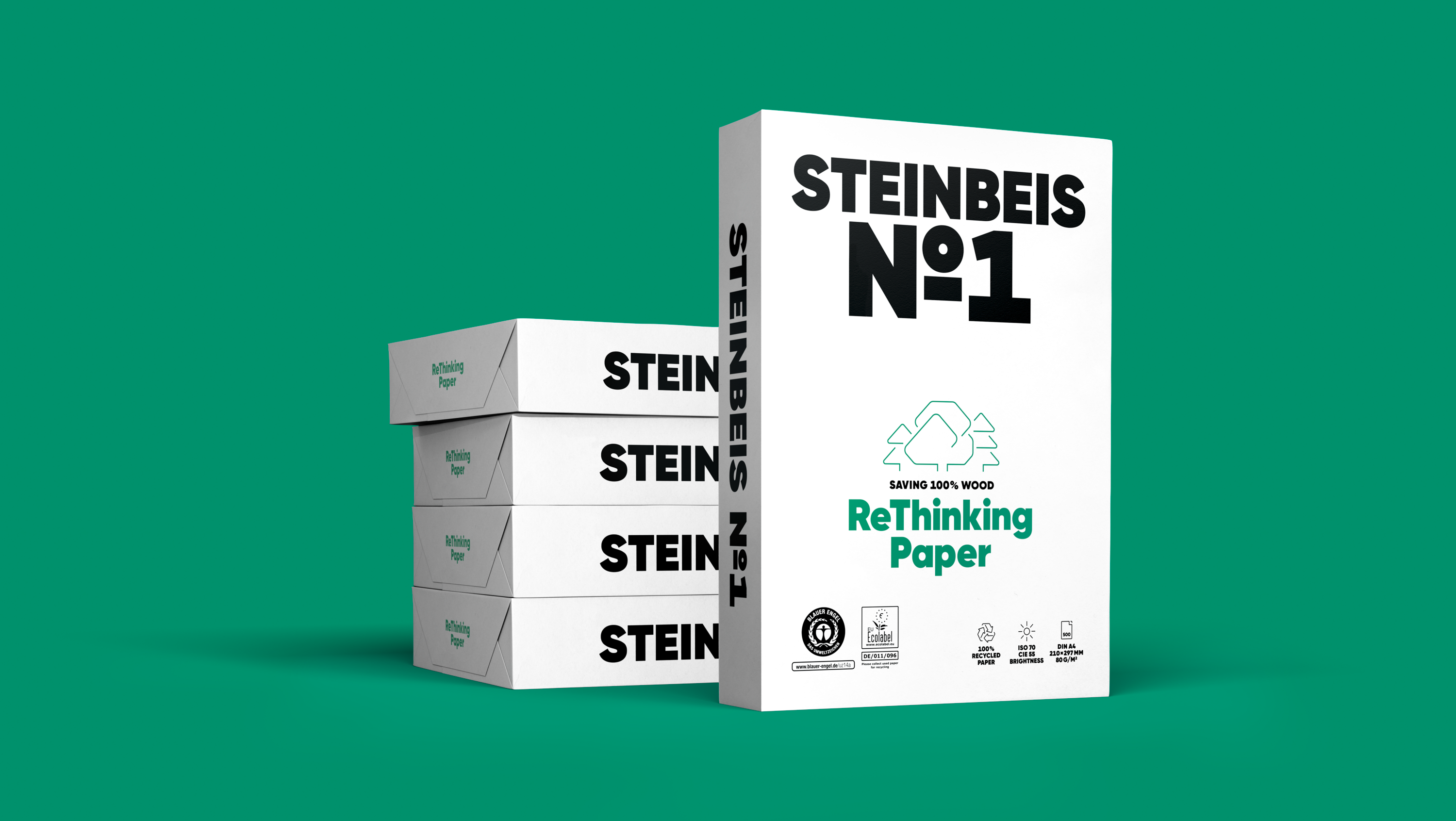
Environmental labels such as the Blue Angel are proving to be an important orientation aid and purchase decision criterion for consumers. The environmental improvements and ecological added value are more quickly and easily visible to consumers. Around 75 per cent of the products awarded the Blue Angel are printers and multifunctional devices, paper products, paints and varnishes. Federal authorities are setting a good example with the product "printer and copier paper". The use of recycled printer paper with the Blue Angel is 90 per cent and is to be increased to 95 per cent. Recycled paper with the Blue Angel is also predominantly used by local authorities due to its sustainable production and improvement of the municipalCO2 balance. Initiatives such as the "Paper Atlas" and "Greener Procurement" as well as the "German Sustainability Award" contribute to sustainable development in the economy and the increasing affinity for recycled paper among authorities and municipalities. Europe's leading manufacturers of printer and copier systems are also promoting the use of recycled paper as the leading medium for printing applications at European level.
Federal authorities are setting a good example when it comes to printer and copier paper. The use of recycled printer paper with the Blue Angel is 90 per cent and is to be increased to 95 per cent.
RECYCLED PAPER - HIGH-TECH PRODUCT WITH THE BEST CO2 VALUES
While experts are still divided when it comes to interpreting the life cycle assessment of electrically powered vehicles, the case for recycled paper made from 100 per cent waste paper is clear. Manufacturers with 100 per cent sustainable production achieve the best ecological savings in terms ofCO2, energy and water consumption and the use of raw materials. Consumers who are open-minded about environmental protection and sustainable products can reduce their carbon footprint by using Blue Angel recycled paper. Without major investment costs and without compromising on quality. This is because the new, sustainable generation of recycled paper is a high-tech and cost-effective product.
Blue Angel recycled paper - a role model for federal authorities
If, according to a forsa study, 42 per cent of those surveyed who own an electric car or want to buy one consider the role model effect on others to be decisive, the role model function of municipalities and federal authorities with regard to recycled paper should be even more so. Above all, because its use does not have to go a long way politically. Just imagine: If the per capita paper consumption in Germany of around 245 kilos per year were largely made from recycled paper, what a positive impact that would have on theCO2 balance. And on the protection of resources? In contrast to conventional paper with a high fresh fibre content, Blue Angel recycled paper is made from 100 percent waste paper (household waste). If you are prepared to protect the environment, you should use recyclable multifunctional paper in your everyday office work. In addition to the public sector, the regional churches are also increasingly switching to sustainable products for printer and copier paper (see www.kleine-kniffe.de).
High recycled paper quota - state government of Schleswig-Holstein
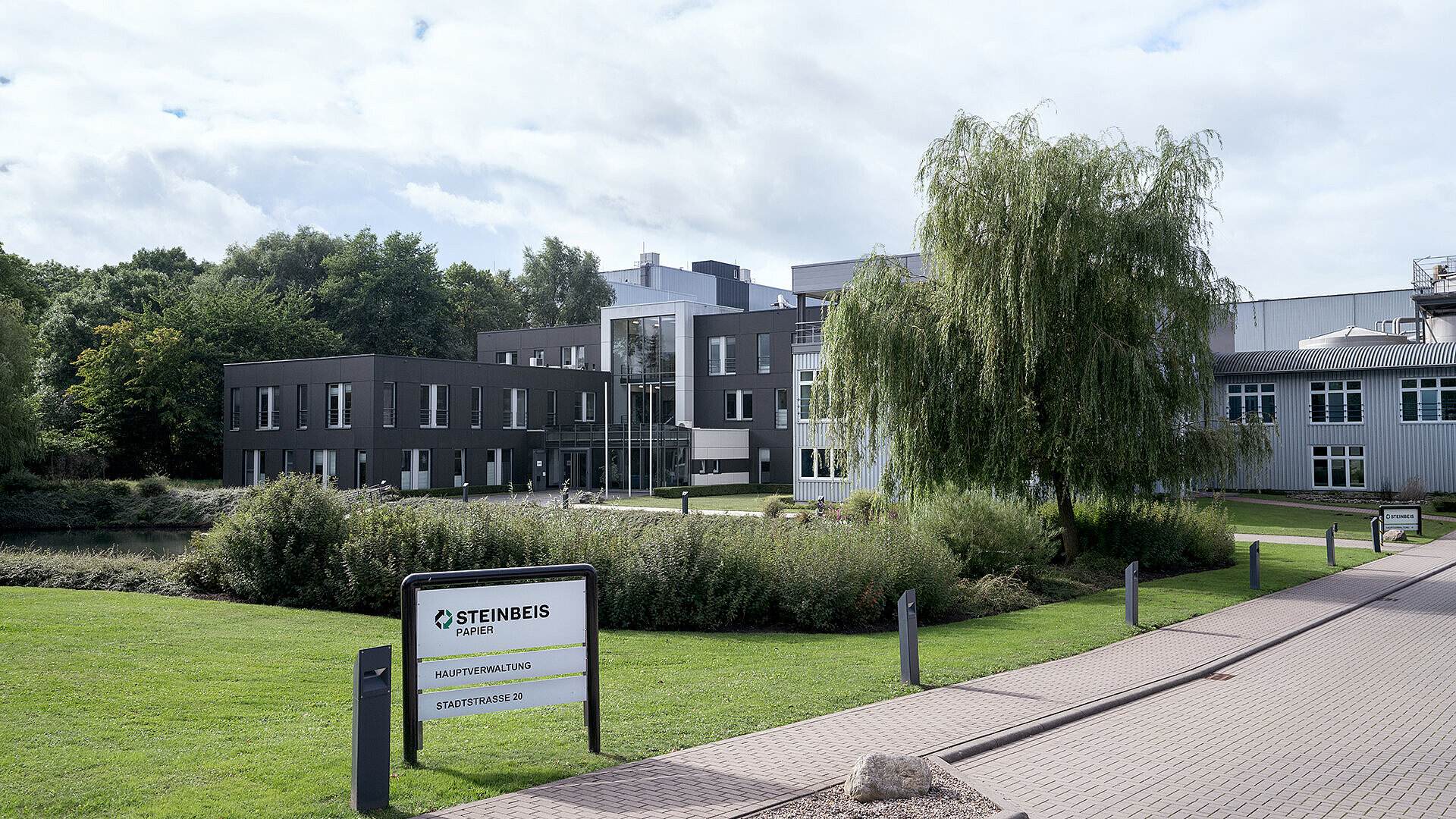
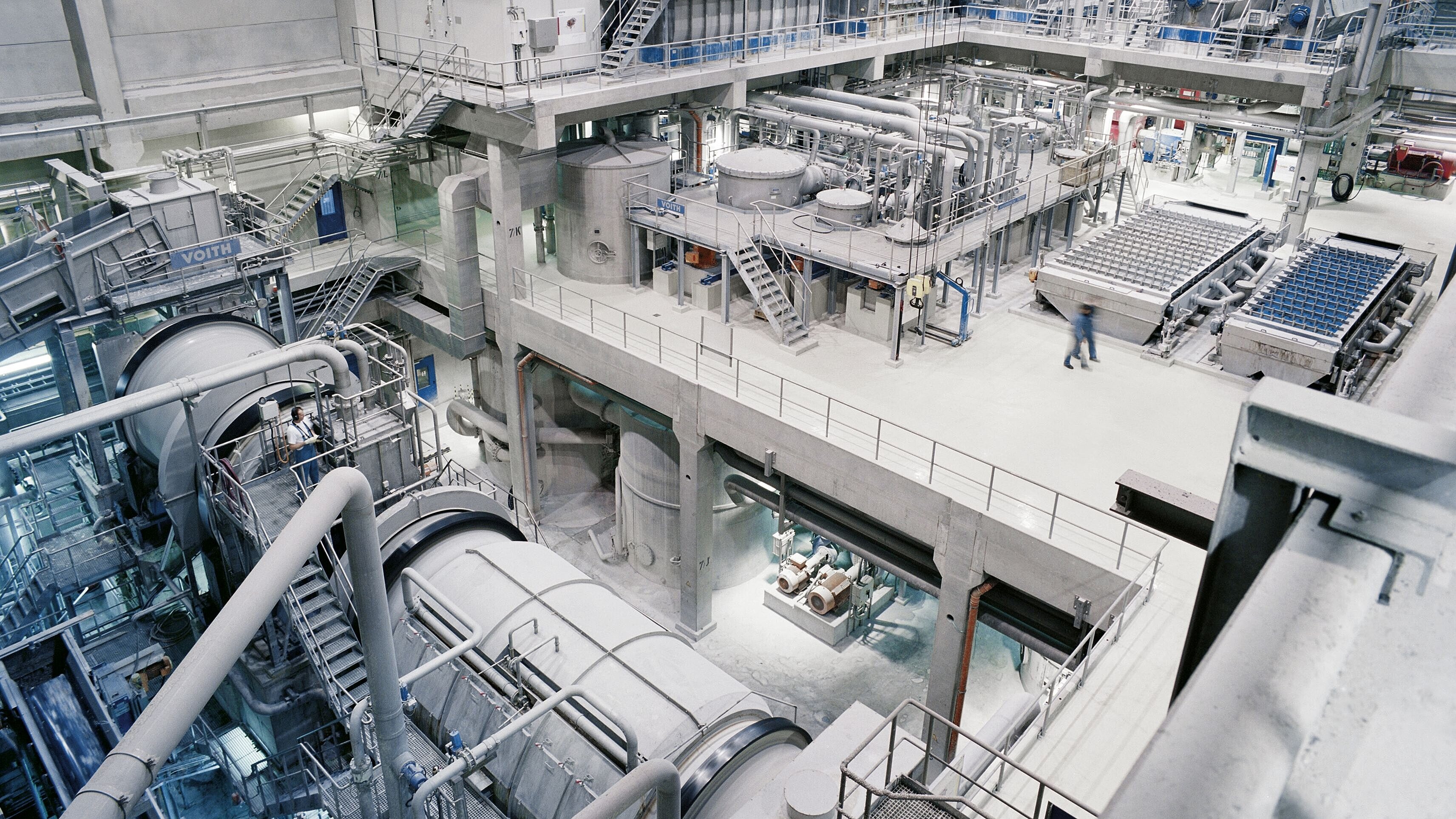
The state administration of Schleswig-Holstein is also setting a good example and uses 92 per cent high-quality recycled paper. It has increased the rate in the state administration from 58 to 92 per cent within a year. State Finance Minister Monika Heinold visited the Steinbeis Papier plant in Glückstadt and saw the sustainable production of the environmentally friendly paper for herself. Above all, she praised the lower costs for her government. This has already saved the state 250,000 euros a year.
Product life cycle of sustainable printing paper
Where a product comes from, how it is manufactured and supplied, and how it is recycled in the cycle are also included in theCO2 assessment. The product life cycle of recycled paper is exceptional. The recycled fibres can be reused up to ten times to produce fresh quality paper. The sustainable procurement and production chain achieves significant savings inCO2 emissions, water and energy consumption and the conservation of natural raw materials compared to the manufacture of traditional products based on virgin fibres. Neither chlorine nor other chemicals that are harmful to health and the environment are used in the reprocessing of the paper. By using recycled paper with the Blue Angel, companies can strengthen their environmental footprint and thus their CSR image - and, together with their employees, form an important and direct part of a sustainable consumer chain. Ultimately, every consumer can contribute to a goodCO2 climate- by simply switching to recycled paper.
Cover photo: iStock
Author: Klaus E. Jopp
https://www.jopp-communications.de/
Sources:
Current forsa study: Electric cars have what it takes to become a status symbol, at: www.cosmosdirekt.de/veroeffentlichungen/elektromobilitaet-52532/
Bay, Lukas: "The controversial carbon footprint of the electric car", at: http: //www.handelsblatt.com/unternehmen/industrie/co2-belastung-die-umstrittene-klimabilanz-des-elektroautos/20018160.html
The magazine for sustainable procurement in parishes and church organisations, at: https: //kleine-kniffe.de/
German Sustainability Award, at: https: //www.nachhaltigkeitspreis.de/
Donath, Andreas: "Electric cars should be more climate-friendly than combustion engines", at: https: //www.golem.de/news/co2-ausstoss-elektroautos-sollen-klimafreundlicher-als-verbrenner-sein-1802-132707.html
Greener procurement, at: http: //www.gruener-beschaffen.de/
State administration uses almost only recycled paper, at: www.shz.de/regionales/newsticker-nord/landesverwaltung-verwendet-fast-nur-noch-recyclingpapier-id19611756.html
Orange by handelsblatt: "Is waste separation really for the bin? We do the fact check!", at: https: //orange.handelsblatt.com/artikel/39128
Paper atlas, at: http: //www.papieratlas.de/
"Resources for 2018 already used up", at: https: //www.tagesschau.de/inland/ressourcen-verbrauch-101.html
Schäfer, Madlne: "Big rip-off? Why printer cartridges cost so much", at: https: //www.techbook.de/easylife/grosse-abzocke-warum-druckerpatronen-so-viel-kosten
Federal Environment Agency: "Green products: Market figures", at: https: //www.umweltbundesamt.de/daten/private-haushalte-konsum/konsum-produkte/gruene-produkte-marktzahlen