Against the Flow: The Journey of Water Through the Paper Mill
Water is essential for paper production. At the Steinbeis Papier factory in Glückstadt, it is therefore used as efficiently as possible. Only surface water from the River Elbe is used as process water; no drinking water is used. Let’s follow the water’s journey through the paper mill: from the River Elbe, via the paper machine, to the waste paper processing stage – with two process and water circuits – and finally to the mill’s own fully biological sewage treatment plant.
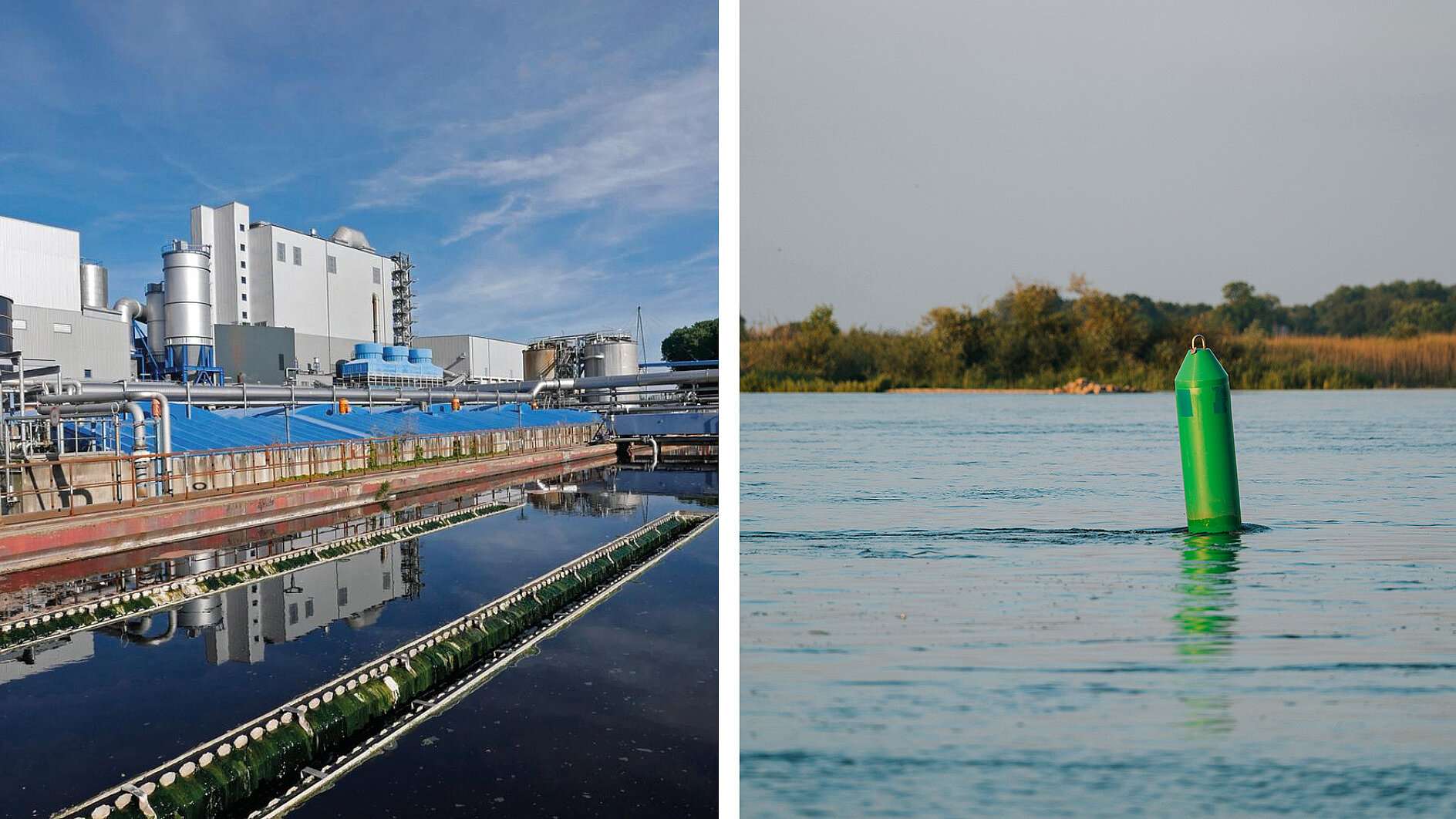
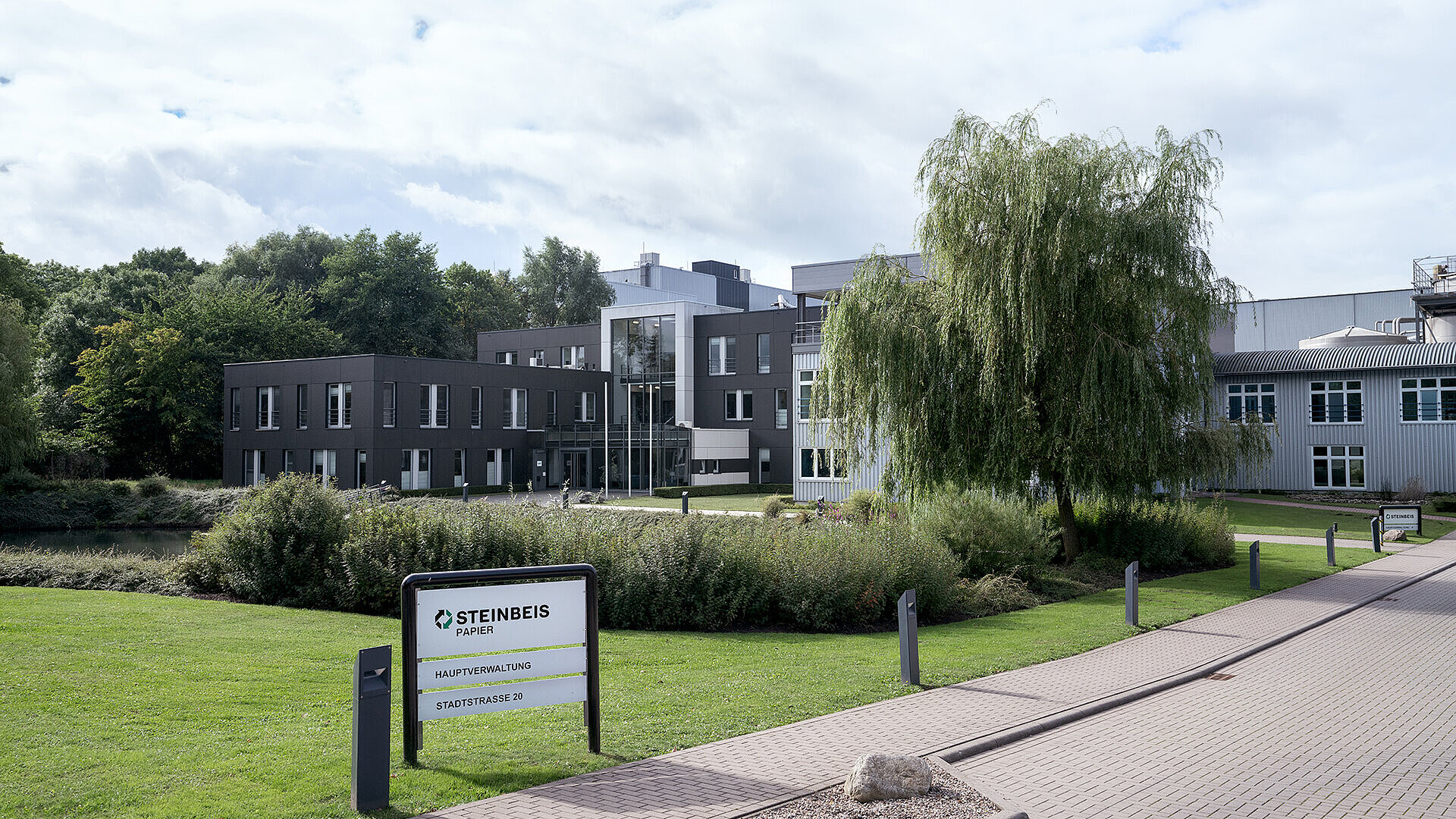
Near the harbour at Glückstadt stands a small, unassuming red-brick cottage, barely 20 square metres in size: the Steinbeis pump house. From here, water is pumped from the River Elbe into the paper mill. One might think that a factory here is ruthlessly exploiting a river. But the opposite is true: “The pumps are strictly controlled on an as-needed basis to avoid wasting water, and we return almost all the water we take out,” assures Andreas Steenbock, sustainability manager at Steinbeis Papier.
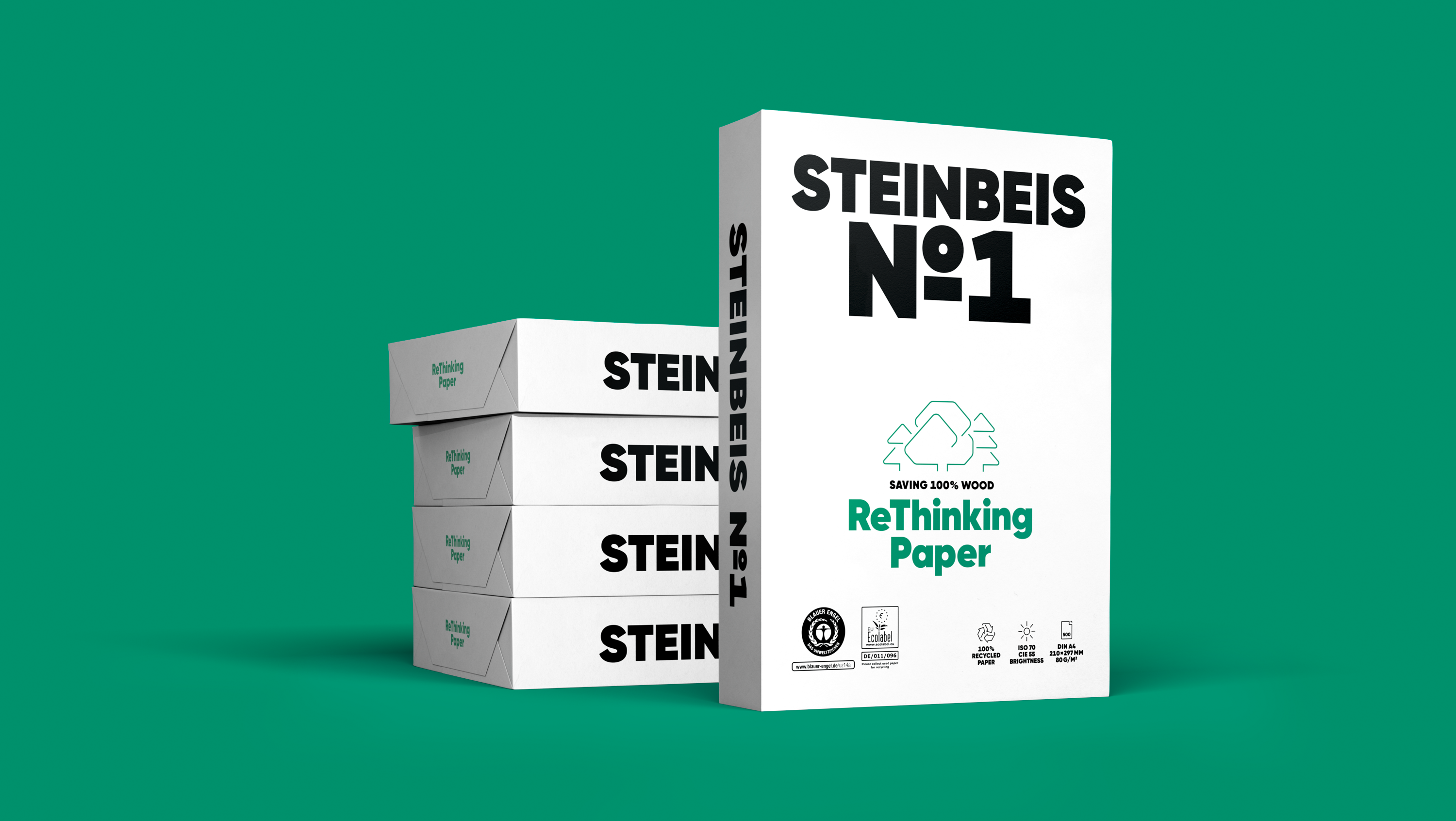
Water is essential for a paper mill. However, Steinbeis Papier differs from many other paper mills: the company produces its recycled paper exclusively from waste paper. Compared with the production of virgin fibre paper, this means that production requires 79 per cent less water. Compared with virgin fibre paper, Steinbeis’s recycled paper saves 40 cubic metres of water per tonne of paper – that is, 40,000 litres.
So the savings are significant, but even the production of recycled paper still requires a considerable amount of water. At Steinbeis, around nine to ten cubic metres of water must be fed into the cycle per tonne of paper. “Water is the carrier medium here,” explains Andreas Steenbock. In the water, the paper fibres that have already been used once are separated from the composite, transported through the plant, cleaned and finally reformed into a new paper web. Although the water is moved through the factory as a transport medium, it is not actually consumed in the process. This is because at Steinbeis, great care is taken to use as little water as possible.
Water is becoming an industrial issue
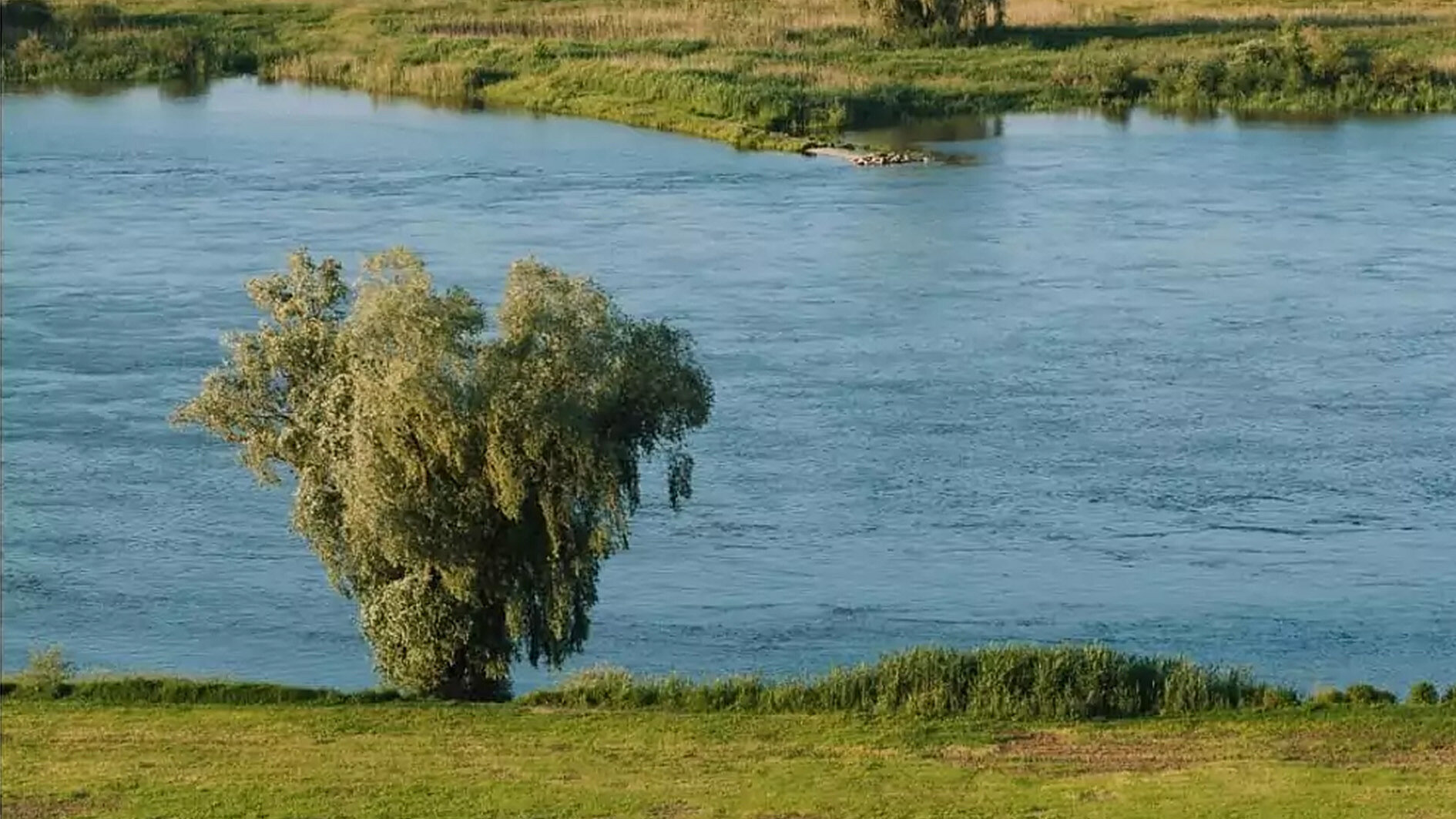
The summer of 2026 revealed just how precious water has become. Heat and a lack of rain caused water levels in many rivers to fall steadily. By the end of July, all of Germany’s major rivers were affected by low water levels. On the Rhine, historic lows were even recorded in early August. Sandbanks protruded from the river, and in some places cargo ships could only carry a fraction of their usual load. Drinking water suppliers also came under pressure in some regions; local authorities called for water-saving measures, and Munich even issued a water-saving order in July.
In Glückstadt, at least on the Elbe, there was no water shortage. This is because the Lower Elbe here is influenced by the tides: if too little water flows downstream, the sea simply raises the water level. Yet even here, dry and hot summers are taking their toll. “As summers get hotter, the salinity of the Elbe’s water rises. For us, higher salt loads mean a greater need for additives, and corrosion of the plant equipment also increases. Pipes and plant components will have to be suitably durable in future or replaced more frequently,” explains Andreas Steenbock. But for now, the problem remains within manageable limits.
If we follow the water as it flows from the harbour basin to the factory and is first treated so that it can be used as process water, we take the opposite route across the approximately 100-hectare factory site to that taken by the paper, which is produced here round the clock. “The water is at its purest at the paper machine. Its purity gradually decreases as it moves through the waste paper processing area,” says Andreas Steenbock. This is because, whilst the waste paper is initially still full of printing inks and other foreign substances and only becomes cleaner as the processing progresses, the freshly treated water is first used at the end of the paper production process – at the paper machine. Here, particularly high standards of purity and quality apply.
Where recycled fibre is turned back into paper
The paper machine: the paper web races through a seemingly endless row of massive rollers, where it is dewatered, pressed and progressively dried. It is warm and noisy; the few staff members moving amongst the largely automated machinery wear ear protectors. The water used in the process is also warm, at around 40 degrees – at this temperature, all stages of the process operate at maximum efficiency.
As it passes through the machine, the paper web loses almost all of its water. But even the water vapour produced in the process is not simply allowed to go to waste. Heat exchangers recover heat and water; some of it condenses and can be reused. In any case, the paper mustn’t be allowed to become completely dry. Depending on the quality, four to five per cent moisture remains in the paper at the end. “Otherwise, the paper would lose its flexibility and become brittle, like baking paper after use in the oven,” explains Andreas Steenbock. Not even this residual moisture constitutes a loss of water. This is because the waste paper delivered to the mill already contains, on average, around eight per cent moisture.
On the paper machine, the water is reused several times: it absorbs fines and fillers, is then treated and fed back into the process. This is just one of numerous water cycles in the mill. The water circulates through this cycle several times before it is gradually discharged.
The path of the water leads back to the beginning
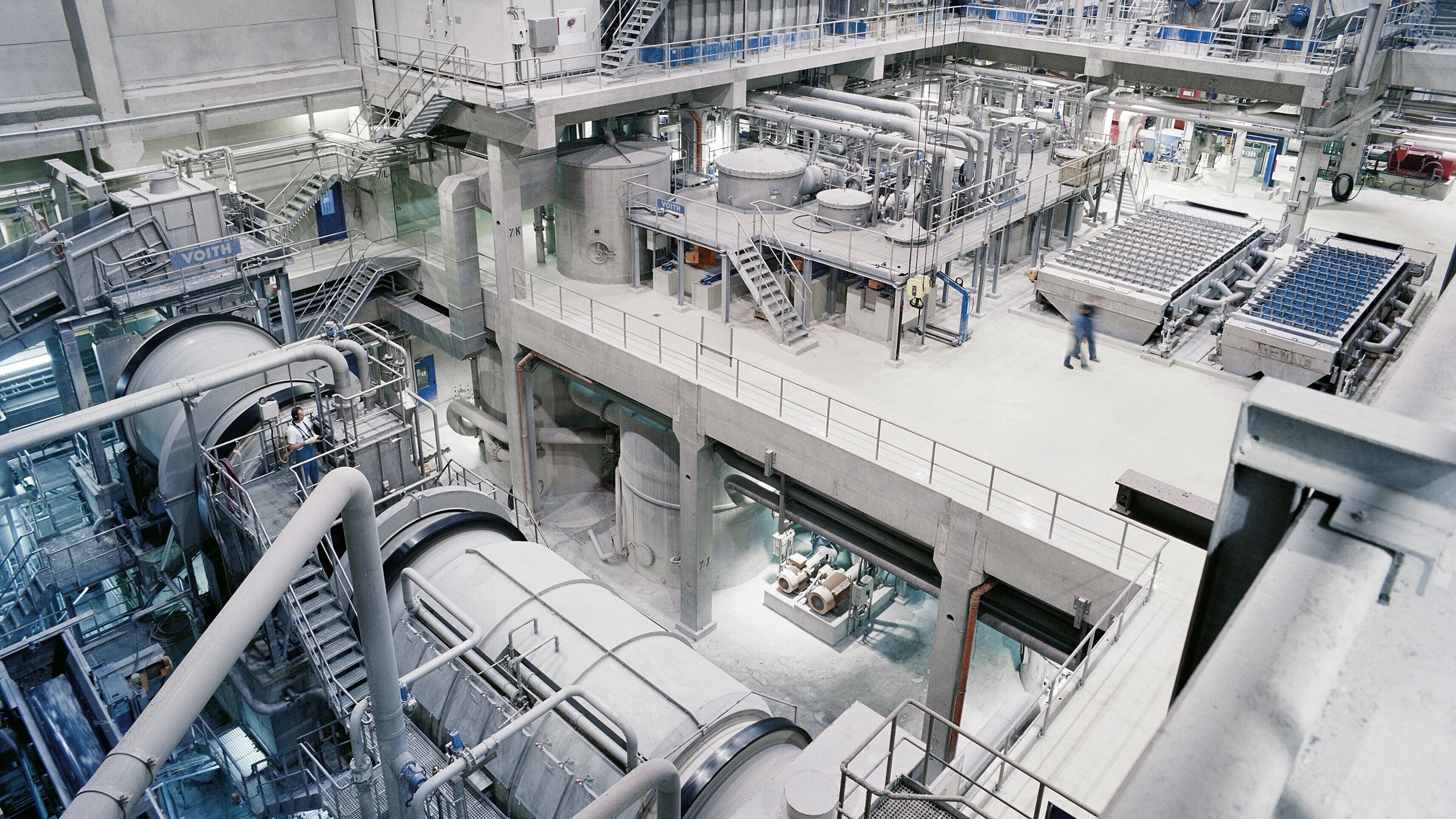
Walking along a narrow walkway made of metal grating, a few metres above the ground, we follow the water further towards the start of the paper-making process, past countless pipes – some barely as thick as an arm, others as massive as tree trunks: conduits for water, pulp and energy. In some pipes, the increasingly purified pulp flows towards us on its way to the paper machine. In other pipes, the water flows in the opposite direction, towards where paper production begins and the water is most heavily polluted.
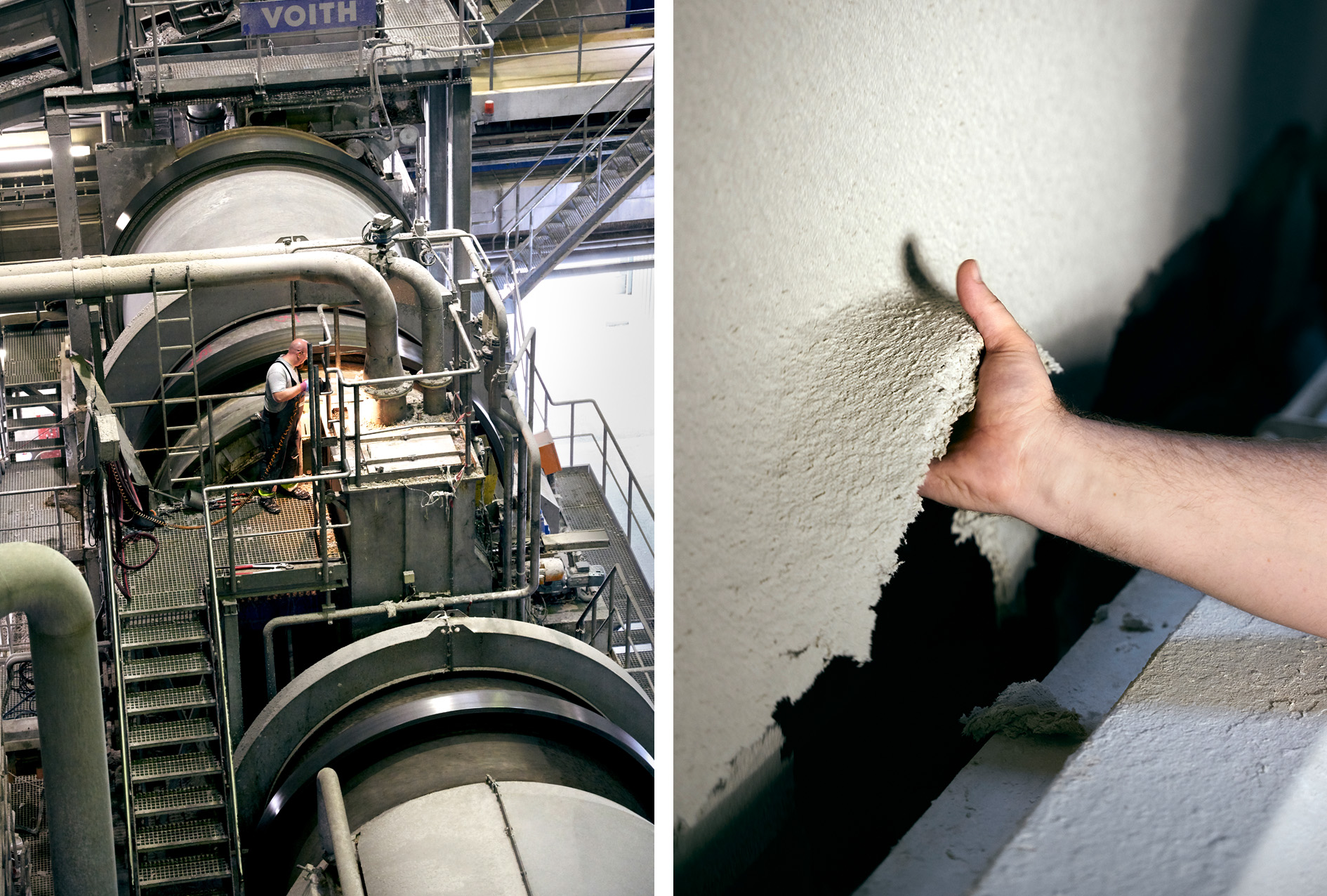
The closer we get to the start of production, hall by hall, the more labour-intensive the work becomes. Everywhere, motors hum and pumps roar. The aim is to extract individual, clean paper fibres from the waste paper that has been delivered. Right at the very start stands a massive pulping and sorting drum. Waste paper and water are mixed together inside it; spray water pours in, the paper softens and gradually breaks down into a light-coloured, pumpable fibre pulp. Coarser foreign matter is already sorted out at this stage. After that, the separation becomes increasingly fine. During slot screening, the fibre pulp is forced under pressure through screens with openings just 0.2 mm wide: the paper fibres pass through, whilst larger impurities are retained. And finally comes the process known as flotation. Here, the printing ink is separated from the fibre suspension.
Andreas Steenbock takes a handful of dark sludge from a trough – what is known as deinking sludge. It is produced during the flotation process: soap and extremely fine air bubbles, amongst other things, are added to the fibre-water mixture. Printing ink particles adhere to the bubbles, rise to the surface and form a dark foam, which is skimmed off and collected as deinking sludge. This sludge is by no means waste with no further use. It is dewatered and incinerated at the Steinbeis Energie power station – also on the factory premises – and thus used to generate energy. “And whatever cannot be converted into heat at our own power station is supplied to brickworks. They need the sludge to ensure the necessary porosity in the bricks,” explains Andreas Steenbock.
Even dirty water gets a second chance
Even the water, which has by now absorbed printing inks, fibre residues and other contaminants, is still a long way from reaching the end of its journey. The waste paper processing plant has two process-separated circuits, known as ‘loops’. Each loop has its own separate water circuit. The process water is chemically treated – a process in which impurities are flocculated – and separated in a dedicated flotation unit. The purified water then flows back into the processing system and is reused. “Here, too, the water is recirculated several times,” explains Andreas Steenbock. Just as in the circuit at the paper machine, a small portion is continuously discharged – otherwise, dissolved substances would accumulate to an ever-greater extent.
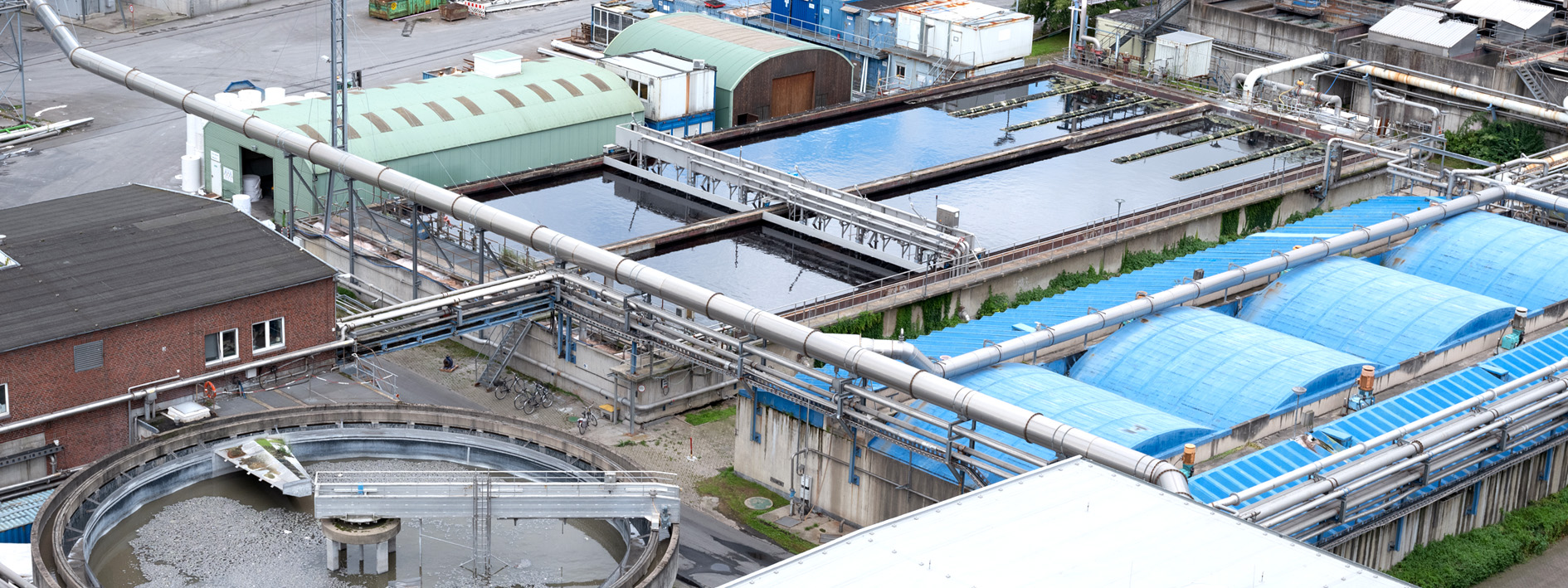
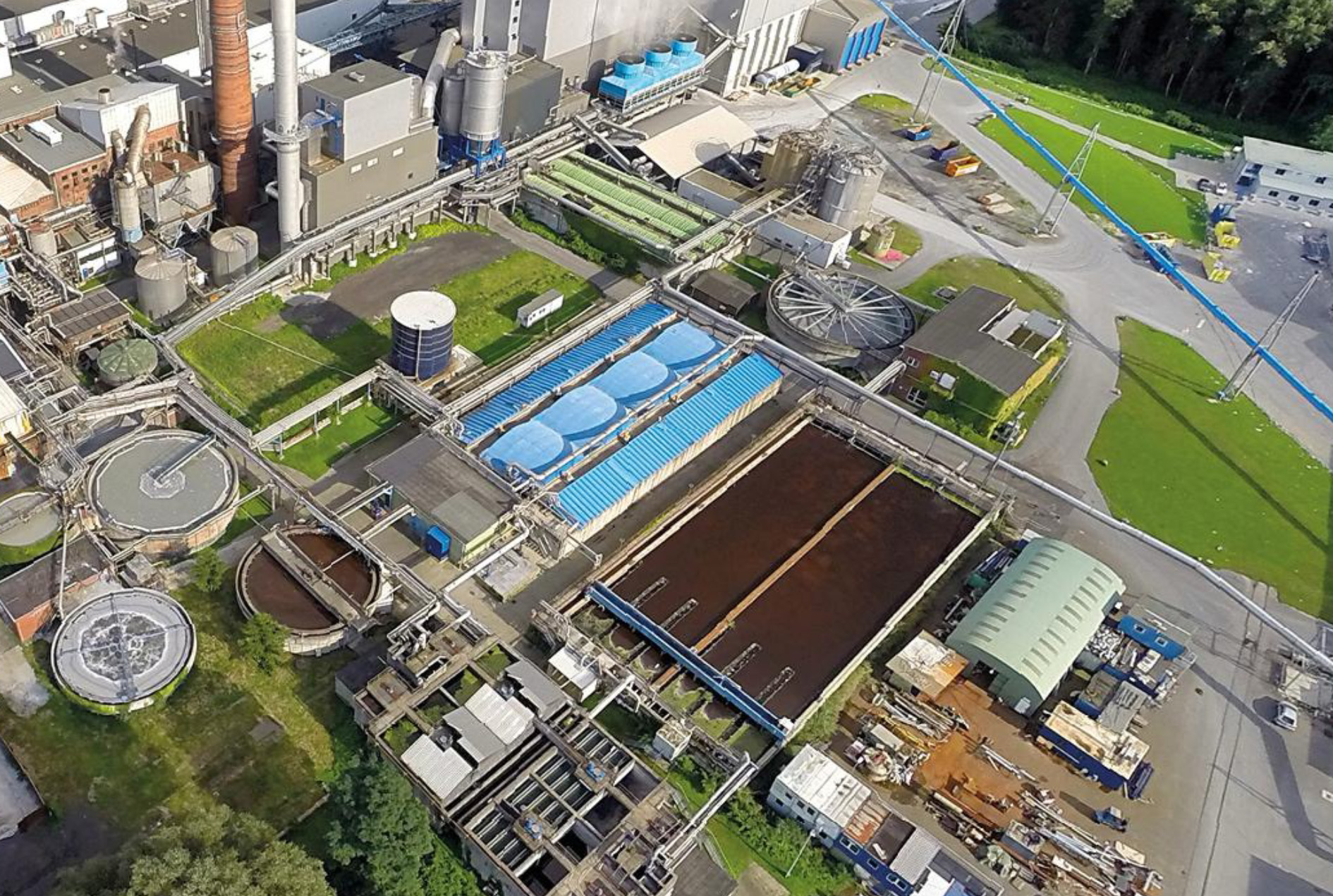
The discharged water is channelled to the mill’s own sewage treatment plant. We see large, open basins criss-crossed by pipes and walkways; foam flakes float on the grey-brown water’s surface, whilst the scrapers turn slowly. Here, the water undergoes several stages of biological treatment. Micro-organisms break down the remaining organic matter, whilst solids settle and are removed as sludge. “What remains afterwards is purified, clear water,” says Andreas Steenbock. This water is returned to the river Elbe.
“Like a small industrial town”
Power station, waterworks, sewage treatment plant, waste paper processing: almost everything required for paper production is located within a compact area on the factory site. “It’s like a small industrial town,” explains Andreas Steenbock. And just like in a town, the individual systems are interlinked. Residual materials from paper production are recycled or used to generate energy in the factory’s own power station. “The paper mill itself produces virtually no waste,” says Andreas Steenbock. Waste that actually needs to be disposed of is produced only in very small quantities – such as oil-soaked rags from repair work. The situation is similar with water: no drinking water is required for the actual paper production. Drinking water is only used where people need it – in showers, toilets and other sanitary facilities. For the production process, on the other hand, water from the River Elbe is sufficient; it is continuously treated and recycled.
It could hardly be more sustainable: the factory essentially consumes no water, and hardly any waste is produced. It produces only what it is designed to produce: lots and lots of recycled paper.
Cover photo: Steinbeis Papier sewage treatment plant (Photo: Florian Thoss for Steinbeis Papier)
Author

Christian Heinrich holds a PhD in medicine and trained as a journalist at the German School of Journalism in Munich. He has been working as a freelance journalist and writer since 2010. Christian Heinrich writes for DIE ZEIT, the Süddeutsche Zeitung, SPIEGEL, GEO and other publications. He is a member of the editorial office nerdpol, a collective of science journalists.